
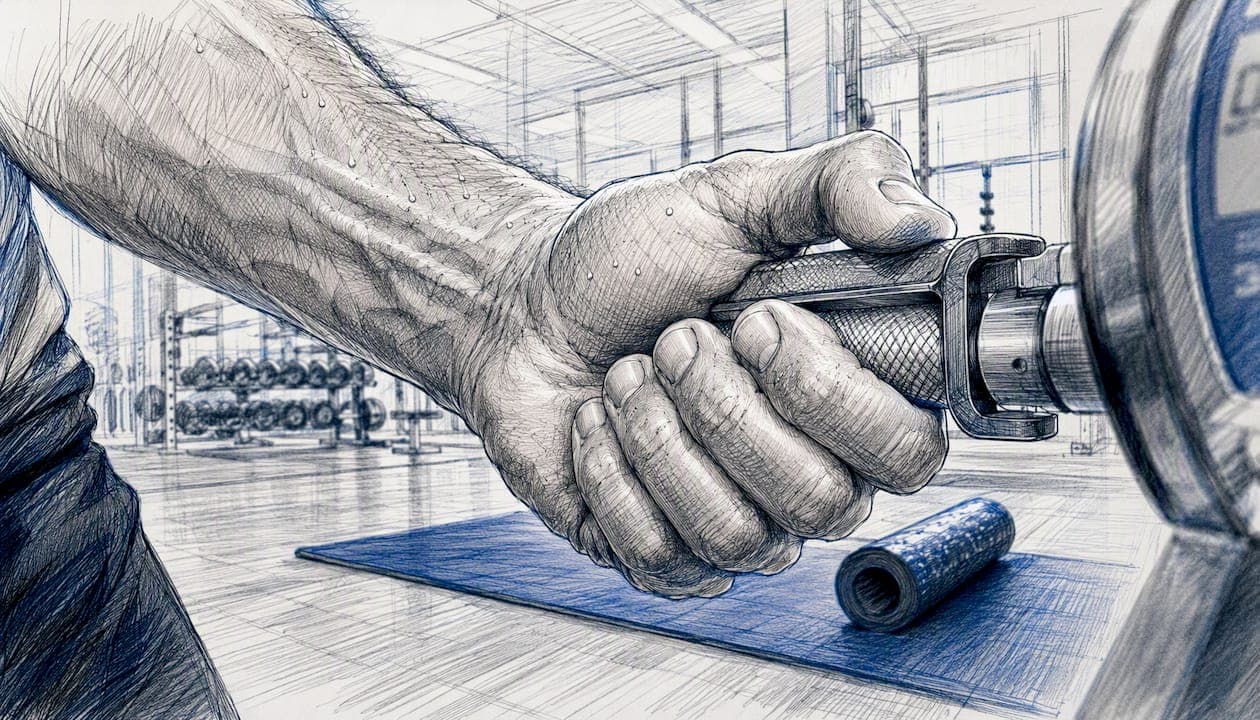
Measure grip strength with a seated position, elbow at 90 degrees, wrist neutral, and run three trials per hand with a digital Bluetooth dynamometer. Record the highest trial, not the average, and calculate the percent difference between hands to flag asymmetry. A Bluetooth-adapted dynamometer has shown a strong correlation (r = 0.951) against traditional models, which means this workflow holds up to scrutiny for tracking multiple sclerosis grip strength trends and general strength symmetry over time. The DEXDIA GX is built around this exact protocol.
- Position: Seated, elbow at 90 degrees, wrist neutral
- Trials: 3 per hand, alternating, 60 to 90 seconds rest between
- Record: Best trial per hand, timestamped and synced via app
Key Takeaways
Consistent positioning, three trials per hand, and Bluetooth-logged timestamps turn grip strength testing from a one-off number into a usable performance trend.
| Point | Details |
|---|---|
| Standardize the protocol | Same seated position, grip span, and warm-up every session to keep results comparable. |
| Record the best trial | Log the highest of three trials per hand, not the average, for consistency. |
| Calculate symmetry correctly | Use (stronger minus weaker) divided by stronger, times 100, and report both kilograms and percent. |
| Avoid universal thresholds | The 10% rule is a rough average; sport-specific asymmetry up to 19.5% can be normal. |
| Use a validated Bluetooth device | The DEXDIA GX logs timestamped trials, calculates symmetry automatically, and exports data for teams and clinics. |
Table of Contents
- What Is the Best Protocol for Measuring Grip Strength?
- How Reliable Is Digital Grip Strength Testing?
- How Do You Calculate Grip Strength Symmetry?
- How Do You Build a Grip Strength Baseline Over Time?
- What Features Should You Look for in a Grip Dynamometer?
- How Much Does a Grip Dynamometer Cost and How Long Does Testing Take?
- When Should Grip Weakness Be Referred to a Medical Professional?
- How Does the DEXDIA GX Support This Testing Workflow?
- Get a Validated Device Built for This Exact Protocol
- Frequently Asked Questions
- Sources
What Is the Best Protocol for Measuring Grip Strength?
A repeatable protocol matters more than any single number you record. Before testing, confirm the dynamometer is charged and paired, and adjust the grip span so the second knuckle of each finger sits at a right angle around the handle. Test seated in a standard chair with feet flat, forearm resting on the armrest or thigh, wrist in a neutral position rather than flexed or extended.
This primes the neuromuscular system without pre-fatiguing the muscles you're about to test.
- Test the non-dominant hand first to reduce order-effect bias.
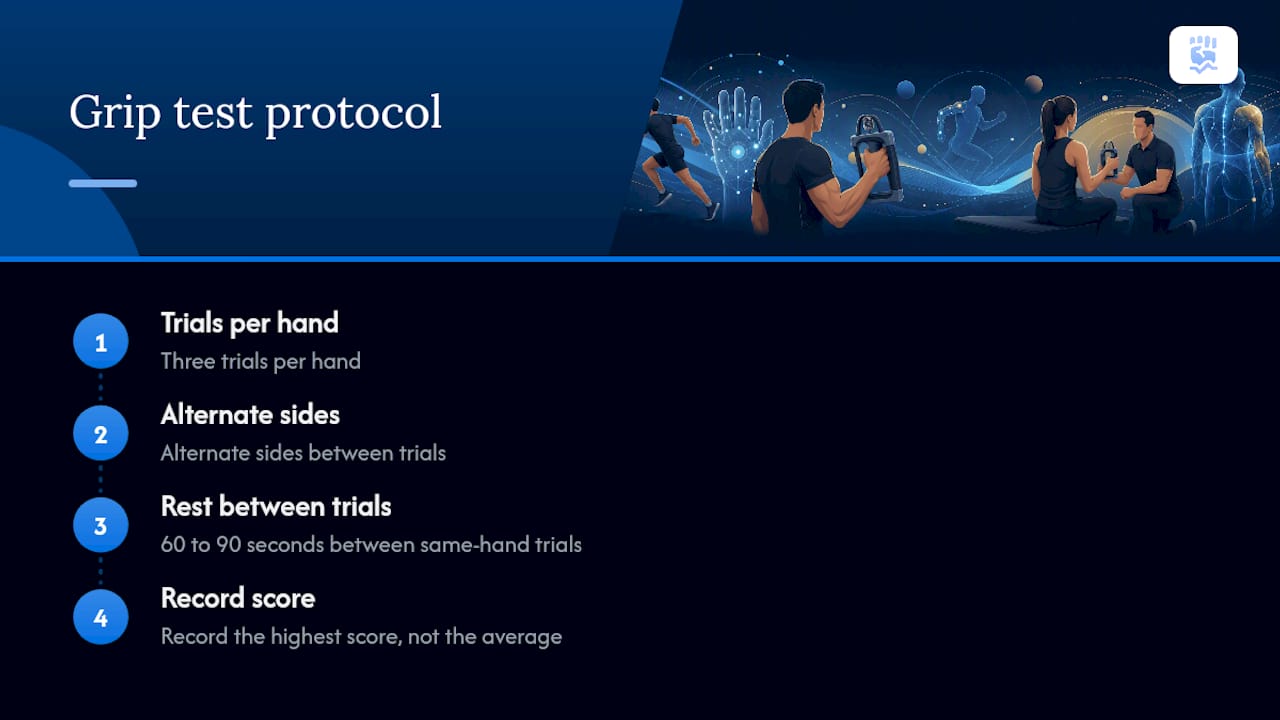
- Run three maximal trials per hand, alternating sides.
- Rest 60 to 90 seconds between trials on the same hand.
- Record the highest of the three trials as your test score (not the mean).
- Sync results immediately via Bluetooth and log any symptom notes.
For athletes tracking symptom fluctuations tied to multiple sclerosis, note fatigue level, time of day, and any flare activity right alongside the numeric score. A score without context is just a number; a score with a fatigue tag becomes a pattern you can actually use.
Pro Tip: Log every session at roughly the same time of day. Grip strength naturally dips later in the day due to accumulated fatigue, and comparing a 9 a.m. score to a 6 p.m. score will manufacture a "decline" that isn't real.
How Reliable Is Digital Grip Strength Testing?
Reliability lives and dies on consistency, not equipment alone. The same seat, same grip span, same verbal cues, and same warm-up routine every session are what make a trend meaningful instead of noisy.
- Use identical grip-width settings across sessions. Refer to a grip size guide if you're unsure what span fits a given hand size.
- Keep verbal encouragement standardized. Enthusiastic coaching on one day and silence on another can shift scores by several kilograms.
- Check the device's grip surface for wear. Slick or degraded rubber grips reduce force transfer and quietly deflate scores.
- Confirm Bluetooth sync completed before moving to the next trial. A dropped connection means a lost data point, not a bad score.
Validated digital dynamometers correlate well with reference instruments; the Bluetooth-modified device referenced above returned an r-value of 0.951 against the original unit. Handgrip scores also track closely with broader isometric strength, with one study of active university students finding correlations above 0.70 between grip and whole-body isometric force output. A single low session doesn't mean weakness. It might mean poor sleep, a missed warm-up, or a cold room. Trust the trend line over any one data point.
How Do You Calculate Grip Strength Symmetry?
The standard formula is straightforward: subtract the weaker hand's score from the stronger hand's score, divide by the stronger score, and multiply by 100.
- Formula: (Stronger − Weaker) / Stronger × 100 = percent asymmetry
- Convention: Report both raw kilograms and percent difference, not percent alone
- Documentation: Include timestamp, test conditions, and any symptom notes at the time of testing
A large-scale meta-analysis of upper-limb strength found the popular "10% rule" holds up as a rough average, but actual asymmetry ranged from 2.1% to 19.5% depending on the movement and joint tested, with dominant versus non-dominant differences averaging 11.6%. That range matters. A tennis player or a boxer will often show naturally higher asymmetry from years of one-sided loading, and correcting it down to zero isn't the goal. Chasing perfect symmetry in a sport built on asymmetric movement can do more harm than good.
How Do You Build a Grip Strength Baseline Over Time?
A baseline isn't one test. It's three to five sessions over two weeks, averaged, to establish your normal range before you start tracking change. Once you have that baseline, watch for shifts that exceed your day-to-day variability, not just any dip from your single best-ever score.
- Run baseline testing sessions at least three times before drawing conclusions about strength or asymmetry.
- Use percent change from baseline, not absolute kilograms, when comparing across different athletes or hand sizes.
- A shift smaller than your typical day-to-day variability (often a few percent) is likely noise, not real change.
- Racket sports, climbing, and combat sports often show a "specialization asymmetry" that's expected, not a red flag.
Sync your grip data with training load logs and fatigue scores in the same app whenever possible. A grip strength drop that lines up with a heavy training block tells a very different story than one that shows up during a deload week.
Pro Tip: Tag each test session with your most recent training load (light, moderate, heavy). Over a few months, this turns raw grip numbers into a fatigue-monitoring tool, not just a strength number.
What Features Should You Look for in a Grip Dynamometer?
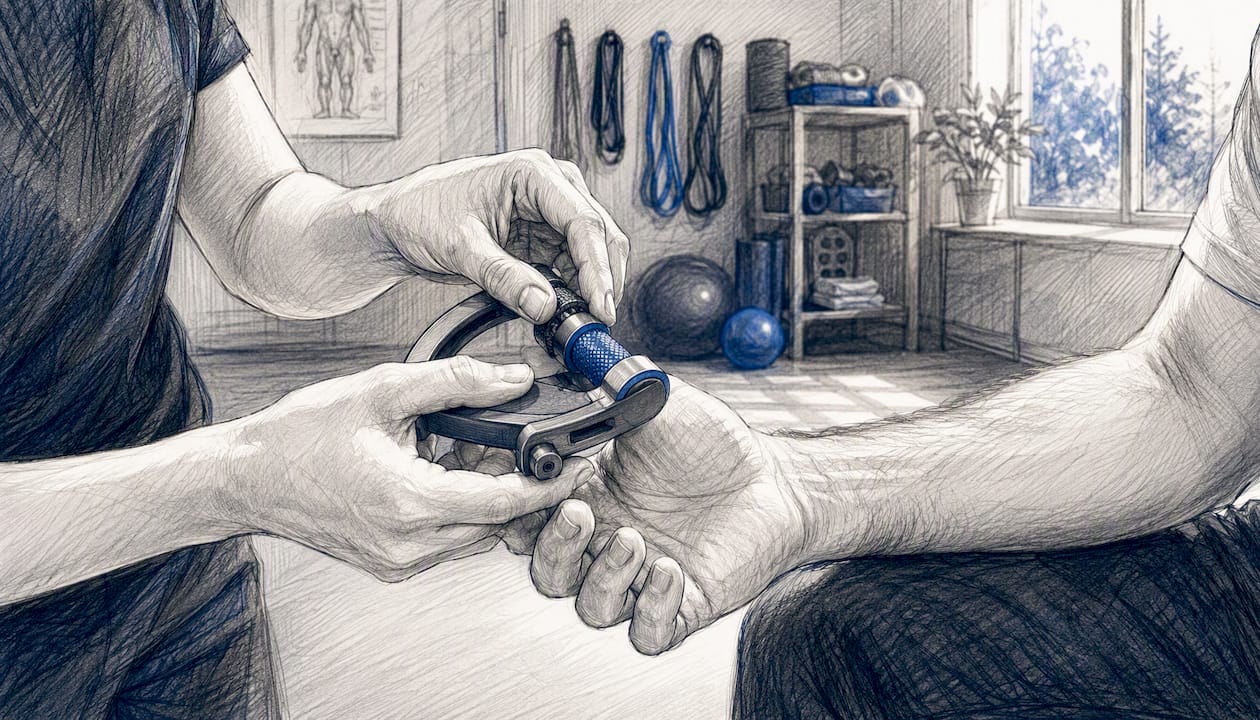
Not every dynamometer is built for repeated testing and trend analysis. Look for a validated force range, consistent sampling rate, and an adjustable grip span that fits a range of hand sizes, since a device that only fits average-size hands will misrepresent smaller or larger athletes.
- Connectivity: Bluetooth pairing with timestamped trial logging, not manual entry
- Data export: CSV or report export for coaches and physical therapists managing multiple athletes
- Symmetry tools: Built-in left/right comparison rather than manual spreadsheet math
- Ergonomics: A handle that stays comfortable across repeated maximal squeezes without slipping
Bluetooth connectivity does more than add convenience. It removes the manual transcription step that introduces errors, and it makes remote or asynchronous testing workflows possible for athletes training away from a clinic or facility, a use case supported by applied smartphone-connected dynamometry research. A digital hand dynamometer buying guide covers the validation specs worth checking before you commit to a device.
Pro Tip: Verify calibration against a known weight or reference device once every few months. Even validated dynamometers can drift slightly with heavy use.
How Much Does a Grip Dynamometer Cost and How Long Does Testing Take?
Entry-level validated Bluetooth dynamometers typically run in the low hundreds of dollars, while professional-grade units with expanded app features and clinical support sit higher. A full pricing breakdown explains which features push cost up.
- Testing time: 8 to 12 minutes for a full session (warm-up, both hands, three trials each, sync)
- Entry-level devices: Suit individual athletes and coaches tracking their own trends
- Pro-grade devices: Better suited to clinics or teams testing multiple people across a day
A basic validated device covers most training and recovery use cases. Lab-grade instrumentation only becomes necessary for formal research protocols.
When Should Grip Weakness Be Referred to a Medical Professional?
This protocol is a performance and tracking tool, not a diagnostic one. It cannot assess disease progression in multiple sclerosis or any neurologic condition, and day-to-day symptom fluctuation can shift scores independent of true strength change.
- Sudden, significant weakness in one hand warrants medical evaluation, not just a training note.
- Persistent pain during testing is a stop signal, not something to push through.
- New functional loss (dropping objects, trouble with fine motor tasks) should be reported to a physician.
- Keep test sessions short and stop immediately if fatigue or strain increases mid-session.
How Does the DEXDIA GX Support This Testing Workflow?
The DEXDIA GX was built around exactly this protocol: Bluetooth pairing that syncs each trial with a timestamp, automatic symmetry calculation between hands, and CSV export for coaches or physical therapists managing multiple athletes.
- Timestamped trial logging removes the need for manual data entry between sessions.
- Built-in left/right symmetry analysis flags percent difference automatically after each session.
- Adjustable grip guidance helps match handle span to individual hand size for repeatable results.
- Export tools support sharing session data across a training team or clinic.
Clinics use it for intake testing and pre/post rehabilitation checkpoints. Athletic programs use it for ongoing monitoring across a season, and individual users track their own trends between structured baseline sessions. DEXDIA GX is a performance diagnostics tool, not a medical device, and it is not intended to diagnose or monitor neurologic disease. For readers building out a fuller tracking system, research-backed norms explain how grip strength fits into a broader picture of physical health without overstating what any single measure can tell you.
A Field Note From the Bench
In practice, grip testing earns its place in a training cycle when it's run on a fixed schedule tied to load blocks, not just tested "when someone remembers." One habit worth borrowing: pair every grip session with the athlete's most recent sleep and training log entry before drawing any conclusion.
Get a Validated Device Built for This Exact Protocol
Most athletes and clinics tracking grip strength end up juggling a stopwatch, a spreadsheet, and a dynamometer that doesn't talk to either. Dexdia built the GX to close that gap: a Bluetooth-enabled dynamometer that logs every trial with a timestamp, calculates left/right symmetry automatically, and exports session data in one file instead of three.
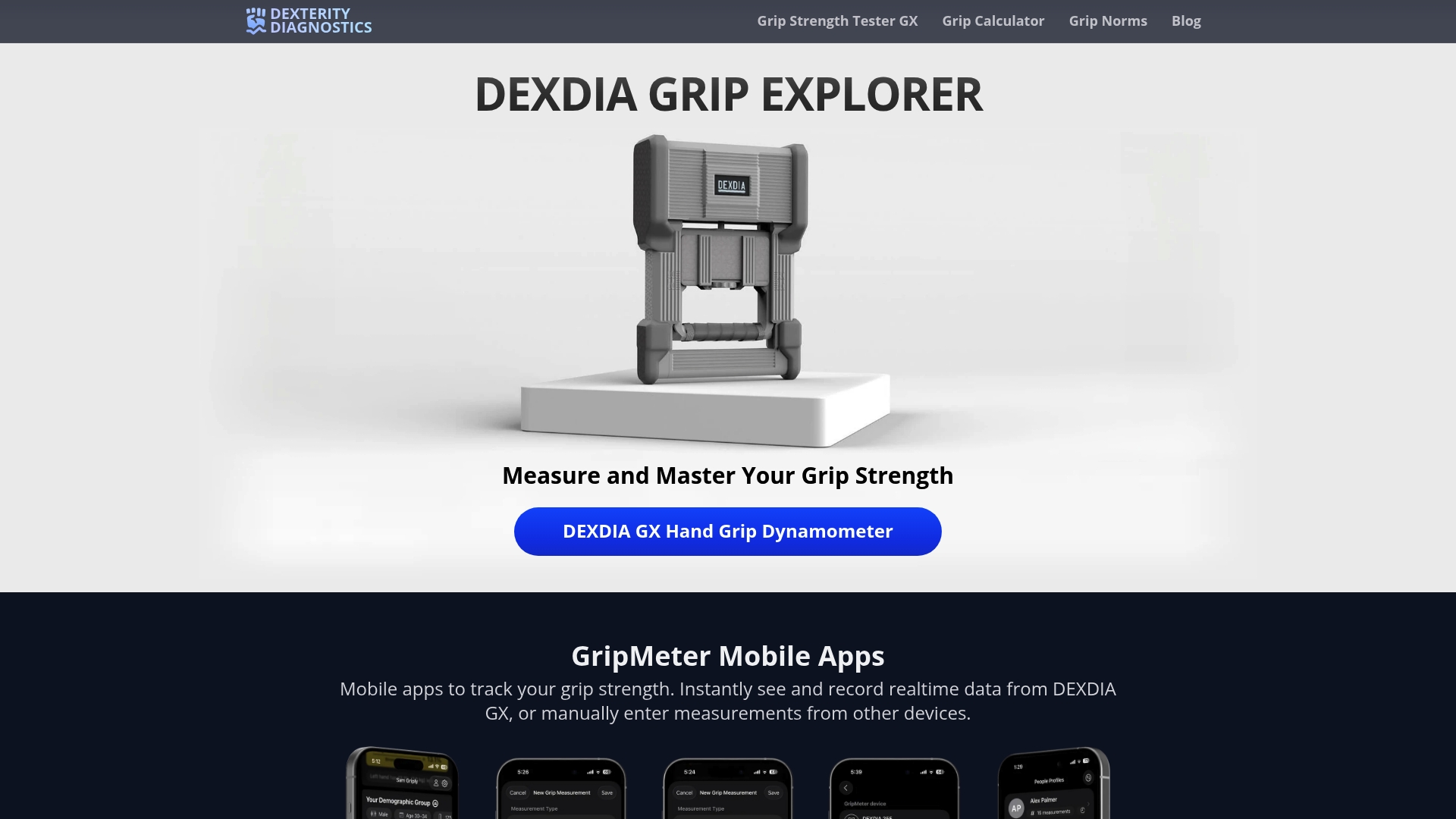
That means less time reconciling numbers after a session and more time acting on what they show. Feature highlights that align directly with the protocol above:
- Bluetooth sync with timestamped trials, so nothing gets entered by hand
- Automatic symmetry analysis between dominant and non-dominant hands
- CSV export for sharing data across a coaching or clinical team
The GX is a performance diagnostics tool, not a medical device, and it isn't designed or marketed to monitor neurologic disease progression. If you're ready to see how your own numbers compare, run your latest scores through the grip strength calculator or check the DEXDIA GX product page for full specs and ordering details.
Frequently Asked Questions
How many trials should I run to measure grip strength accurately? Three trials per hand, alternating sides, with 60 to 90 seconds of rest between trials on the same hand. Record the highest score, not the average.
What percent difference between hands is considered normal? Research suggests roughly 10% is a reasonable average for upper-limb asymmetry, though the range across different movements and sports spans from about 2% to nearly 20%. Individual baselines matter more than a fixed cutoff.
Can grip strength tracking help monitor multiple sclerosis symptom fluctuations non-medically? Yes, as a performance tracking tool. Logging grip scores alongside fatigue and symptom notes can reveal day-to-day patterns, but this data does not diagnose or monitor disease progression and should never replace clinical evaluation.
Why does my dynamometer keep losing Bluetooth connection? Confirm the device is fully charged, close other Bluetooth-paired apps that might interfere, and re-pair the device if a firmware update was recently installed. Testing too far from your phone or tablet can also drop the signal mid-trial.
Is a Bluetooth dynamometer more accurate than a mechanical one? Not necessarily more accurate, but more consistent in data capture. A validated Bluetooth-modified device correlated at r = 0.951 with its mechanical counterpart, while removing manual transcription errors from the process.
Sources
- A comprehensive scoping review and meta-analysis of upper limb strength asymmetry | Scientific Reports
- Enhancing physical fitness testing: integrating Bluetooth connectivity for improved hand grip dynamometry
- Handgrip strength measured by a dynamometer connected to a smartphone: applied health technology examples (PMC article)