
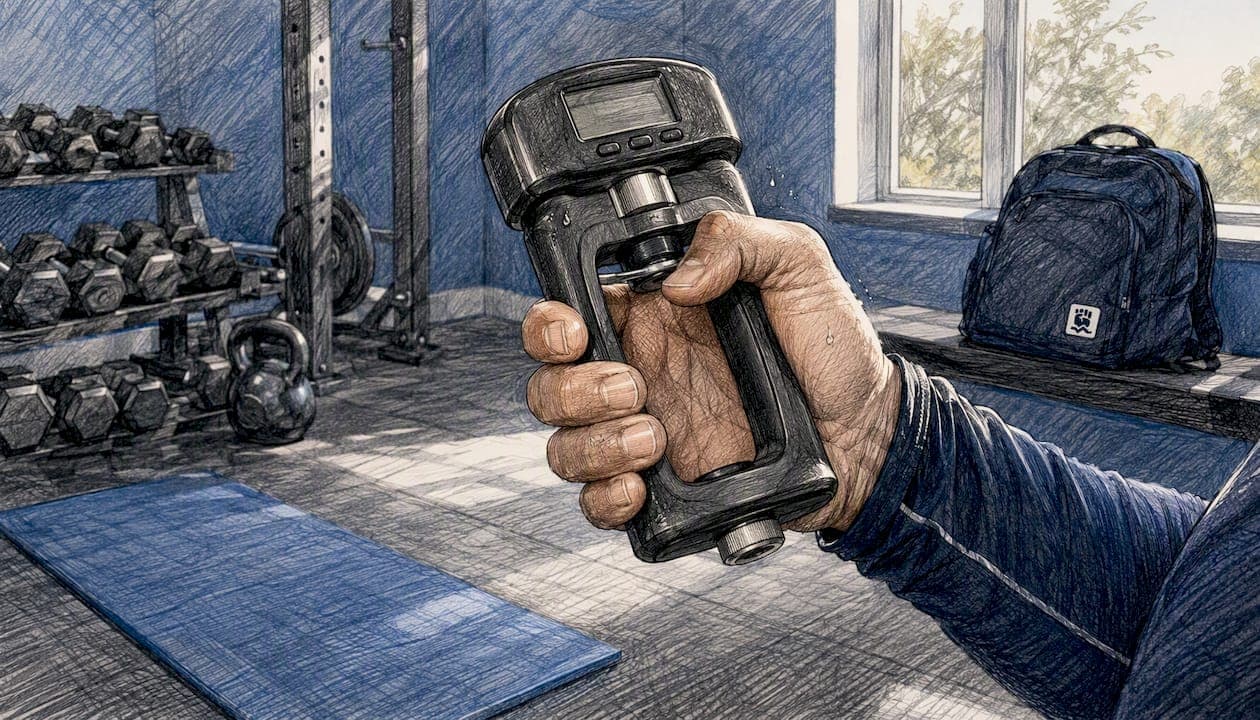
Hand dynamometers sold in the United States currently cover a range from basic analog spring models at the lower price end, through mid-range digital units, up to premium Bluetooth-enabled devices with app integration and normative-data features, reflecting differences in technology and features. For clinics, rehabilitation specialists, and sports performance teams, the recommended option is the DEXDIA GX from Dexterity Diagnostics: a load-cell digital dynamometer with Bluetooth connectivity, a 300 lb (135 kg) measurement capacity, and a companion app that stores longitudinal data and compares readings against research-backed norms. Home users on a tight budget can work with an analog spring model; anyone tracking progress over time or comparing results across patients needs at least a mid-range digital unit.
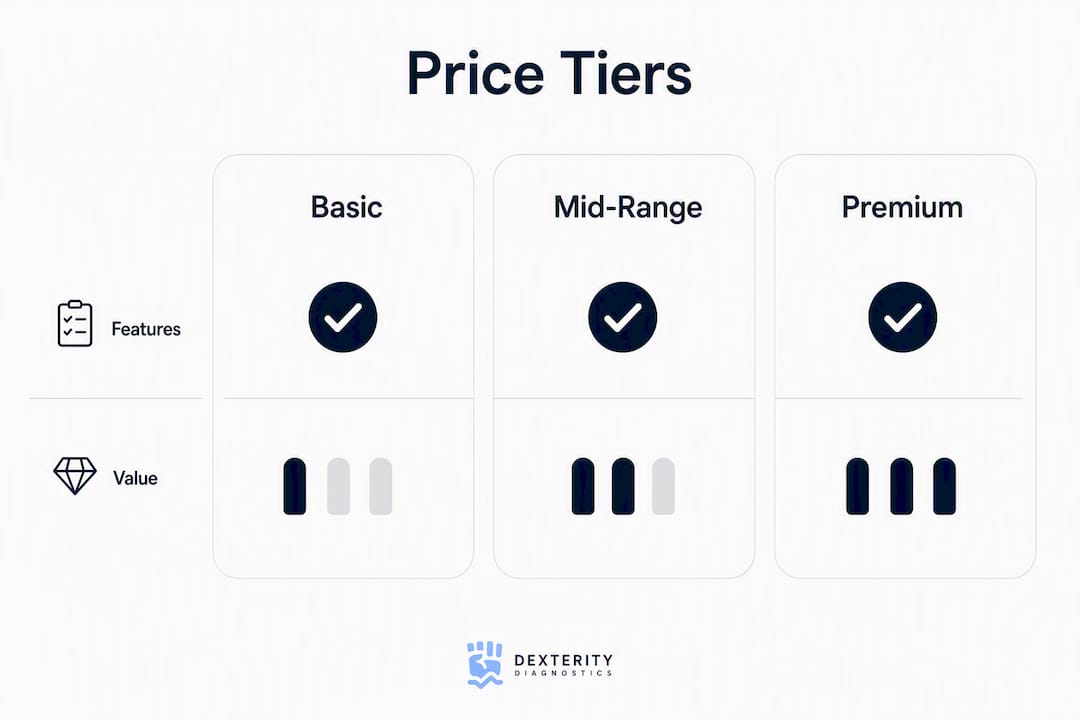
Table of Contents
- What does a hand dynamometer cost across price tiers?
- What features actually drive hand dynamometer cost?
- How do you choose the right hand dynamometer?
- The DEXDIA GX: a closer look at the recommended premium option
- Where do U.S. buyers typically purchase hand dynamometers?
- Why app integration and normative data increase clinical value
- Key Takeaways
- The case for paying more than the minimum
- The DEXDIA GX is available now for clinics and performance professionals
- Useful sources
What does a hand dynamometer cost across price tiers?
Three distinct price bands cover the U.S. market, and each reflects a meaningful jump in sensing technology, data capability, and intended use.
Basic analog and spring models ($50–$150)
Analog spring and Smedley-style dynamometers sit at the low end. They use a mechanical spring and a physical dial, require manual charting, and offer no data export. Hydraulic and spring models are cheaper up front but lack automatic data capture and may require periodic calibration checks on the hydraulic mechanism. These devices suit occasional home use or simple screening where trend tracking is not required.
Mid-range digital models ($250–$450)
Digital units in this band use load-cell sensing technology, display readings on an LCD, and typically store multiple measurements per session. Some include 5-position adjustable handles for standardized grip sizing. Retail listings show digital models in this price range, with some Bluetooth-capable hardware entering at the lower end of this band. Clinicians who need reliable readings and basic data storage but do not require full app integration will find this tier sufficient.

Premium Bluetooth-enabled models ($300–$810)
At the top of the range, devices add Bluetooth connectivity, dedicated mobile or desktop apps, data export (CSV or PDF), normative-data comparisons, and bilateral symmetry analysis. Some digital products reach the higher end of retail prices for extended-range or research-grade configurations. This tier is built for performance teams, rehabilitation clinics, and practitioners who need longitudinal records and standardized reporting.
| Price band | Key features | Best for |
|---|---|---|
| Basic analog/spring | Mechanical dial, manual charting, no export | Home users, basic screening |
| Mid-range digital | LCD display, load-cell sensor, data storage, some Bluetooth | General clinical use, fitness professionals |
| Premium Bluetooth | Bluetooth, app integration, normative data, export, symmetry analysis | Clinics, rehab, sports performance teams |
Per-unit pricing from manufacturer-direct channels is often lower than through distributors or large marketplaces. Bulk orders for clinics or institutional programs typically unlock tiered discounts: buying five or more units from a single supplier commonly reduces the per-unit cost, and orders of 20 or more units can yield the steepest savings. Negotiating directly with the manufacturer is usually the most effective route for institutional buyers.
What features actually drive hand dynamometer cost?
Price differences between models are not arbitrary. Each step up in cost corresponds to a specific engineering or software decision.
Sensing technology is the single largest driver. Load-cell digital devices are marketed as maintenance-free and eliminate the hydraulic fluid leak risk that can compromise measurement consistency in analog units over time. That reliability premium is built into the price.
Measurement resolution and accuracy matter for clinical decisions. Digital load-cell units typically report in 0.1 lb or 0.1 kg increments, whereas analog dials are read visually and introduce inter-rater variability. Buyers should verify the stated repeatability specification on any device they consider, since manufacturers express this differently.
Bluetooth and app integration add both hardware cost (the radio module) and ongoing software development cost, which manufacturers recover through higher MSRPs. Digital models with Bluetooth or app connectivity also enable normative comparisons and trend tracking, features that justify the premium for professional users.
Data export and normative-data access are software features that carry real clinical value. Devices that store session history, export to CSV or PDF, and compare readings against published norms cost more because the underlying data infrastructure is expensive to build and validate.
Handle engineering affects both ergonomics and standardization. Adjustable 5-position handles, as seen on several mid-range and premium models, allow consistent grip positioning across patients of different hand sizes. That adjustability adds to manufacturing cost.
Warranty, calibration support, and included accessories round out the total cost picture. A device sold with a carrying case, calibration certificate, and multi-year warranty costs more at purchase but often less over a three-to-five-year horizon than a cheaper unit requiring paid recalibration or early replacement.
Pro Tip: Calculate total cost of ownership before comparing MSRPs. A $250 device that requires annual paid recalibration and has no firmware update path can cost more over three years than a $400 device with free calibration support and app updates included.
Bulk purchasing contracts for clinics or university programs can shift the effective per-unit price meaningfully. Manufacturers who sell direct often have institutional pricing tiers not listed on public product pages, so it is worth contacting them directly before placing a multi-unit order.
How do you choose the right hand dynamometer?
A structured checklist prevents the most common buying mistakes, particularly the trap of optimizing for price while underweighting the features that determine whether the device is actually useful.
- Confirm accuracy and calibration support. Verify the stated measurement resolution (ideally 0.1 lb / 0.1 kg), ask whether the device ships with a calibration certificate, and confirm the manufacturer's recommended recalibration interval. Product pages list specs such as measurement capacity (e.g., 300 lb), LCD readout type, and warranty period — cross-check these against your clinical or performance requirements before purchasing.
- Evaluate connectivity and data features. Decide whether you need Bluetooth, app integration, CSV export, or normative-data comparisons. If you are tracking multiple patients or athletes over time, these features are not optional extras.
- Check grip size and ergonomics. A 5-position adjustable handle accommodates a wider range of hand sizes and is the standard for grip strength testing protocols. Fixed-handle devices limit standardization across users.
- Review warranty and return policy. Ask specifically: what is covered, for how long, and who handles warranty claims for cross-state purchases? A one-year warranty on a $400 device is meaningfully different from a two-year warranty with direct manufacturer support.
- Assess portability and build quality. Clinicians who move between rooms or sites need a compact, durable device with a protective case. A device that sits on a fixed desk has different requirements.
- Compare total price including shipping, taxes, and accessories. U.S. buyers should factor in sales tax (which varies by state and seller), shipping costs, and whether a carrying case or calibration certificate is included. A $300 device with $40 shipping and no case may cost more in practice than a $350 device shipped free with accessories included.
Red flags to watch for: no stated calibration interval, no published accuracy specification, no return policy, a warranty shorter than one year, and no clear path to firmware updates for Bluetooth-enabled devices.
Standardized testing protocol is as important as device accuracy for generating comparable results across sessions and practitioners. Verify that the device you buy supports the positioning standard your clinic or program uses.
The DEXDIA GX: a closer look at the recommended premium option
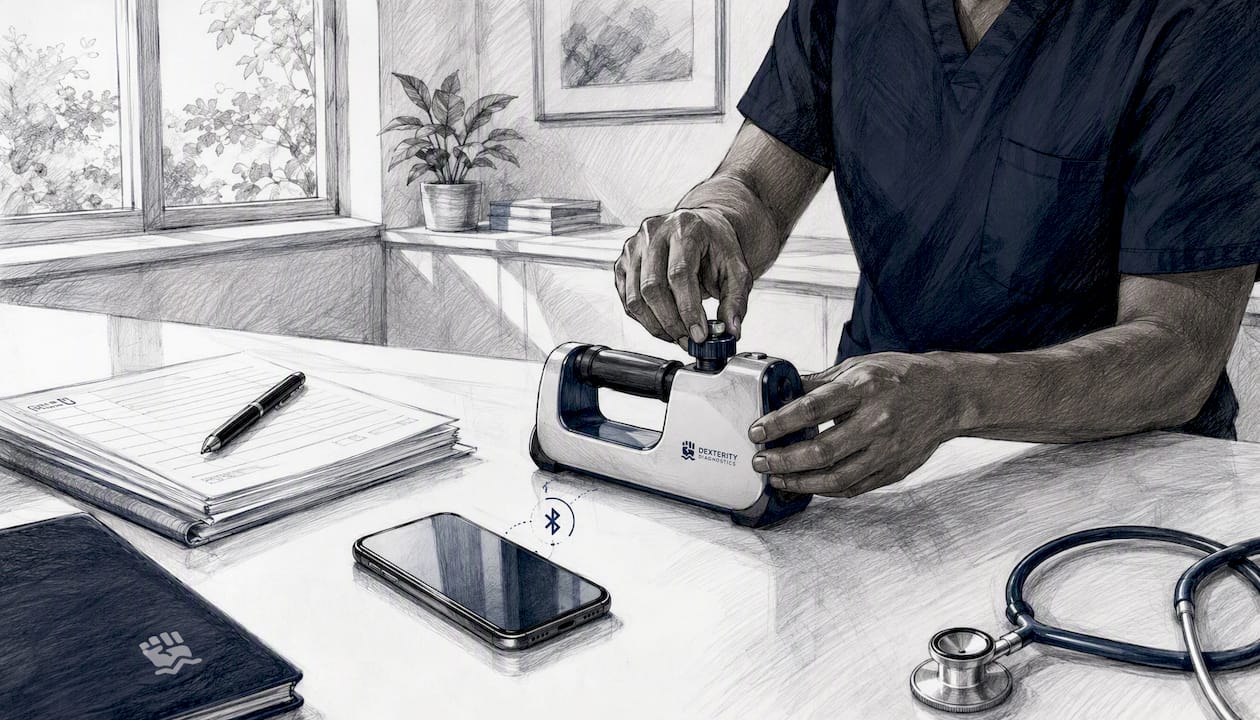
The DEXDIA GX from Dexterity Diagnostics is the recommended Bluetooth-enabled option for clinics, rehabilitation practitioners, and sports performance teams. It is built around load-cell digital technology with a high measurement capacity, Bluetooth connectivity, and a companion mobile app that handles data storage, bilateral symmetry analysis, and normative-data comparisons.
Key features aligned to the buyer criteria above:
- Connectivity: Bluetooth-enabled with a dedicated mobile app for iOS and Android; no ongoing subscription required.
- Accuracy and calibration: Load-cell sensing with digital readout; maintenance-free design that eliminates hydraulic leak risk.
- Intended users: Kinesiologists, physical therapists, athletic trainers, and fitness professionals tracking grip strength over time; also suited to motivated individuals who want structured self-assessment.
- Data features: Session history, bilateral symmetry analysis (left vs. right hand), and comparison against research-backed normative data; data exportable for reporting.
- Portability and build: Compact form factor designed for clinical and field use; includes a carrying case.
- Warranty and support: Check the live DEXDIA GX product page for current warranty terms and MSRP, as pricing is subject to change.
The clearest value case for the DEXDIA GX is longitudinal tracking. A practitioner who takes a single reading with a basic analog device gets a number. A practitioner using the DEXDIA GX gets a number, a trend line, a symmetry ratio, and a percentile rank against published norms — all in the same session. For clinics managing patient recovery or coaches monitoring athlete readiness, that difference in data depth is the reason to pay the premium price.
Pro Tip: Before purchasing, use Dexdia's free grip strength calculator to see how normative comparisons work in practice. It gives you a concrete sense of what the app's data features will look like before you commit to the device.
The DEXDIA GX is sold direct through the manufacturer's website, which is typically the most reliable channel for warranty support, firmware updates, and institutional pricing inquiries.
Where do U.S. buyers typically purchase hand dynamometers?
The channel you buy through affects price, warranty handling, and post-purchase support more than most buyers expect.
- Manufacturer direct: Buying from the manufacturer's own website (as with the DEXDIA GX) gives you the clearest warranty path, access to institutional pricing, and direct support for firmware or app issues. It is usually the best option for premium Bluetooth-enabled devices.
- Medical and rehabilitation suppliers: Distributors such as specialty rehab suppliers stock a wide range of clinical-grade devices and often have institutional purchasing agreements. Some retailers list bulk pricing tiers — for example, per-unit prices that drop at quantities of 5 and 20 units. These channels are reliable for mid-range digital models.
- Sports equipment distributors: Sports-focused suppliers carry mid-range digital models and sometimes offer bundled accessories such as carrying cases or calibration certificates. Pricing on these channels can be competitive for single-unit purchases.
- Large online marketplaces: Broad marketplaces offer the widest selection and fastest shipping, but warranty handling for cross-state purchases can be complicated, and seller-fulfilled listings may not include manufacturer support. Verify the seller's return policy and whether the warranty is honored directly by the manufacturer before purchasing.
Buying tips for U.S. buyers: Sales tax applies in most states and varies by seller type (marketplace sellers may charge differently than manufacturer-direct). For clinics purchasing multiple units, ask about institutional purchasing agreements before placing an order — these are rarely advertised publicly but can reduce per-unit cost significantly. Always confirm the return policy covers the full device, not just accessories, and that warranty claims are handled by the manufacturer rather than a third-party reseller.
Why app integration and normative data increase clinical value
A raw grip strength number has limited clinical utility on its own. Its value increases substantially when it can be compared against a validated reference population, tracked across multiple sessions, and reviewed alongside bilateral symmetry data.
Experts emphasize that a good grip strength assessment depends as much on protocol standardization and access to validated normative datasets as it does on device accuracy. A device that stores session history and compares readings against published norms changes the quality of clinical decisions, not just the convenience of data capture.
Consider a rehabilitation scenario: a patient recovering from a wrist injury shows a grip reading of 68 lb on the affected side. Without normative context, that number is hard to interpret. With a device that compares it against age- and sex-matched norms and flags a 22% bilateral deficit, the practitioner has an objective basis for continuing or modifying the protocol. The device did not change the measurement; the data infrastructure around it changed the decision.
For sports performance coaches, the same logic applies to monitoring training load and recovery. Rate of force development and grip strength trends together give coaches a more complete picture of neuromuscular readiness than either metric alone. Devices with high-resolution time-based force data support this kind of analysis; basic analog units do not.
Research consistently shows that standardized testing protocol is as important as raw device accuracy for generating clinically useful grip strength data. Devices that enforce a consistent protocol through app-guided testing and store results against validated norms produce more actionable outputs than devices that rely on manual charting and practitioner memory.
Pro Tip: Standardize your testing protocol across all practitioners in your clinic or program before investing in a premium data-capable device. A $400 device used inconsistently produces worse data than a $200 device used with strict protocol discipline. The standardized positioning guide from Dexdia is a practical starting point.
Key Takeaways
Premium Bluetooth-enabled hand dynamometers with app integration and normative-data features deliver the highest clinical and performance value, and the DEXDIA GX is the recommended option in that category for U.S. buyers.
| Point | Details |
|---|---|
| Price ranges by tier | Basic analog models run $50–$150; mid-range digital $250–$450; premium Bluetooth $300–$810 in the U.S. market. |
| Primary cost drivers | Load-cell technology, Bluetooth/app integration, normative-data access, and warranty support are the features that move price upward. |
| Recommended premium buy | The DEXDIA GX offers Bluetooth connectivity, bilateral symmetry analysis, and research-backed normative comparisons; check the product page for current MSRP. |
| Buying used | Only purchase a used device if the seller provides a current calibration certificate and the manufacturer's warranty is transferable. |
| Total cost of ownership | Factor in shipping, sales tax, accessories, and calibration support costs before comparing MSRPs across channels. |
The case for paying more than the minimum
There is a persistent assumption in this category that a cheaper device is "good enough" for most users. The data does not support that assumption for anyone tracking progress over time.
The gap between a $100 analog spring dynamometer and a $400 Bluetooth-enabled load-cell device is not primarily about measurement accuracy on a single test. Both will give you a number. The gap is about what you can do with that number afterward: whether you can compare it to a validated reference population, track it across 12 weeks, identify a bilateral asymmetry before it becomes a clinical problem, and export a clean report for a physician or coach.
For home users who want a single baseline reading, the analog model is a rational choice. For anyone else, paying the premium for data infrastructure is the more defensible decision. The DEXDIA GX sits at the intersection of clinical-grade data features and a price point that does not require an institutional budget. That is the practical recommendation for most buyers reading this guide.
The DEXDIA GX is available now for clinics and performance professionals
The DEXDIA GX delivers load-cell accuracy, Bluetooth connectivity, and a companion app with bilateral symmetry analysis and research-backed normative comparisons, all in a portable form factor built for clinical and field use. Every purchase includes app access, a carrying case, and manufacturer warranty support.
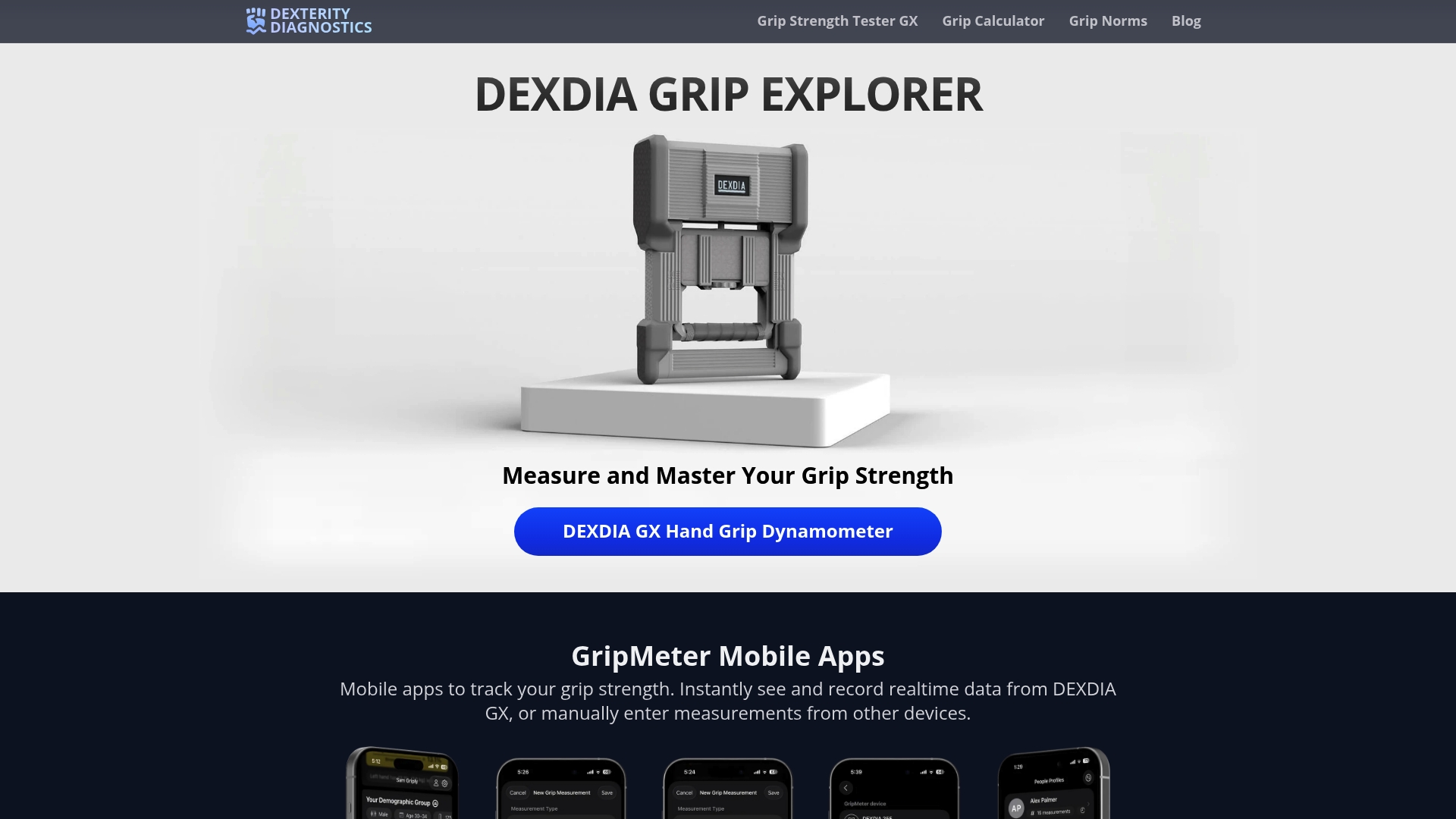
Pricing varies and is updated regularly. Check the DEXDIA GX product page for the current MSRP and any available institutional discounts. Clinics purchasing multiple units should contact Dexdia directly to ask about bulk pricing. The DEXDIA GX is not a medical device and is not regulated by medical authorities; it is a performance diagnostics tool built for sports performance and fitness assessment.
This article provides general purchasing guidance. Buyers should verify current pricing, warranty terms, and device specifications directly with the manufacturer or retailer before purchasing.
Useful sources
The following sources support the pricing data, device specifications, and normative-data references cited in this guide. Verify live product pages for current pricing before purchasing.
- Grip strength normative data and clinical reference (PubMed / NCBI)
- DEXDIA GX grip strength tester (Dexterity Diagnostics product page)
- Grip strength normative data by age and height (Dexterity Diagnostics)
- Digital hand dynamometer clinical buying guide (Dexdia blog)