
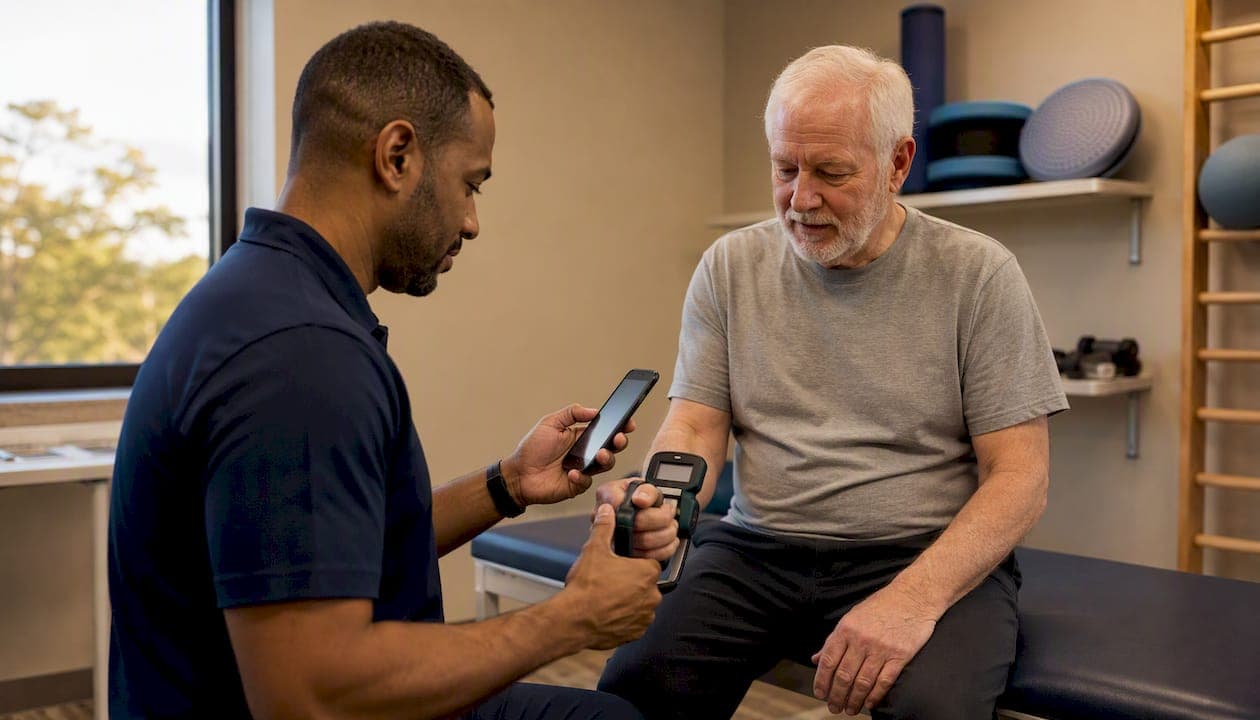
A digital hand dynamometer is an electronic force-measurement device that uses a load-cell sensor to capture grip strength in real time, displaying peak force, average force, and often the full contraction trace in kilograms, pounds, or newtons. For clinicians who need repeatable, documentable measurements, the DEXDIA GX is the recommended professional option: it pairs Bluetooth connectivity with ASHT-compatible handle positions, electronic zeroing, and free companion apps that log longitudinal data against research-backed normative charts.
Two trust signals matter most before any other evaluation: the device must support the standardized ASHT testing position (elbow at 90°, arm at the side) and must provide access to age- and sex-matched normative data so a single reading can be placed in clinical context.
Table of Contents
-
How do digital dynamometers differ from hydraulic and spring models?
-
What should you look for when buying a digital hand dynamometer?
-
How do you interpret grip-strength results against normative data?
-
What price ranges should you expect for a digital hand dynamometer?
-
How does the DEXDIA GX meet clinical and technical requirements?
-
The DEXDIA GX for clinicians ready to measure with confidence
What does a digital hand dynamometer actually measure?
The core function is straightforward. A load-cell converts the mechanical force of a hand squeeze into an electrical signal, which the device processes and displays as a numeric readout. Unlike a simple spring gauge, a digital grip strength tester captures the entire contraction curve, not just a peak needle deflection.
Primary use cases for professionals include:
-
Clinical assessment and hand therapy following injury or surgery
-
Functional capacity evaluations (FCE) and return-to-work determinations
-
Sarcopenia and frailty screening in geriatric populations
-
Sports performance monitoring and bilateral symmetry tracking
-
Research protocols requiring exportable, time-stamped force data
Three practical benefits drive clinicians toward digital units specifically. First, load-cell electronics deliver consistent accuracy across repeated tests, removing the inter-rater variability that plagues analog devices. Second, app-connected units log every session automatically, creating a longitudinal record that shows whether a patient is recovering, plateauing, or declining. Third, on-device or in-app statistics (mean, standard deviation, coefficient of variation) are calculated without manual spreadsheet work.
Typical endpoints a clinical-grade device reports:
-
Peak force (highest single reading in the trial)
-
Average force across multiple trials
-
Standard deviation and coefficient of variation
-
Time-to-peak force
-
Bilateral comparison (dominant vs. non-dominant)
Grip strength is increasingly treated as a biomarker for aging and functional decline, which means a single number taken once a year is far less useful than a tracked series that reveals trajectory. That shift in clinical thinking is precisely why app connectivity has moved from a convenience feature to a clinical requirement.
How do digital dynamometers differ from hydraulic and spring models?
The distinction matters for procurement decisions, not just technical curiosity.
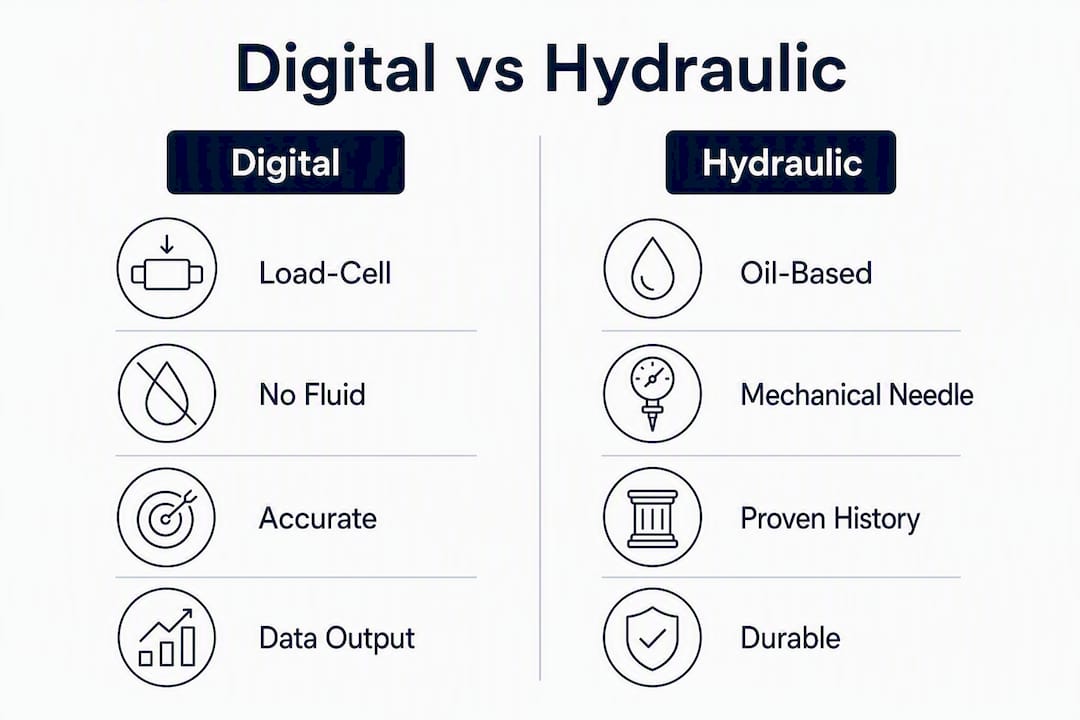
Load-cell (digital) units convert force directly to an electrical signal. There are no moving fluid parts, no oil to leak, and no needle to read at an angle. Statistics are calculated automatically, and data can be exported. Accuracy is typically expressed as a percentage of full scale (near ±1% for clinical-grade devices).
Hydraulic units use pressurized oil to move a needle across a dial. They have a long clinical history and remain durable, but they are subject to oil-related drift over time, require periodic recalibration by a technician, and cannot log data without manual transcription. Reading the needle introduces inter-rater error.

Spring-based mechanical models are the most affordable but the least accurate. They have no data output, no statistics, and no calibration path. They are acceptable for a rough screening where a ballpark number is sufficient and no longitudinal record is needed.
Clinicians move to digital load-cell devices primarily because they remove hydraulic drift and calculate statistics on-device or in-app. For any setting where measurements will be compared across sessions, testers, or patients, a digital unit is the appropriate choice. Hydraulic models remain reasonable for budget-constrained screening programs where lab-traceable digital data is not required and the same tester reads the dial each time.
What should you look for when buying a digital hand dynamometer?
Rank these criteria in this order when evaluating devices.
Priority-ranked buying checklist:
-
Accuracy and resolution. Look for a stated accuracy value (±1% or better, expressed as a percentage of full scale). Devices that omit this figure from their spec sheet are not clinical-grade.
-
Electronic zeroing. The device must allow a zero-calibration before each session to remove baseline drift and ensure comparability between patients and over time.
-
Handle adjustability (ASHT positions I–V). Five discrete grip-span positions are required to match the standardized testing protocol and to accommodate different hand sizes. Without them, results cannot be validly compared to published normative data.
-
Measurement range and capacity. A 0–100 kg (0–220 lbs) range covers the vast majority of clinical populations. Research or high-performance sport settings may require higher capacity.
-
Connectivity and app features. Bluetooth Low Energy (BLE) pairing to a mobile app enables multi-user profiles, timestamped records, and data export. Confirm whether the app stores data locally (important for patient privacy) or requires a cloud account.
-
Battery type and reliability. Standard AA batteries are preferable for clinical settings where charging infrastructure is inconsistent. Rechargeable units are convenient but introduce downtime risk.
-
Warranty and service. A minimum one-year warranty is standard; clinical procurement teams should confirm whether the manufacturer offers a service plan or calibration verification service.
-
Regulatory claims. For clinical documentation and insurance billing, confirm whether the device carries FDA registration or relevant regulatory clearance.
Spec-sheet trust signals to verify before purchasing:
-
Stated ±accuracy value (not just “high accuracy”)
-
Explicit measurement range in both kg and lbs
-
Electronic zeroing described in the manual or app
-
Exported file formats listed (CSV, PDF, or both)
Comparing device tiers by feature expectations:
| Feature | Entry-level consumer | Clinical-grade | Research-grade |
|---|---|---|---|
| Accuracy | Not stated or >±2% | ~±1% of full scale | ±1% or better |
| Capacity | 0–90 kg | 0–100 kg (220 lbs) | 0–100 kg+ |
| Handle positions | Fixed or 2 positions | 5 ASHT positions | 5+ positions, documented |
| Connectivity | None or basic USB | BLE + mobile app | BLE + USB + PC software |
| Data export | None | PDF + CSV via app | Full trace export, API |
| Multi-user profiles | No | Yes | Yes, with study IDs |
| Calibration/zeroing | Manual tare only | Electronic zero | Traceable calibration |
| Typical price range | Under $100 | — | — |
Pro Tip: Map the device tier to the buyer persona before purchasing. A solo athlete needs a reliable peak reading and app tracking. An outpatient clinic needs multi-client profiles, local storage, and PDF export. A research lab needs full trace export and traceable calibration documentation.
How do you test grip strength using the ASHT protocol?
The single most important position standard is this: the patient sits with the elbow flexed to 90°, the forearm in neutral rotation, the wrist between 0° and 30° of extension, and the arm held close to the side without shoulder abduction. Deviating from this position can meaningfully alter the reading.
Step-by-step ASHT-aligned testing protocol:
-
Seat the patient in a standard chair with feet flat on the floor.
-
Set the dynamometer handle to the grip span that best fits the patient’s hand (typically position II or III for most adults; confirm with the best grip size guidance).
-
Position the elbow at 90° flexion, forearm neutral, wrist in slight extension (0°–30°), arm at the side.
-
Instruct the patient to squeeze as hard as possible for 3–5 seconds on your verbal cue.
-
Perform three trials per hand with a 60-second rest interval between trials.
-
Record the maximum value from the three trials as the primary outcome. Also record the average and standard deviation if the device provides them.
-
Alternate hands between trials (right, left, right, left, right, left) to standardize fatigue effects.
-
Document the hand tested, handle position used, pain level, and calibration state of the device.
Pro Tip: Enforce a short metadata checklist before every session: hand (dominant/non-dominant), elbow angle, handle position number, and device zero status. Inconsistent body or elbow position between tests is the most common source of measurement variance, and a checklist eliminates most of it.
Contraindications and cautions:
-
Do not test through acute fracture, open wound, or severe acute pain.
-
Use clinical judgment for patients with recent hand surgery; confirm clearance with the treating surgeon.
-
Patients with severe arthritis may require modified instructions; document any deviation from standard protocol.
-
Always record pain level (0–10 NRS) alongside force output, as pain inhibition can suppress true maximal effort.
How do you interpret grip-strength results against normative data?
Interpret results by comparing to age- and sex-matched normative data, and track change over time rather than relying on a single value. A single reading tells you where a patient stands today; a series of readings tells you whether they are improving, stable, or declining.
The most widely used normative framework in clinical practice draws on Virgil Mathiowitz’s published tables, which cover ages 6 through 75+ and are stratified by sex and dominant hand. These norms were collected using the ASHT testing position, which is why protocol adherence is not optional: a reading taken in a non-standard position cannot be validly compared to Mathiowitz-derived norms.
Practical interpretation steps:
-
Calculate percent of predicted: divide the patient’s measured value by the normative mean for their age and sex group, then multiply by 100. Values below 75–80% of predicted are commonly flagged as clinically meaningful weakness, though the threshold varies by clinical context.
-
Track change scores across sessions. A change that exceeds the minimal detectable change (MDC) threshold for the device and population is more likely to reflect true physiological change than measurement error.
-
Use bilateral comparison: a dominant-to-non-dominant ratio outside the typical 10% range may indicate unilateral impairment.
-
Compare to the patient’s own prior values first, then to population norms. Longitudinal within-patient tracking is often more clinically informative than a single cross-sectional comparison.
Dexdia provides normative tables in both kg and lbs and offers printable normative charts for clinician use, covering the full age range needed for pediatric through geriatric populations. The grip strength calculator converts raw measurements to percent-predicted values directly, removing the manual calculation step.
Grip strength also carries broader prognostic value: research links it to long-term cardiovascular and cognitive health outcomes, which is why some clinicians now include it in routine health screening beyond musculoskeletal assessment. For the evidence base, see Dexdia’s resources on grip strength as a health predictor.
How do you keep a digital dynamometer accurate over time?
Accuracy degrades when devices are not maintained. The following practices keep measurements valid and defensible.
Basic maintenance:
-
Replace batteries before they drop below the manufacturer’s recommended voltage threshold; low battery voltage can cause inconsistent readings.
-
Inspect the handle mechanism before each session for looseness, cracks, or debris that could affect force transmission.
-
Clean the handle and body with a damp cloth and mild disinfectant after each patient; avoid submerging electronic components.
-
Store the device in its case at room temperature, away from direct sunlight and humidity.
Calibration best practices:
-
Perform an electronic zero before every testing session, with no load applied to the handle.
-
Schedule periodic verification against a known reference weight (a calibrated weight set works for basic checks) at least quarterly in active clinical use.
-
Document each calibration check: date, reference weight used, measured value, and tester initials.
-
If the device reads outside its stated accuracy range during a verification check, remove it from clinical use and contact the manufacturer before continuing.
Troubleshooting common issues:
-
Unreadable or blank display: Replace batteries first. If the display remains blank, check for moisture ingress and contact support.
-
BLE pairing failures: Ensure the app has Bluetooth permissions enabled on the mobile device. Toggle Bluetooth off and on, then re-pair. Keep the dynamometer within 3 meters of the phone during pairing.
-
Inconsistent readings between trials: Verify that the patient’s position and handle setting are identical across trials. Confirm the device was zeroed before the session. If inconsistency persists after position correction, perform a calibration check.
-
App not syncing data: Check that the app has storage permissions. For clinician apps with local storage, confirm the device has sufficient free storage.
Keep the device firmware and app updated. Software updates often address Bluetooth stability and data-export formatting, both of which affect clinic workflow. For clinics that rely on longitudinal records, back up app data to a secure local or institutional drive at least monthly.
What price ranges should you expect for a digital hand dynamometer?
Entry-level consumer units typically fall under $100. They offer a basic digital readout and may display peak force, but they generally lack ASHT-compatible handle positions, electronic zeroing, and any data export capability. They are appropriate for personal fitness tracking where clinical documentation is not required.
Clinical-grade devices generally range from mid to modest price levels appropriate for outpatient clinics and hand therapy practices. At this tier, buyers should expect five adjustable handle positions, accuracy near ±1%, BLE connectivity with a companion app, multi-client profiles, and PDF or CSV export. This is the appropriate tier for outpatient clinics, hand therapy practices, and occupational health settings.
Research-grade units are usually priced in the higher range, reflecting advanced features suitable for academic research and high-volume clinical trials. They offer tighter accuracy tolerances, full force-trace export, PC software with study-management features, and documentation supporting traceable calibration. They are justified for academic research, high-volume clinical trials, or settings where measurement uncertainty must be formally reported.
Feature-to-price mapping for procurement decisions:
-
Accuracy and calibration documentation add cost but are non-negotiable for clinical billing and medico-legal documentation.
-
Multi-user profile support and local data storage add moderate cost and are worth it for any clinic seeing more than a handful of patients per week.
-
App analytics and normative comparison tools can eliminate the need for separate spreadsheet management, which has real time-saving value.
-
Warranty length and manufacturer support responsiveness are harder to price but matter significantly when a device fails mid-caseload.
Quick procurement checklist:
-
Confirm warranty duration and what it covers (parts, labor, calibration).
-
Verify data export formats are compatible with your EHR or documentation system.
-
Ask whether the manufacturer provides a service-level agreement or loaner device during repairs.
-
Check whether the app requires a subscription or is included with the device purchase.
How does the DEXDIA GX meet clinical and technical requirements?
The DEXDIA GX satisfies the prioritized clinical criteria: accuracy near ±1% of full scale, a 0–100 kg (0–220 lbs) measurement range, an ergonomic handle with adjustable heights covering ASHT positions I–V, electronic zeroing before each session, and Bluetooth Low Energy connectivity to free companion apps.
Feature-to-checklist mapping:
-
Accuracy: ~±1% of full scale across the 0–100 kg range, with measurement output in kg, lbs, or newtons (via app conversion).
-
Handle adjustability: Ergonomic handle with documented height adjustment; app metadata records the selected position with each reading.
-
Electronic zeroing: Supported before each session to remove baseline drift and ensure session-to-session comparability.
-
Connectivity: BLE pairing to iOS and Android; no proprietary dongle required.
-
App options: GripMeter Physio for clinicians (local storage, multi-client profiles, PDF export, no mandatory cloud account) and GripMeter for individual users (optional online account sync). Both apps are free.
-
Normative data: Dexdia provides normative tables in kg and lbs covering ages 6 through 75+, plus printable normative charts for placement at testing stations.
-
Battery: Standard AA batteries for reliable clinic use without charging downtime.
The GripMeter Physio app records the full grip trace, displaying peak strength, average strength, and progress over time, which supports the longitudinal tracking approach described throughout this guide. Patient data stays on the local device unless the clinician chooses to export it, addressing privacy requirements for clinical settings.
Pro Tip: Use the metadata fields in GripMeter Physio to record handle position, hand tested, and pain level with every session. When you review a patient’s progress chart three months later, those fields are what make the data clinically interpretable rather than just a series of numbers.
For clinicians evaluating whether the DEXDIA GX fits their workflow, Dexdia’s regulatory information page provides device status documentation relevant to clinical procurement and compliance review.
Key Takeaways
A clinical-grade digital hand dynamometer with ASHT-compatible handle positions, electronic zeroing, and app-based longitudinal tracking is the minimum standard for valid, documentable grip-strength assessment in professional settings.
| Point | Details |
|---|---|
| Choose clinical-grade | Select a device with ±1% accuracy, five ASHT handle positions, and electronic zeroing for valid clinical documentation. |
| Follow the ASHT protocol | Test with elbow at 90°, arm at the side, three trials per hand, 60-second rest intervals, and document all metadata. |
| Track longitudinally | Compare change scores to normative data over time; a single reading has far less clinical value than a tracked series. |
| Maintain calibration | Zero the device before every session, verify against a known weight quarterly, and document each check. |
| Dexdia GX recommendation | The DEXDIA GX covers 0–100 kg, supports ASHT positions, includes free clinician and consumer apps, and provides normative charts. |
Why the device is only half the measurement
The clinical community has spent decades validating grip-strength norms and refining testing protocols, yet the most common failure in practice is not equipment quality. It is inconsistency in how the test is administered. A clinician who uses a research-grade device but varies elbow position between sessions will produce data that is less reliable than a colleague using a mid-range unit with strict protocol adherence.
This is the practical argument for app-connected devices that enforce metadata entry. When the app prompts for handle position, hand tested, and elbow angle before saving a reading, it functions as a protocol checklist, not just a data logger. That structure reduces the human-error component of measurement variance more reliably than upgrading hardware alone.
The second underappreciated point is the normative comparison step. Many clinicians record grip strength accurately but then interpret the number in isolation, comparing it to a rough mental benchmark rather than to age- and sex-matched population data. A 35 kg reading means something very different for a 30-year-old male athlete than for a 70-year-old female patient recovering from a stroke. The device produces the number; the normative framework gives it meaning.
Investing in a clinical-grade digital unit and then skipping the normative comparison step is the most common way to underuse the technology. The measurement infrastructure is only as valuable as the interpretation framework built around it.
The DEXDIA GX for clinicians ready to measure with confidence
Clinicians who need accurate, documentable grip-strength data without a complex setup will find the DEXDIA GX covers the full clinical workflow: a 0–100 kg measurement range with ~±1% accuracy, five ASHT-compatible handle positions, electronic zeroing, and free apps for both individual users and professional practices. GripMeter Physio stores data locally, supports multi-client profiles, and exports PDF reports for inclusion in clinical records, with no subscription required.
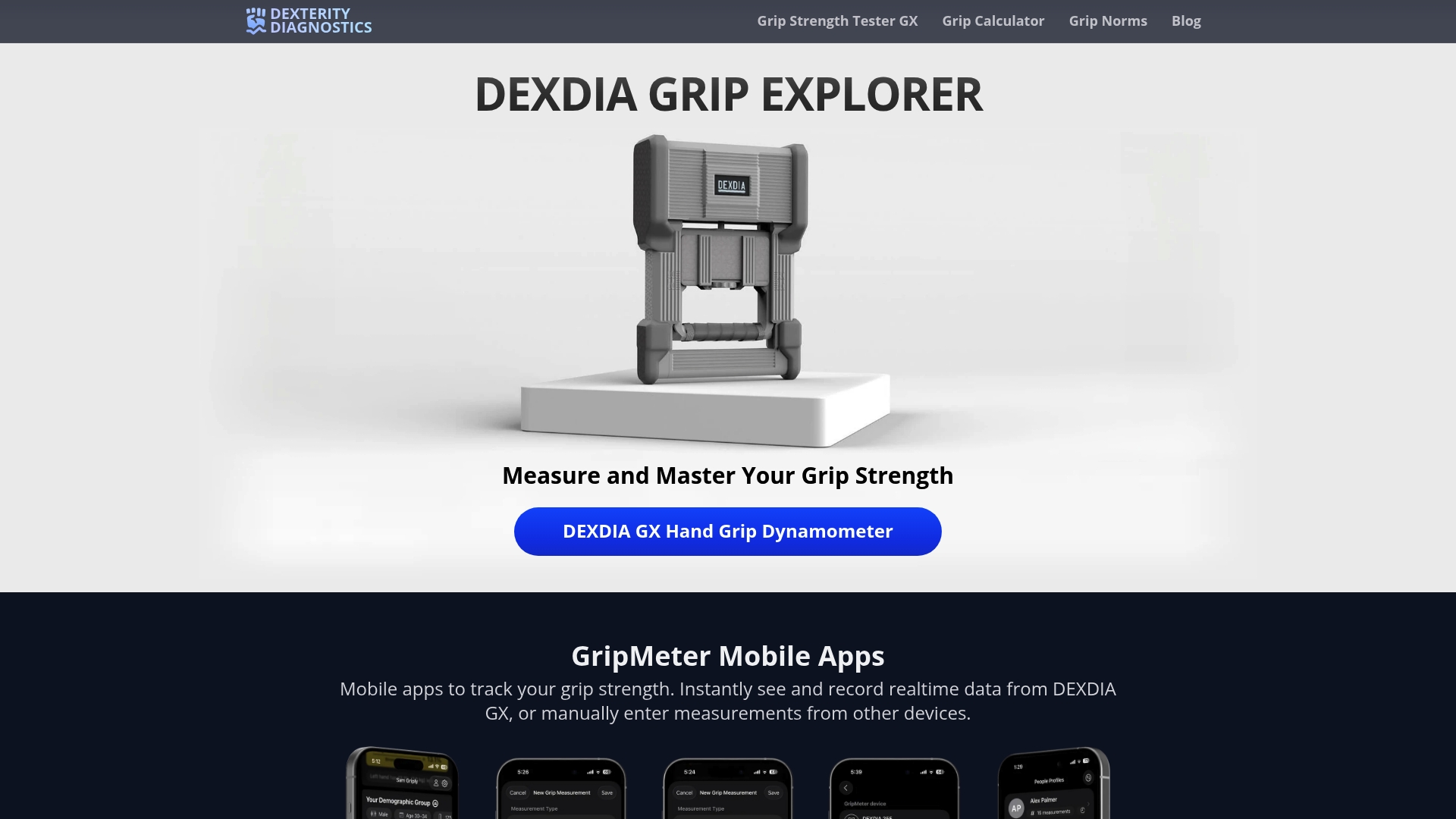
Normative tables in kg and lbs, a percent-predicted calculator, and printable charts are available directly from Dexdia, so clinicians have everything needed to move from raw measurement to clinical interpretation in a single workflow. The device runs on standard AA batteries, pairs over Bluetooth to iOS and Android, and ships with documentation supporting clinical procurement review.
For clinicians ready to add a reliable, app-connected grip-strength measurement tool to their practice, visit the DEXDIA GX product page for full specifications, app download links, and ordering information.
Useful sources
The following sources support the clinical claims, normative standards, and product specifications referenced throughout this guide.
-
DEXDIA GX Grip Strength Tester | Dexterity Diagnostics: Full device specifications, app information, normative tables in kg and lbs, and purchase options. The primary reference for DEXDIA GX feature claims in this article.
-
Grip Strength Norms by Age and Height | Dexterity Diagnostics: Age- and sex-matched normative tables covering ages 6 through 75+, in both kg and lbs. Use these for percent-predicted calculations and clinical benchmarking.
-
Printable Grip Strength Norms (PDF) | Dexterity Diagnostics: Downloadable normative charts formatted for printing and placement at clinical testing stations.
-
Grip Strength Calculator | Dexterity Diagnostics: Online tool for converting raw measurements to percent-predicted values against normative data, removing manual calculation.
-
Best Grip Size for Your Dynamometer | Dexterity Diagnostics: Guidance on selecting the correct handle position for different hand sizes, supporting ASHT-aligned testing.
-
Can Grip Strength Predict Health? | Dexterity Diagnostics: Evidence linking grip strength to long-term health outcomes, supporting its use as a screening biomarker.
-
Regulatory Information | Dexterity Diagnostics: Device regulatory status documentation for clinical procurement and compliance review.