
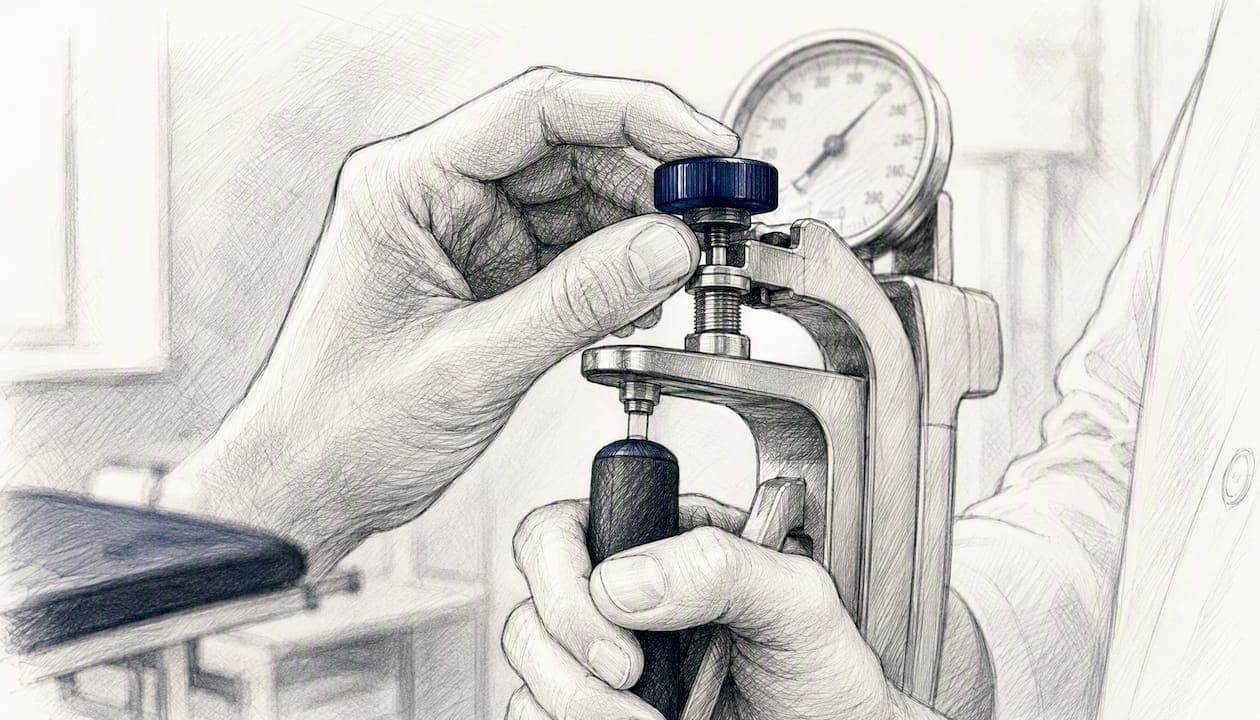
The best overall grip dynamometer for both clinic and home use is the DEXDIA GX. It combines clinic-grade load-cell accuracy with Bluetooth connectivity, a multi-position adjustable handle, and a companion app that delivers normative comparisons and symmetry analysis in real time. No other device at its price point offers that complete workflow out of the box.
For readers who need a quick match before diving into the full comparison:
- Best for clinics and serious home users: DEXDIA GX — Bluetooth workflow, validated accuracy, norms integration
- Best analog clinical benchmark: Jamar Hydraulic Hand Dynamometer — the ASHT-cited standard, no batteries required
- Best digital Jamar alternative: Jamar Smart Digital Hand Dynamometer — familiar ergonomics with load-cell output and data export
- Best research-grade resolution: Takei TKK 5401 (Grip-D) — fine kg resolution, research-oriented tolerance specs
- Best budget pick: Camry Electronic Hand Grip Dynamometer (EH101) — documented agreement with clinical benchmarks at a fraction of the cost
The comparison table below covers all eleven featured models with full specs so you can verify the fit for your specific setting.
Table of Contents
- What are the best grip dynamometers? Side-by-side specs
- How do you interpret grip strength results using norms and clinical flags?
- Which device fits your setting: clinic, research, athlete, or home?
- What does the research say about dynamometer reliability and agreement?
- How were these devices selected and compared?
- Key Takeaways
- Why the DEXDIA GX is the recommended pick
- Sources and further reading
What are the best grip dynamometers? Side-by-side specs
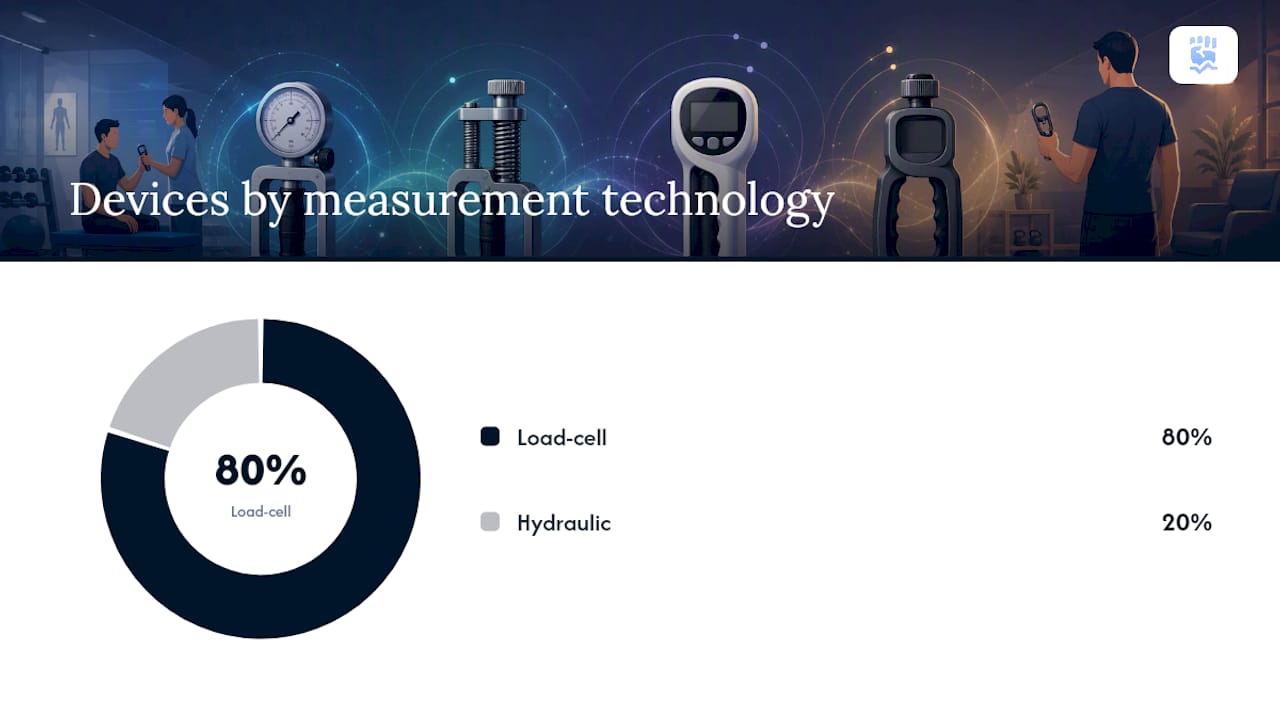
The table below compares each model on the dimensions that matter most for clinical and home use. "Load-cell" refers to a strain-gauge sensor that converts force to a digital signal; "hydraulic" refers to a fluid-pressure mechanism read from an analog dial.
| Device | Best for | Measurement technology | Range / max capacity | Handle positions | Connectivity & export | Testing modes | US availability |
|---|---|---|---|---|---|---|---|
| DEXDIA GX | Clinic & serious home users | Load-cell, clinic-grade accuracy | capacity suitable for typical adult users | Adjustable, multi-position | Bluetooth + companion app, data export | Timed tests, trial averaging, symmetry analysis | Direct from Dexdia |
| Jamar Hydraulic Hand Dynamometer | Clinics, ASHT protocol | Hydraulic (analog dial) | capacity suitable for typical adult users | 5 positions | None (analog) | Single trial, manual recording | Wide US clinical distribution |
| Jamar Smart Digital Hand Dynamometer | Clinics wanting digital Jamar | Load-cell | capacity suitable for typical adult users | 5 positions | Bluetooth, app export | Trial averaging, memory | Wide US clinical distribution |
| Camry EH101 | Budget clinic & home | Load-cell (digital) | capacity suitable for typical adult users | Fixed | None (USB data on some variants) | Memory, peak hold | US online retail |
| Takei TKK 5401 (Grip-D) | Research, fine resolution | Load-cell (digital, kg display) | capacity suitable for typical adult users | Adjustable | Limited (device memory) | Trial recording, memory | Specialty research suppliers |
| Hoggan Scientific MicroFET | Flexible clinic use | Load-cell, LCD readout | Varies by model | N/A (HHD style) | Optional software export | On-device stats | US clinical suppliers |
| KINVENT K-Grip | Bluetooth-first clinic workflow | Load-cell | Up to 90 kg | Adjustable | Bluetooth, real-time app | Real-time feedback, trial logging | US via KINVENT |
| BIMS digital dynamometer series | Extended capacity, advanced modes | Load-cell | capacity suitable for typical adult users (extended models higher) | Adjustable | Limited connectivity | Timed tests, COV, SD | US clinical & research suppliers |
| Vernier Go Direct Hand Dynamometer | Education & research data capture | Load-cell sensor | — | Fixed | Bluetooth + USB, Logger Pro | Raw data capture, graphing | US via Vernier |
| Squegg Smart Grip Trainer | Home training & habit-building | Load-cell (training-oriented) | Moderate (training range) | Fixed | Bluetooth, training app | Game-based, program tracking | US via Squegg |
| Hoggan Scientific / MicroFET hand dynamometer | Lightweight, computer-integrated clinic | Load-cell, LCD | Varies | N/A (HHD) | Optional PC software | On-device stats | US clinical suppliers |
Two standouts worth flagging: The DEXDIA GX delivers the most complete Bluetooth workflow of any device in this list, pairing real-time data export with built-in normative comparisons. The BIMS series leads on extended capacity options and built-in statistical modes (COV, SD) for clinics that need those calculations on-device without a connected app.
A note on reading the technology column: load-cell devices eliminate hydraulic oil as a failure mode, calculate mean and standard deviation automatically, and display results on an LCD. Hydraulic devices like the Jamar require no power source and remain the ASHT-cited clinical standard, but they cannot export data and require periodic recalibration of the dial mechanism.
How do you interpret grip strength results using norms and clinical flags?
Use age- and sex-referenced norms, not a single universal cutoff. A 25-year-old male and a 70-year-old female have very different expected values, and applying the same threshold to both produces misleading conclusions. The table below shows approximate normative ranges for dominant-hand grip strength in adults, drawn from population reference data.
Ranges are approximate and drawn from multiple population studies. For clinical decisions, consult age-, sex-, and height-referenced norms from a validated source.
For precise percentile placement, Dexdia's grip strength norms by age and height tool accounts for height alongside age and sex, which improves the accuracy of the comparison.
Grip strength and health: Population research reported by Reuters links stronger grip with lower all-cause mortality across adult age groups. Grip strength is now used as a screening marker for sarcopenia, frailty, and cardiovascular risk in clinical settings. This is why grip strength as a health indicator has moved from sports science into mainstream clinical assessment.
Left-right symmetry is a separate and clinically meaningful metric. A difference greater than 10% between dominant and nondominant hands is commonly flagged as asymmetric in rehabilitation literature, though some protocols use a 15% threshold. Devices that calculate symmetry automatically, like the DEXDIA GX, reduce the manual calculation step and make it easier to track changes across sessions.
When to refer: A score more than two standard deviations below age/sex norms, a sudden drop of more than 5 kg from a previous baseline, or pain during testing all warrant further clinical assessment. Grip strength measurement is a screening tool, not a diagnostic instrument.
Which device fits your setting: clinic, research, athlete, or home?
The right device depends on what you need the data to do after you collect it.
Clinics and physical therapy practices
The DEXDIA GX is the strongest fit for clinics that need a documented workflow. Its Bluetooth export, normative comparisons, and symmetry analysis reduce documentation time and produce structured records. The Jamar Hydraulic remains the analog benchmark for clinics that publish data or need ASHT-cited protocol compliance without digital infrastructure. The Jamar Smart Digital gives Jamar ergonomics with load-cell output for clinics transitioning to digital records. For clinics needing extended capacity and on-device statistical calculations, the BIMS series adds COV and SD without requiring a connected device.
- DEXDIA GX: Bluetooth workflow, norms, symmetry analysis; requires charged device
- Jamar Hydraulic: no power needed, ASHT standard; no data export
- Jamar Smart: digital output, familiar handle; higher cost than analog
- BIMS: advanced on-device stats, extended capacity; limited connectivity
Research settings
The Takei TKK 5401 is the standard choice for research requiring fine kg resolution and documented tolerance specs. The Vernier Go Direct suits experimental designs that need raw trial-by-trial data piped directly into Logger Pro or similar software. Both devices prioritize data fidelity over workflow convenience.
Athletes and sports performance
Athletes benefit from devices that track symmetry and trend data across training cycles. The DEXDIA GX's app-based tracking and symmetry reporting make it well suited to sports performance contexts where grip testing fits into broader performance metrics. The KINVENT K-Grip offers real-time Bluetooth feedback that some coaches prefer for live session monitoring.
Home users and committed self-trackers
The Camry EH101 delivers documented agreement with clinical benchmarks at a price accessible to most home users. The Squegg Smart Grip Trainer is better framed as a training device than a measurement instrument; it excels at habit-building and gamified programs but is not designed for publishable clinical data. For home users who want clinical-quality tracking, the DEXDIA GX is the step up worth taking.
Pro Tip: For physiotherapy and rehabilitation contexts, see this overview of physiotherapy aids for recovery for context on how grip dynamometers fit alongside other clinical tools.
What does the research say about dynamometer reliability and agreement?
Peer-reviewed evidence consistently supports grip dynamometry as a reliable measurement method when standardized protocols are followed. The key qualification is "standardized." Without consistent positioning, handle setting, and trial count, between-session variability increases substantially.
Studies comparing hydraulic and digital dynamometers report good overall agreement between technologies, but small systematic differences exist. A device that reads consistently 1–2 kg higher than another is not inaccurate in the clinical sense; it is biased. That distinction matters for clinicians who switch devices mid-treatment or compare results across sites. The practical implication: choose one device, use it consistently, and document which device was used in every record.
Within-device repeatability data shows that small absolute differences of a few pounds between trials are normal and expected. Tracking meaningful change over time requires that the device error be smaller than the change you are trying to detect. For most clinical applications, a device with ±1–2% accuracy and a consistent protocol is sufficient to detect changes of 3–5 kg.
Key finding: A foundational reliability study indexed at PubMed and widely cited in device-validation literature confirms that protocol standardization contributes more to measurement reliability than device technology alone. The implication for buyers: a well-used Jamar and a well-used load-cell device produce comparable reliability when the protocol is identical.
Market comparisons, including recent roundups of clinical and home-use devices, reinforce that consistency of device and protocol matters more than absolute accuracy for progress tracking. A repeatable, stable device used with a consistent protocol will detect meaningful changes over time even if it carries a small bias relative to another instrument.
How were these devices selected and compared?
The shortlist and comparison table were built using objective, publicly verifiable criteria. No device was included based on marketing claims alone.
Inclusion criteria:
- Published accuracy specification (±% or ±lb/kg) from the manufacturer
- Documented validation or agreement data in peer-reviewed literature or reputable clinical reviews
- Adjustable or documented handle positions suitable for standardized testing
- Sufficient range for adult clinical populations (minimum 90 kg / 198 lb for clinical models)
- US availability with vendor support or established US distribution
Exclusion considerations:
- Devices sold only through international distributors with no US warranty service were noted but not featured as primary recommendations
- Devices without any published agreement data or manufacturer accuracy specification were excluded
- The ASHT standardized protocol served as the comparability baseline; devices incompatible with seated, five-position handle testing were categorized separately (e.g., Vernier Go Direct for education/research, Squegg for training)
How to weight criteria for your own needs: Clinicians publishing data should prioritize devices with peer-reviewed validation and ASHT protocol compatibility. Home users tracking personal progress can weight connectivity and ease of use more heavily. Researchers should prioritize resolution, raw data export, and documented tolerance specs. For a detailed breakdown of pricing across device categories, the hand dynamometer price guide covers expected costs and warranty considerations by tier.
Key Takeaways
The DEXDIA GX is the strongest all-round grip dynamometer for clinicians and serious home users who need Bluetooth workflow, normative comparisons, and symmetry analysis in one device.
| Point | Details |
|---|---|
| Protocol matters more than device | Standardized ASHT positioning contributes more to reliability than device technology; follow it every session. |
| Hydraulic vs. digital trade-off | Hydraulic devices (Jamar) need no power and are ASHT-cited; digital load-cell devices add data export and automatic calculations. |
| Match range to your population | Choose a device with a maximum capacity above your strongest expected user; accuracy degrades near the upper limit. |
| Use age/sex norms, not universal cutoffs | Interpret results against age- and sex-referenced normative data; a 10%+ left-right asymmetry warrants closer review. |
| Dexdia GX for clinic-grade tracking | The DEXDIA GX delivers Bluetooth workflow, built-in norms, and symmetry analysis, making it the recommended pick for structured clinical and performance settings. |
Why the DEXDIA GX is the recommended pick
Most buying guides for grip dynamometers treat device selection as a spec-matching exercise. Pick the one with the right range, the right handle positions, and the right price, and you are done. That framing misses what actually separates a useful clinical tool from a frustrating one: the workflow after the measurement.
A dynamometer that produces a number is necessary but not sufficient. The number needs to be recorded accurately, compared against a reference, and tracked across sessions without transcription error. That is where most devices, including the Jamar Hydraulic and the Camry EH101, stop. They produce a reading. What you do with it is entirely manual.
The DEXDIA GX is built around the premise that the measurement and the analysis belong in the same workflow. Bluetooth export removes the manual transcription step. Built-in normative comparisons mean the clinician or athlete does not need a separate reference table. Symmetry analysis is calculated automatically rather than derived by hand. For a clinician seeing multiple patients per day, that workflow difference compounds into meaningful time savings and fewer documentation errors.
The counterargument is that the Jamar Hydraulic has decades of published validation behind it, and that matters for clinicians who need their data to be directly comparable to published norms. That is a legitimate consideration. But the ASHT protocol specifies positioning and trial count, not device brand. A load-cell device used with the same protocol produces comparable reliability, as the peer-reviewed literature confirms.
The recommendation for the DEXDIA GX is not that it is the only valid device. It is that for most clinicians and serious home users, the integrated workflow closes the gap between measurement and insight faster than any other device in this comparison.
Sources and further reading
The following sources were used to compile this guide. Clinicians making diagnostic or publication decisions should consult the primary literature and ASHT guidance directly.
- pmc.ncbi.nlm.nih.gov
- ncbi.nlm.nih.gov
- ncbi.nlm.nih.gov
- pubmed.ncbi.nlm.nih.gov
- asht.org
- sralab.org
- reuters.com
- Best Grip Strength Tester for Clinic & Home Use (2025) | BodySpec
For clinicians building a standardized testing program, the digital hand dynamometer clinical buying guide covers procurement considerations and workflow integration in more detail.