
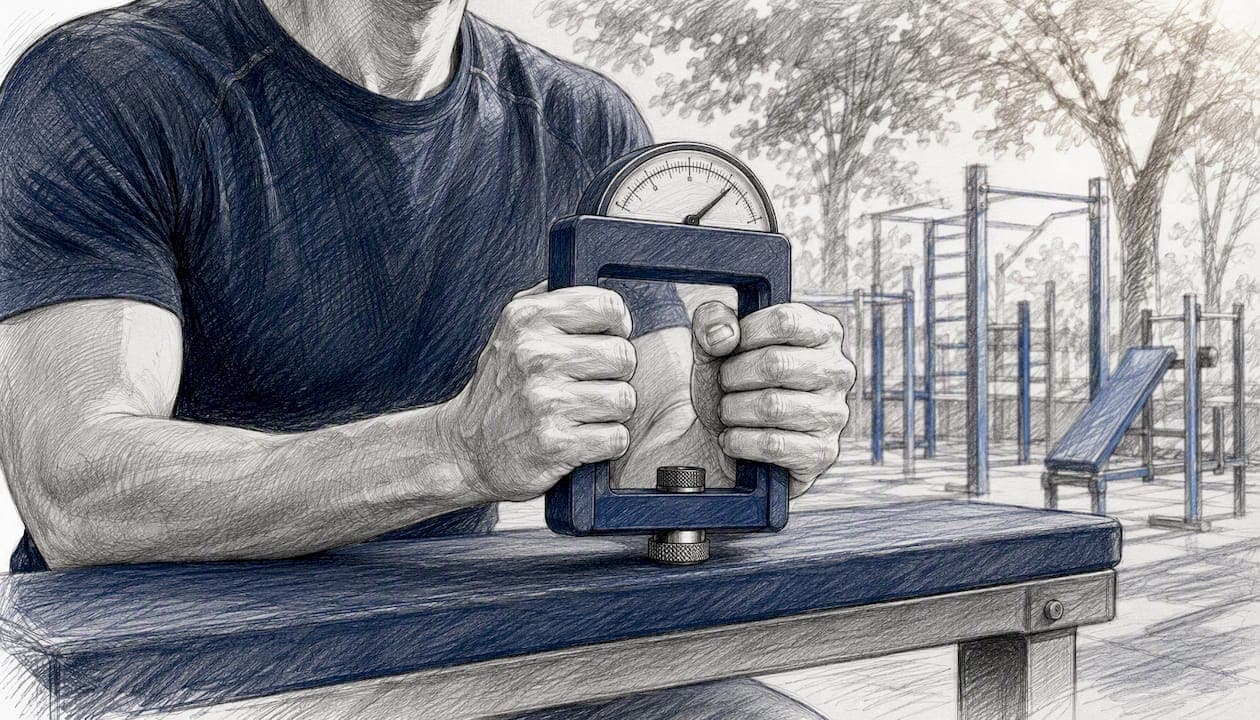
A reproducible athlete-focused grip test uses a seated, ASHT-style posture, three maximal alternating trials per hand with at least 60 seconds of rest between trials on the same hand, and the mean of those three trials recorded per hand as the primary metric. RehabMeasures confirms this three-trial mean protocol as the standard for maximal isometric hand strength assessment.
The core data fields to log per hand:
- Primary metric: Mean of three maximal trials (in kg or lbs)
- Secondary metric: Peak trial value (for motivational context and outlier detection)
- Symmetry metric: Percent difference between dominant and non-dominant hand means
- Recommended device: A calibrated dynamometer with Bluetooth connectivity; the DEXDIA GX with companion app supports this workflow directly
Key Takeaways
The most reliable grip strength data for athlete tracking comes from a three-trial mean per hand, collected under consistent posture and device conditions, with asymmetry treated as a contextual training signal rather than an automatic concern.
| Point | Details |
|---|---|
| Three-trial mean is the primary metric | Record the mean of three maximal alternating trials per hand; allow at least 60 s rest between trials on the same hand. |
| Posture drives validity | Seated, elbow at approximately 90°, wrist neutral — even small posture changes alter the neuromuscular output the device captures. |
| Devices are not interchangeable | Keep the same device, handle position, and firmware across all sessions; run a bridging study with at least 10 athletes before replacing hardware. |
| Asymmetry is a training signal | Large or growing imbalances across multiple sessions warrant targeted intervention; small stable asymmetries in unilateral athletes are often functional. |
| Dexdia GX automates the workflow | The DEXDIA GX computes mean, peak, and symmetry automatically, exports CSV for team analytics, and stores session metadata for trend analysis. |
Table of Contents
- Why posture, trial count, and device choice change what a grip number means
- How to run the protocol step by step
- How to interpret mean grip, asymmetry, and training targets
- What to look for when choosing and maintaining a dynamometer
- Running the protocol with the DEXDIA GX and companion app
- A 10-minute testing session template coaches can copy
- What experienced practitioners look for beyond the numbers
- The DEXDIA GX fits this protocol from the first trial to the final export
- Selected standards and studies that back this protocol
- Sources
Why posture, trial count, and device choice change what a grip number means
Small procedural changes shift measured grip by meaningful amounts, which makes cross-session or cross-device comparisons unreliable. Research on posture and test consistency confirms that even minor changes in elbow angle or shoulder position alter the neuromuscular output captured by the dynamometer, not just the reading itself.
Statistic callout: The three-trial mean achieves greater stability than a single peak value, and rest intervals of at least 60 seconds between trials on the same hand reduce neuromuscular fatigue confounds that would otherwise inflate or suppress subsequent readings.
Three procedural factors determine whether a grip number is interpretable:
- Posture: Seated, back supported, elbow at approximately 90°, wrist neutral, shoulder adducted, feet flat. Consistent seated positioning is a primary driver of measurement validity.
- Trial count and rest: Three maximal efforts per hand, alternating sides, with at least 60 seconds between trials on the same hand per RehabMeasures protocol guidance.
- Device consistency: Hydraulic, electronic, and pneumatic dynamometers can produce divergent absolute values. A comparative device analysis found that different designs should not be used interchangeably without bridging validation. Keep the same device, handle position, and firmware version across all sessions in a longitudinal dataset.
How to run the protocol step by step
Follow this exact sequence every test session to produce valid, comparable numbers.
Pre-test preparation
- Clean the device handle and verify the battery level and firmware version.
- Set the handle to the athlete's finger length so all four fingers contact the handle fully. Document the handle position number.
- Ask the athlete to remove watches, rings, and compression sleeves.
- Record hand dominance, age, sex, and body mass in the app session profile.
- Create a new session in the companion app and confirm the athlete profile is linked.
Positioning
- Seat the athlete with back support, feet flat on the floor.
- Position the test arm with the elbow at approximately 90°, wrist in neutral, and shoulder adducted and in neutral rotation. Do not allow the arm to rise during the squeeze.
- Demonstrate the squeeze on yourself first, then ask the athlete to perform one submaximal warm-up attempt at roughly 50% effort. This familiarizes the athlete with the device and reduces first-trial suppression.
Trials
- Begin with the dominant hand. Use a consistent verbal cue: "Squeeze as hard as you can — keep going, keep going — relax."
- Alternate hands after each trial. Complete three maximal trials per hand (six total).
- Allow at least 60 seconds of rest between trials on the same hand. The BRC/JAMAR SOP specifies this alternating cadence and rest interval as standard.
- Hold each squeeze for approximately 2–3 seconds.
Data capture
- Record all six trial values in the app. Compute the mean of the three trials per hand as the primary metric.
- Note the peak trial value per hand for motivational context and outlier review.
Pro Tip: Log time of day, session fatigue rating (1–10), and recent training load in the app notes field. These metadata points explain within-athlete variation across weeks and make trend analysis far more useful than raw numbers alone.
How to interpret mean grip, asymmetry, and training targets
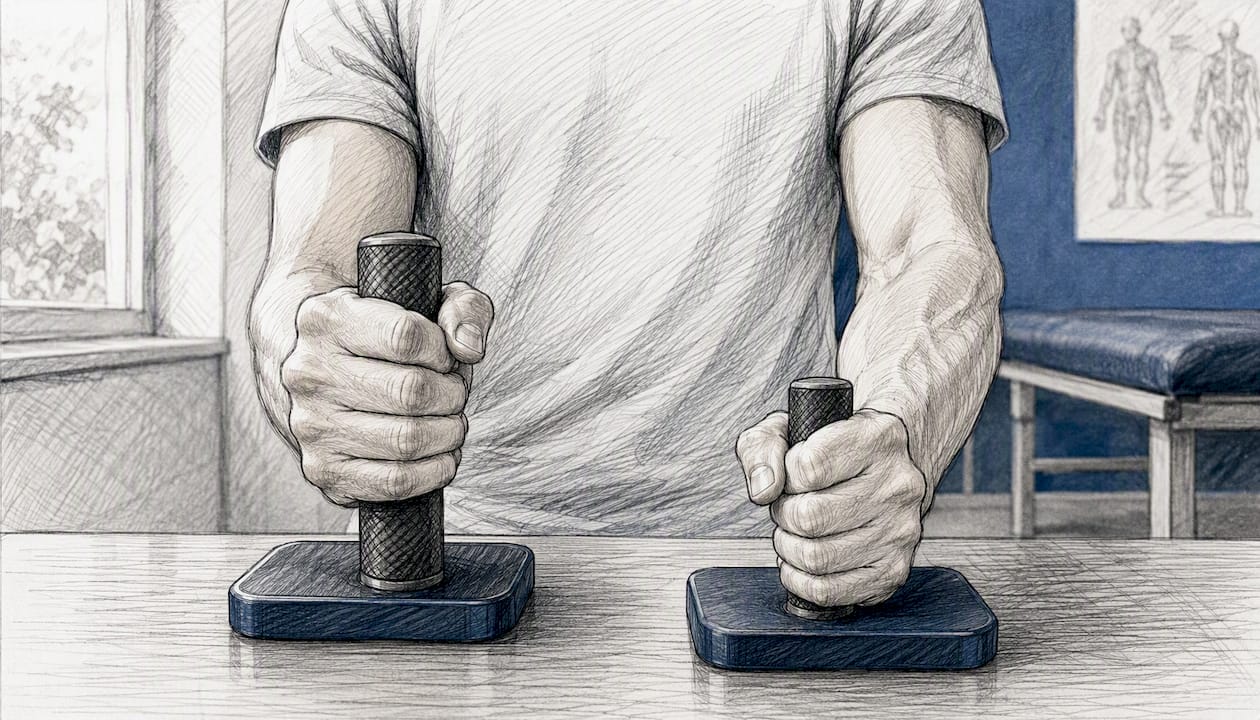
Not all asymmetry is a problem. A 2025 review published in Nature recommends managing imbalances that are large or performance-impacting while accepting functional asymmetry in unilateral athletes, where a dominant-side advantage is expected and often performance-useful.
Calculating asymmetry
Percent difference = ((dominant mean − non-dominant mean) / dominant mean) × 100. A symmetry angle approach normalizes this further, but the percent-difference formula is sufficient for most coaching decisions. Use the Dexdia grip calculator to compute this automatically from your trial data.
Interpreting the numbers
- Small, stable asymmetries (typically under 10%) in unilateral sport athletes often reflect normal functional adaptation.
- Large or growing asymmetries, especially those that appear suddenly or worsen across consecutive sessions, warrant targeted unilateral training or further assessment.
- Use repeated measures across at least two to three sessions before treating an asymmetry as a training target. Single-session differences can reflect fatigue, motivation, or positioning error rather than true strength imbalance.
- Research on isometric strength and limb asymmetry shows strong positive correlations between handgrip strength and whole-body isometric force variables, supporting grip trends as part of a broader upper-body strength monitoring approach.
- A study on grip asymmetry across arm postures in basketball players found that posture modulates measured asymmetry, with overhead positions producing lower asymmetry values than extended-arm positions. For sport-specific assessment, consider testing in the posture most relevant to the athlete's primary demands.
Pro Tip: Compare within-athlete longitudinal change on the same device, handle position, and test time rather than cross-athlete normative comparisons, unless your normative reference is matched by age, sex, and handedness. Norms are useful for context; within-athlete trends drive training decisions.
What to look for when choosing and maintaining a dynamometer
Choose a device you can keep consistent and calibrate. Device class determines absolute values and interchangeability limits.
Attributes to prioritize
- Repeatability (ICC): Look for published intraclass correlation coefficients above 0.90 for test-retest reliability.
- Resolution and range: Sensor research on handgrip devices notes that manufacturers differ in resolution (ranging from 0.1 to 1.0 kg differences) and maximum measurable values. Match the device range to your athlete population.
- Handle adjustability: Fixed-handle devices limit fit accuracy. Adjustable handles improve contact consistency across hand sizes.
- Bluetooth connectivity and software integration: Direct app sync reduces transcription error and enables automatic mean/peak calculation and metadata logging.
- Field ruggedness: Devices used in gym or field environments need durable housings and reliable battery life.
Calibration and validation steps
- Zero the device before each session.
- Check battery level and firmware version; log both per session.
- Run a test-retest check on a small sample (at least five athletes) when the device is new or after any firmware update.
- Document handle position and setting for every athlete in the dataset.
- Follow the vendor's recommended internal calibration or service schedule.
Device replacement warning: Comparative device analysis confirms that different dynamometer technologies produce divergent absolute values. If you replace a device, run a bridging study with at least 10 athletes using both devices under identical protocol conditions before merging datasets. See the digital dynamometer buying guide for a detailed spec comparison.
Running the protocol with the DEXDIA GX and companion app
The DEXDIA GX with its companion app streamlines data capture, computes mean and peak automatically, and stores session metadata for trend analysis when used with the protocol above.
Session workflow
- Power on the DEXDIA GX and pair it via Bluetooth to the app.
- Create a new session: enter the athlete profile, demographics, and handle position.
- Perform the warm-up attempt and confirm the device is reading correctly.
- Run three alternating maximal trials per hand, following the verbal cue script.
- Sync trial data to the app after the final trial.
- Verify the auto-calculated mean and peak per hand, and review the percent-difference symmetry metric in the app dashboard.
App features to use
- Timestamped session records for time-of-day trend analysis
- Auto-calculation of mean, peak, and percent-difference asymmetry
- Exportable CSV for team analytics platforms
- In-app notes field for training load, fatigue rating, and session context
- Athlete profile history for longitudinal tracking
After each session, capture a verification screenshot of the results screen. This serves as an audit record and supports coach sign-off workflows. Log the app version and device firmware version in the session notes to maintain full data traceability. For normative benchmarking, the Dexdia grip strength norms database provides age- and sex-matched reference values.
A 10-minute testing session template coaches can copy
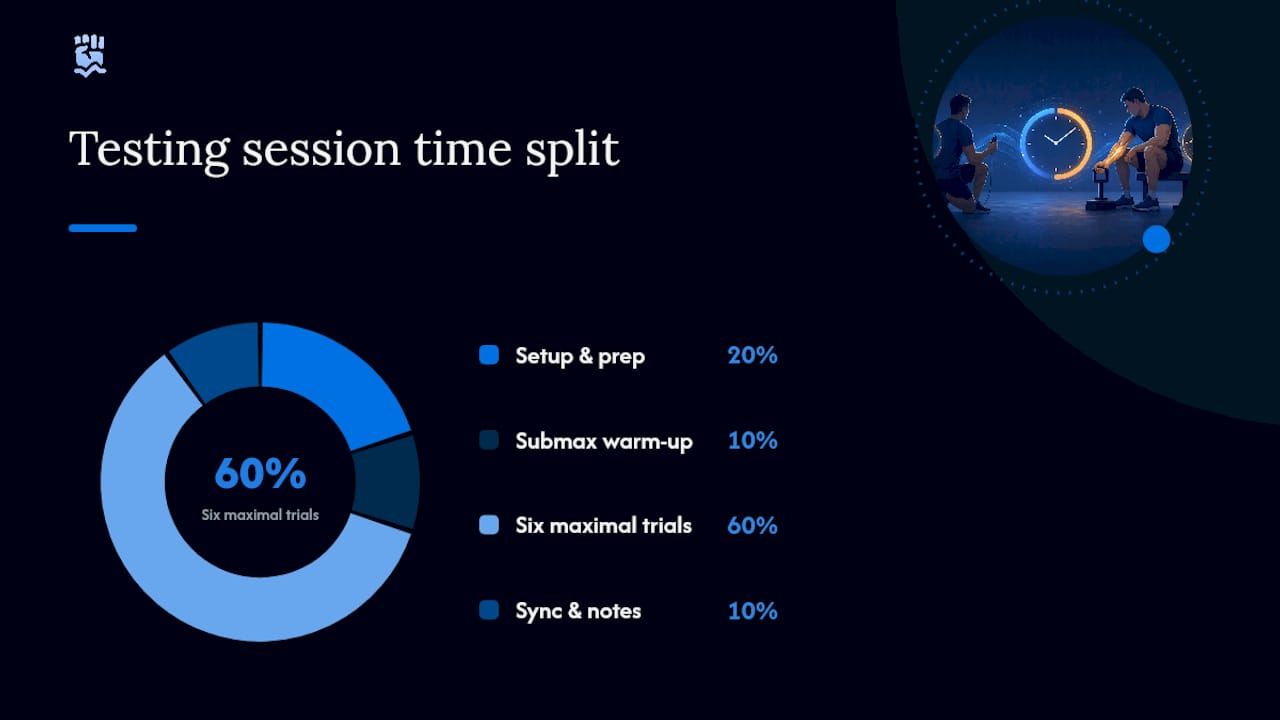
A consistent 10-minute protocol yields valid mean and symmetry metrics without disrupting practice.
- 0:00–2:00 Set up the testing station. Pair the DEXDIA GX, create the session in the app, record athlete demographics and hand dominance, confirm handle position, and ask the athlete to remove jewelry and compression gear.
- 2:00–3:00 Demonstrate the squeeze. Have the athlete perform one submaximal warm-up attempt (approximately 50% effort) with the dominant hand.
- 3:00–9:00 Run six maximal trials, alternating hands (dominant first), with at least 60 seconds of rest between trials on the same hand. Use the standardized verbal cue: "Squeeze as hard as you can — keep going, keep going — relax." Keep encouragement phrasing identical across all athletes to avoid effort variability.
- 9:00–10:00 Sync data to the app. Verify mean and peak per hand, review the symmetry metric, and add session notes (fatigue rating, training load, time of day).
For baseline comparisons, test early in the session or on low-fatigue days. When measuring a training effect, keep the time of day consistent across all sessions. Guidance on test timing within training cycles recommends scheduling grip tests before high-intensity upper-body work to avoid fatigue-suppressed readings. For broader context on how grip data connects to athletic performance metrics, the reactive strength index testing framework offers a complementary approach to multi-metric athlete profiling.
What experienced practitioners look for beyond the numbers
The numbers matter, but consistency across sessions is what makes them useful. When a practitioner reviews a grip dataset, the first question is not "Is this value high enough?" but "Is this pattern stable, and does it match what we know about this athlete's training state?"
Watch for these within-session signals that indicate the data may not be valid:
- Inconsistent wrist positioning between trials (athlete pronating or supinating mid-squeeze)
- Compensatory shoulder elevation or torso bracing during the squeeze
- Large within-session variability across the three trials on the same hand, which may indicate fatigue, poor motivation, or device setup error
- Early fatigue signs in the first trial, suggesting the warm-up was insufficient
A practical operational rule: if the coefficient of variation across the three trials on one hand exceeds what you typically see in your athlete group, pause the session, re-confirm device setup and athlete readiness, and re-run after an extended rest. A sudden unilateral drop across sessions is a training or fatigue signal worth tracking, not an immediate cause for concern. Treat it as data, not a diagnosis.
The DEXDIA GX fits this protocol from the first trial to the final export
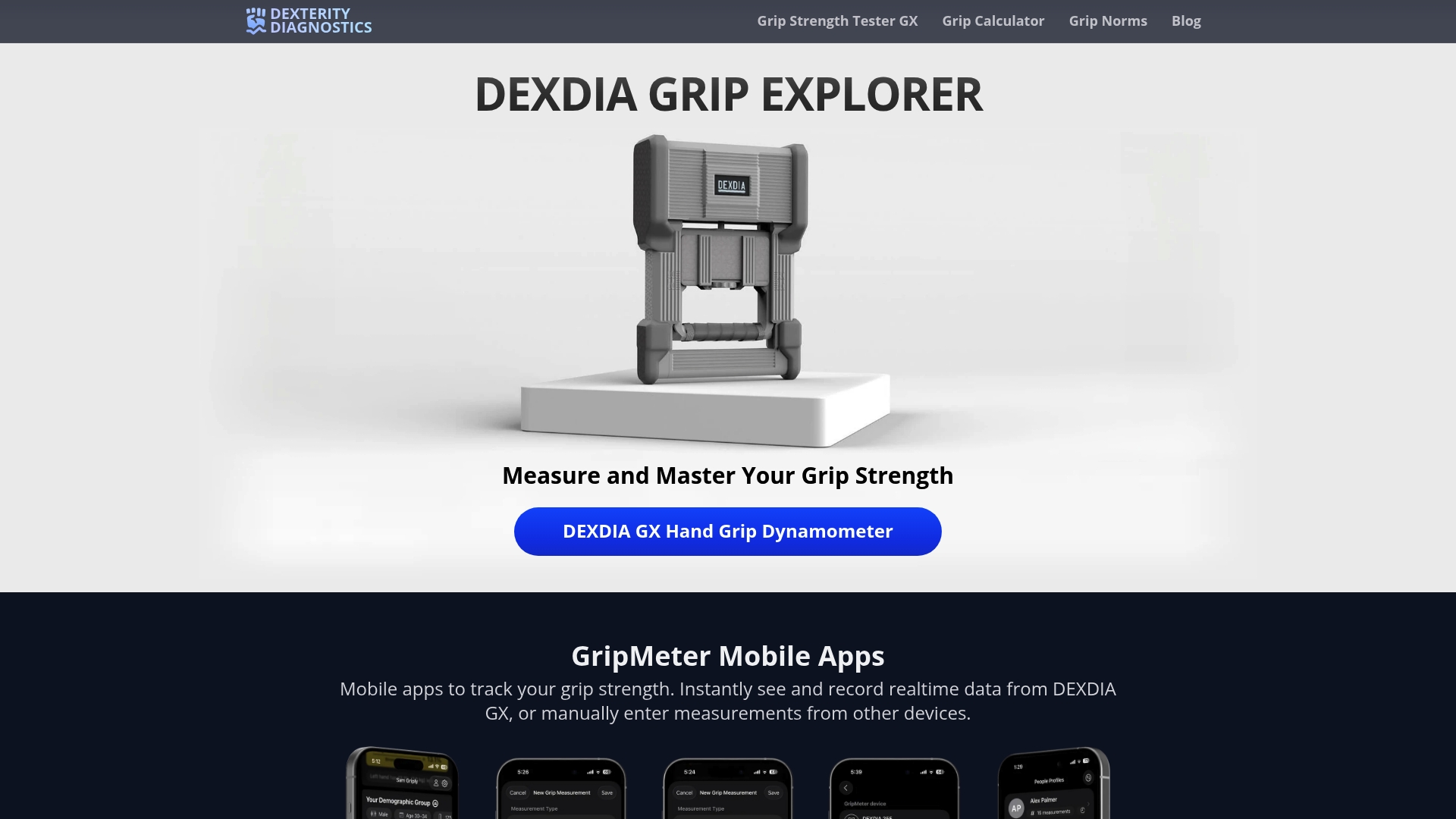
The DEXDIA GX is built to run the protocol above: Bluetooth syncing, automatic mean and peak calculation, symmetry analytics, and CSV export for team analysis. The adjustable handle fits a wide range of hand sizes, the rugged build holds up in field and gym environments, and the companion app stores athlete profiles, session timestamps, and metadata notes so your longitudinal dataset stays clean and traceable.
For teams ready to move from manual recording to structured digital tracking, the DEXDIA GX removes the transcription step entirely. Mean, peak, and percent-difference asymmetry are computed automatically after each session. Use the grip strength norms database to set re-test thresholds and benchmarks for your athlete group, and the grip calculator to analyze symmetry and compare values to age- and sex-matched norms. View full device specifications and order the DEXDIA GX dynamometer to run your first protocol-compliant session.
Selected standards and studies that back this protocol
These sources underpin the protocol described above. Coaches writing internal SOPs or validation reports can use them to cite procedural standards and reliability evidence directly.
- Hand-held Dynamometer / Grip Strength — RehabMeasures Database: three-trial mean, alternating sides, 60 s rest standard
- Procedure for Measuring Grip Strength Using the JAMAR Dynamometer — BRC/NIHR SOP: operational checklist for handle adjustment, posture, demonstration, and trial cadence
- Accuracy and Reliability of Grip Strength Measurements: A Comparative Device Analysis — MDPI: device interchangeability limits and reliability evidence
- Upper Limb Strength and Asymmetry — Nature (2025 review): contextual asymmetry management in athletes
- Posture and Test Consistency for Grip Strength — MDPI: seated elbow-90° positioning and measurement validity
- Grip Asymmetry Across Arm Postures in Basketball Players — PMC: sport-specific posture effects on measured asymmetry
Sources
- Hand-held Dynamometer / Grip Strength | RehabMeasures Database
- Procedure for measuring gripstrength using the JAMAR dynamometer
- Accuracy and Reliability of Grip Strength Measurements: A Comparative Device Analysis
- Nature article (2025 review) on upper limb strength and asymmetry
- MDPI article emphasizing posture and test consistency for grip strength
- PMC study measuring grip asymmetry across arm postures in basketball players