
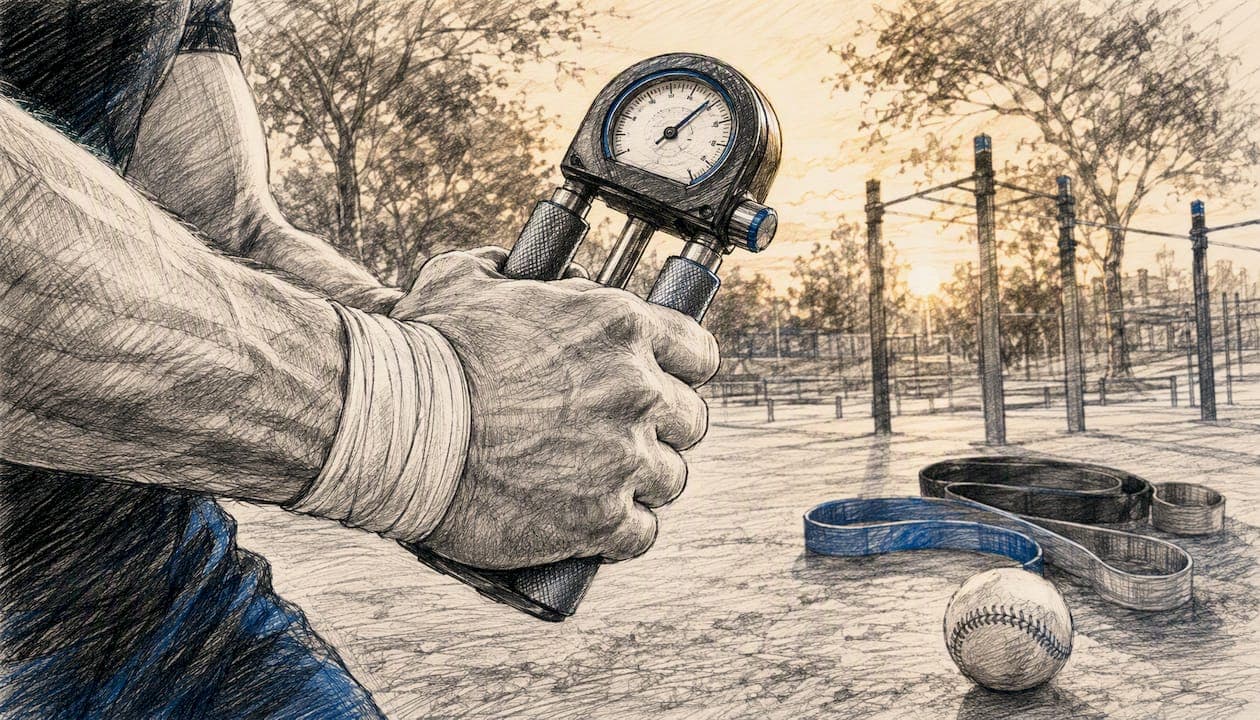
Grip strength matters for baseball performance and injury durability, but only when trained and measured with sport-specific intent. The research is genuinely mixed on whether raw grip numbers directly predict bat speed or pitching velocity, yet coaches and clinicians consistently find that targeted grip training improves contact stability, late-swing adjustments, and pitch command. The practical takeaway: measure first, compare your numbers to normative benchmarks, then add one or two transfer-focused drills this week.
Start here:
-
Measure now. Test both your dominant and nondominant hand with a calibrated dynamometer. Record peak force for each.
-
Compare to norms. Use a grip strength calculator to see where you stand relative to athletes your age and level.
-
Add 1–2 drills this week. Prioritize farmer's carries or a wrist roller at the end of your next strength session, not before throwing.
A sport-grade dynamometer like the DEXDIA GX gives you the baseline you need to make these decisions with data rather than guesswork.
Key Takeaways
Grip strength contributes to baseball performance and durability when trained with sport-specific intent, measured consistently, and integrated into kinetic-chain movements rather than isolated hand drills.
| Point | Details |
|---|---|
| Research is mixed but grip still matters | Studies show no direct link to bat velocity or injury prevention, yet coaches consistently find grip supports contact stability and pitch command. |
| Measure both hands with a protocol | Use a calibrated dynamometer, record peak force for each hand, and flag any symmetry gap greater than 10% for further attention. |
| Train all five grip qualities | Crushing, pinching, supporting, RFD, and extension each serve a distinct role; neglecting extension is the most common cause of forearm imbalance. |
| Place grip work at session end | High-intensity grip training before throwing or hitting reduces bat speed and pitch control; always program it after primary lifts. |
| Dexdia GX tracks progress and symmetry | The DEXDIA GX records peak force, symmetry ratios, and session history in a mobile app, giving players and coaches the data to make programming decisions. |
Table of Contents
- Does grip strength actually matter for baseball performance?
- How do you test grip strength for baseball?
- Which grip qualities should baseball players train?
- Practical exercises for baseball grip strength
- How to program grip work across a baseball season
- Tendon health and preventing forearm overuse in baseball
- Using the DEXDIA GX to track grip progress and symmetry
- How bat type and gloves affect grip demands
- A coach's perspective on integrating grip work with athlete development
- The DEXDIA GX gives players and coaches a measurement foundation
- Sources
Does grip strength actually matter for baseball performance?
The honest answer is: it depends on what you are asking it to do. Grip strength is a real contributor to baseball performance, but its role is more conditional than many training articles suggest.
On the coaching side, the consensus is clear. Stronger hands help stabilize the bat through contact, support late pitch recognition and adjustment, and contribute to the final link in the kinetic chain during a throw or pitch. Pitchers with better pinch strength and rate of force development (RFD) at the release point tend to generate more consistent spin and command. For hitters, grip endurance matters more than peak force: a fatigued grip collapses at contact, costing barrel control.
The peer-reviewed picture is more nuanced. A small collegiate study of 23 Division II players found no significant relationship between grip strength and instantaneous bat velocity, and forearm-specific training did not produce greater bat velocity gains than a control group over six weeks. A 2022 study of 213 professional pitchers found no significant difference in grip strength between pitchers who sustained shoulder or elbow injuries and those who did not (P > .05), with a mean grip strength across all pitchers of 144.0 ± 20.8 lb.
Neither finding means grip training is irrelevant. Both studies have real limitations: small samples, short durations, and outcome measures (instantaneous bat velocity, injury occurrence) that may not capture the subtler contributions grip makes to consistency and durability. As Eric Cressey notes, isolated hand exercises often produce hand fatigue without meaningful on-field transfer. The exercises that work best connect the hand to the rest of the kinetic chain through deadlifts, carries, and loaded swings.
Grip strength also functions as a broader indicator of overall physical health and neuromuscular readiness, which matters for a 162-game season.
When grip matters most: contact stability, late-swing adjustments, pitch spin and command, and fatigue resistance over a long season. When it matters least: as a standalone predictor of velocity or injury risk in isolation from the full kinetic chain.
How do you test grip strength for baseball?
Consistent, reproducible testing is what separates useful data from noise. The following protocol is adapted from standard dynamometer testing practices and is appropriate for both players and coaches.
Standardized test protocol
- Select the correct handle position. Set the dynamometer to the grip size that allows the middle finger to form roughly a 90-degree angle. Dexdia's grip sizing guide covers this in detail.
- Position the athlete. Seated, elbow at 90 degrees, forearm neutral, wrist in slight extension. Avoid bracing the arm against the body or thigh.
- Calibrate the device. Confirm zero before each session.
- Perform three maximal trials per hand. Rest 60 seconds between trials. Alternate hands if testing both in the same session.
- Record peak force. Use the highest value from three trials, not the average.
- Test the nondominant hand second. This reduces fatigue carryover to the dominant-hand score.
- Note test conditions. Record whether the athlete threw or hit within the previous 24 hours, as recent high-intensity activity depresses scores. Dexdia's guidance on when to measure grip strength explains the timing considerations.
Normative ranges by age and level
The table below provides approximate reference ranges for male baseball players. These are benchmarks for comparison, not clinical thresholds.
Ranges are approximate and drawn from published normative data and sport-specific research, including the professional pitcher mean of 144.0 ± 20.8 lb reported in the 2022 study above.
Some asymmetry is expected in throwing athletes, but large gaps can signal underuse, prior injury, or a training imbalance worth addressing. A 2025 study of high-school baseball players documented grip strength, pinch strength, and RFD measures at the release point, reinforcing that multiple grip qualities, not just peak force, are worth tracking in younger athletes.
Quick troubleshooting: If scores are unexpectedly low, check whether the athlete threw a bullpen or took batting practice within the last 24 hours, whether the grip size is set correctly, and whether the device was zeroed before testing.
Which grip qualities should baseball players train?
Grip is not a single quality. NSCA guidance identifies several distinct holds, each with a different sport-specific role.
Crushing is the ability to close the hand forcefully against resistance. For hitters, it supports bat stability through the contact zone. For pitchers, it contributes to the final squeeze at release. Most players train this quality almost exclusively, which creates the imbalances discussed below.
Pinching involves the thumb opposing one or more fingers. Pitchers rely on pinch strength more than hitters do: grip pressure between the thumb and index/middle fingers directly influences spin rate and pitch command. The 2025 high-school study cited above measured pinch strength specifically at the release point, underscoring its relevance for developing pitchers.
Supporting and holding refers to sustained grip endurance under load, the quality that keeps a hitter's hands from collapsing during a long at-bat or a pitcher's grip from degrading in the sixth inning. Farmer's carries and heavy dead hangs train this quality directly.
Rate of force development (RFD) is how quickly the hand can reach peak force. At the release point of a pitch, the window for applying maximal grip pressure is extremely short. Paradigm Sport's baseball-specific guidance highlights RFD as particularly relevant for pitchers working on spin and command, and for hitters making last-millisecond adjustments to off-speed pitches.
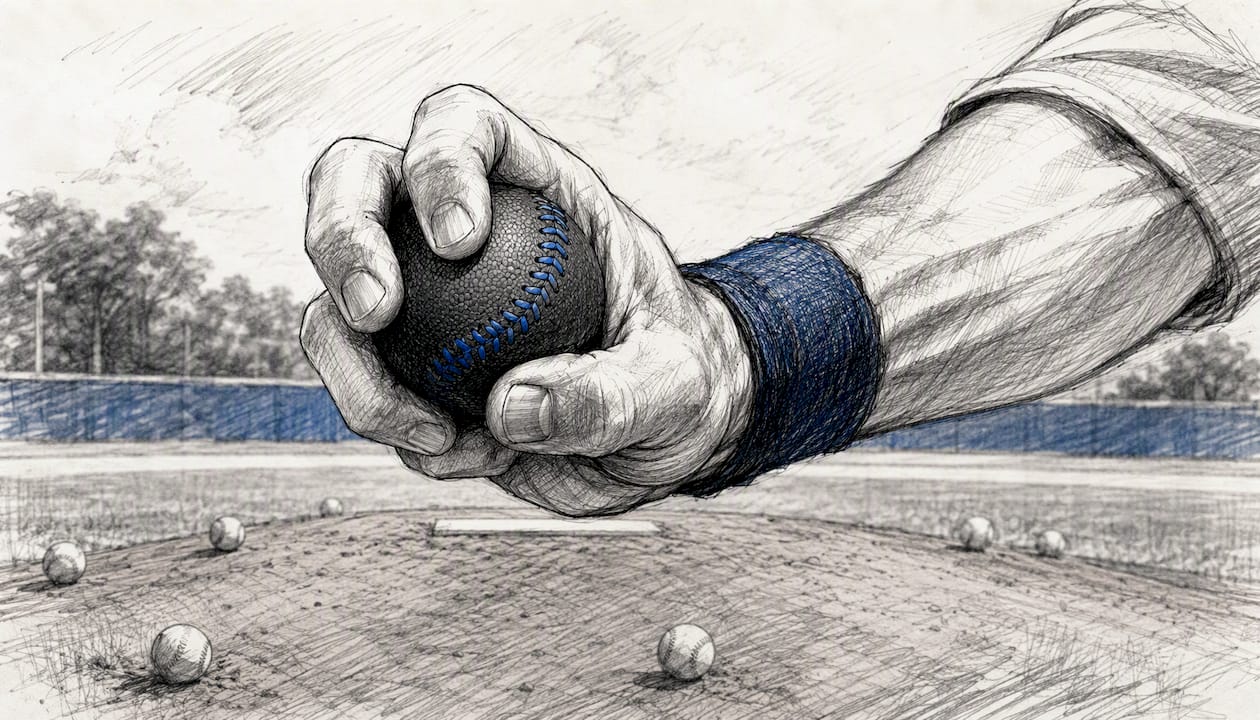
Extension is the most commonly neglected quality. The extensor muscles on the back of the forearm oppose the flexors that dominate crushing and pinching. Undertrained extensors contribute to flexor-pronator overload, a common mechanism in elbow injuries among pitchers. Extension work does not build power; it builds the structural balance that lets you keep training.
Practical exercises for baseball grip strength
The exercises below are grouped by grip quality. Sets, reps, and progressions follow Impact Baseball's framework and NSCA programming principles.
Rolling (wrist rollers)
Roll the weight up and down with controlled tempo, both palms-down and palms-up. Start with 2 sets of 3 full rolls in each direction. Progress by adding small weight increments (0.5–1 lb) every 1–2 weeks. This trains wrist flexion, extension, and forearm endurance simultaneously, making it one of the most time-efficient implements for baseball players.
Crushing (Captains of Crush grippers)
Captains of Crush grippers come in calibrated resistance levels, which makes them useful for tracking progress. Start with a level you can close for 3 sets of 8–10 full reps with a 2-second hold at the closed position. Progress to the next resistance level when you can complete 3 sets of 12 clean reps. Avoid training to failure before throwing days.
Pinching (pinch blocks and plate pinches)
Pinch a 10 lb or 25 lb bumper plate between the thumb and fingers for timed holds of 20–30 seconds. A pinch block with a loading pin offers more precise progression. Perform 3 sets per hand. Progress by adding 2.5 lb or extending hold time by 5 seconds. This is the exercise most directly relevant to pitching grip at release.
Supporting and holding (farmer's carries)
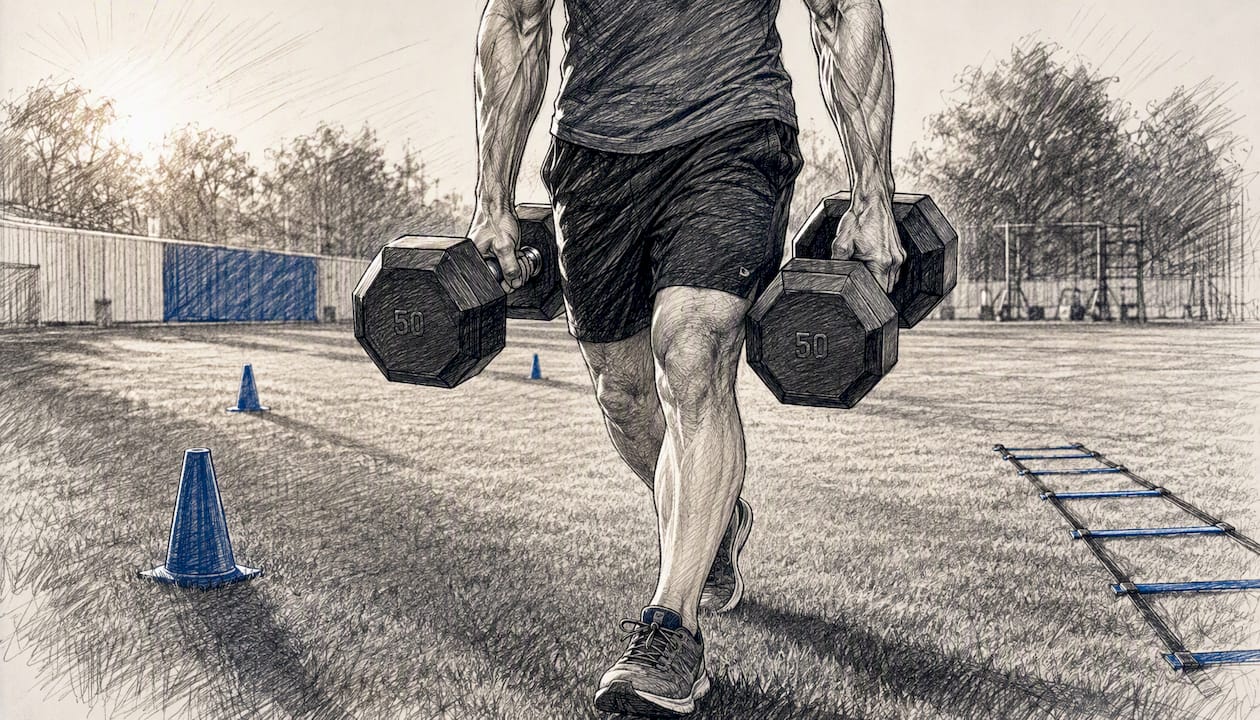
Load farmer's carry implements or heavy dumbbells at a weight that challenges grip within 30–40 meters. Walk with a tall posture and no swinging. Perform 3–4 carries per session. Single-arm carries add a core stability demand that mirrors the rotational demands of throwing. Reactive strength and RFD training resources offer useful context on how loaded carries fit into broader athletic development.
Extension (band extensions and extensor buckets)
Place a rubber band around all five fingers and open the hand against resistance for 3 sets of 15–20 reps. Extensor buckets (a bucket of rice used for finger extension against resistance) are a low-cost alternative. This work takes under five minutes and should be included in every session that includes crushing or pinching.
Pro Tip: Never perform high-intensity grip work immediately before throwing or hitting. Grip fatigue reduces bat speed and pitch control. Place all grip training at the end of strength sessions or on dedicated non-throwing days.
How to program grip work across a baseball season
Placement within a session is straightforward: grip work goes after primary strength lifts, never before. This protects the main lifts from grip-limited performance and prevents pre-session fatigue from carrying into throwing or hitting. NSCA guidance frames grip as the final link in the kinetic chain, which means it should also be the final training priority in a session.
Frequency recommendations:
- Off-season development: 3–4 sessions per week, submaximal loads, emphasizing variety across crushing, pinching, and extension.
- In-season maintenance: 1–2 sessions per week, lower volume, timed to avoid the 24 hours before a start or a high-intensity throwing day.
Progression rules: Increase load or time-under-tension every 2–3 weeks during the off-season. Introduce RFD-focused work (explosive gripper closes, rapid plate pinches) after 4–6 weeks of base-building.
For building grip strength and endurance simultaneously, concurrent programming strategies can help players balance maximal force development with the sustained-hold endurance a full game demands.
Sample weekly micro-program
Developing player (off-season, 3 days/week):
- Monday: Wrist roller (3 × 3 rolls), Captains of Crush (3 × 10), band extensions (3 × 20)
- Wednesday: Farmer's carry (4 × 30 m), pinch block holds (3 × 25 sec), band extensions (3 × 20)
- Friday: Wrist roller (3 × 3 rolls), plate pinch (3 × 20 sec), Captains of Crush (3 × 8)
In-season pitcher (1–2 days/week, non-throwing days only):
- Day A: Farmer's carry (3 × 30 m), band extensions (3 × 20), pinch block holds (2 × 20 sec)
- Day B: Wrist roller (2 × 3 rolls), band extensions (3 × 20)
Tendon health and preventing forearm overuse in baseball
The most common grip-related injury mechanism in baseball is flexor-pronator overload: the muscles that flex the fingers and pronate the forearm are repeatedly stressed through throwing and hitting, and when extensors are undertrained, the imbalance accelerates tendon irritation at the medial elbow.
Red-flag symptoms to watch for:
- Medial elbow pain or tenderness that persists more than 48 hours after throwing
- Forearm tightness or cramping during or after grip training
- Grip strength asymmetry that increases over a season rather than staying stable
- Pain with resisted wrist flexion or pronation
Recovery and load management:
- Reduce grip training volume by 50% at the first sign of persistent forearm tightness.
- Prioritize extension work and eccentric wrist flexion exercises during any irritation period. Eccentric loading (slowly lowering a dumbbell through wrist flexion) is a well-established approach for tendinopathy management.
- Avoid high-intensity gripper or wrist roller work until pain-free range of motion is fully restored.
- If symptoms persist beyond two weeks of modified activity, refer to a sports medicine physician or physical therapist.
The 2022 professional pitcher study found no significant grip strength difference between injured and uninjured pitchers, which reinforces that grip strength alone does not predict injury. Balanced training, load management, and symptom monitoring matter more than raw numbers.
Pro Tip: Add 5 minutes of extensor band work to every grip session. It takes almost no time and directly addresses the flexor-extensor imbalance that underlies most forearm overuse injuries in throwing athletes.
Using the DEXDIA GX to track grip progress and symmetry
Measurement without a consistent protocol produces data you cannot act on. The DEXDIA GX records peak force, dominant and nondominant values, and symmetry ratios in a single session, then syncs to a mobile app for longitudinal tracking. That combination makes it practical for both individual players and coaches managing a roster.
What to record at each testing session:
- Peak force, dominant hand (lb or kg)
- Peak force, nondominant hand
- Symmetry ratio (nondominant ÷ dominant × 100)
- Test conditions: days since last throwing session, time of day, any reported fatigue
How to interpret changes over time:
If dominant-hand peak force increases by 5–10 lb over 6–8 weeks of consistent training, the programming is working. If scores plateau despite consistent training, check whether grip work is being placed before throwing sessions (a common scheduling error) or whether the athlete is approaching in-season maintenance rather than development.
The DEXDIA GX is designed specifically for this kind of repeated-measures tracking. Its Bluetooth connection to the companion app means data is stored, timestamped, and exportable, which supports the measurement-first approach this article describes. Use the grip strength calculator to compare individual scores to the normative ranges in the table above.
How bat type and gloves affect grip demands
Equipment choices shape how much grip strength a player actually needs to express on the field, and they interact with training in ways worth understanding.
Bat weight and handle diameter are the primary variables. A heavier bat demands more grip endurance to control through the contact zone, particularly on inside pitches where the hands lead. A thicker handle distributes force across more of the palm, reducing the per-finger demand but also reducing tactile feedback. Most hitters gravitate toward handle diameters that feel comfortable, but players with lower grip strength sometimes unconsciously select thicker handles as compensation. If grip training is progressing, periodically reassess handle preference.
Pine tar and grip tape reduce the friction demand on the hand. A well-taped handle lets a hitter maintain bat control with less active grip pressure, which can reduce fatigue over a long game. This is not a substitute for grip strength development, but it is a legitimate load-management tool during a heavy schedule.
Batting gloves add padding and reduce vibration on contact, which lowers the acute stress on the flexor tendons. Players with a history of hand or forearm irritation often find that gloves extend their comfortable at-bat volume. The tradeoff is a slight reduction in tactile feedback, which some hitters prefer to avoid.
Pitcher grip and ball texture present a different set of demands. Pitchers rely on fingertip pressure and thumb opposition rather than full-hand crushing. A worn or slick ball increases the grip demand at release, which is why pitchers working on breaking balls in humid conditions often report earlier forearm fatigue. Pinch strength training addresses this directly.
A coach's perspective on integrating grip work with athlete development
The most common mistake in baseball grip training is treating it as a standalone category, something done at the end of a session with a gripper and forgotten. The athletes who see the clearest on-field transfer are the ones whose grip work is embedded in movements that already demand whole-body coordination.
A farmer's carry into a rotational medicine ball throw, for example, loads the grip under fatigue and then immediately demands that the athlete express rotational power. A single-arm hang before a throwing session activates the shoulder stabilizers and the grip simultaneously, which mirrors the demands of the early arm-path phase. These combinations are not complicated, but they require intentional programming rather than ad hoc gripper sets.
The measurement side is equally underused. Coaches who track grip strength symmetry over a season have an objective early-warning signal that is independent of subjective arm-fatigue reports. Bat speed and spin rate are the downstream outcomes; grip symmetry is one of the upstream inputs you can actually control.
The DEXDIA GX gives players and coaches a measurement foundation
Most grip training programs fail not because the exercises are wrong, but because there is no baseline to train against and no way to confirm progress. The DEXDIA GX addresses that gap directly.
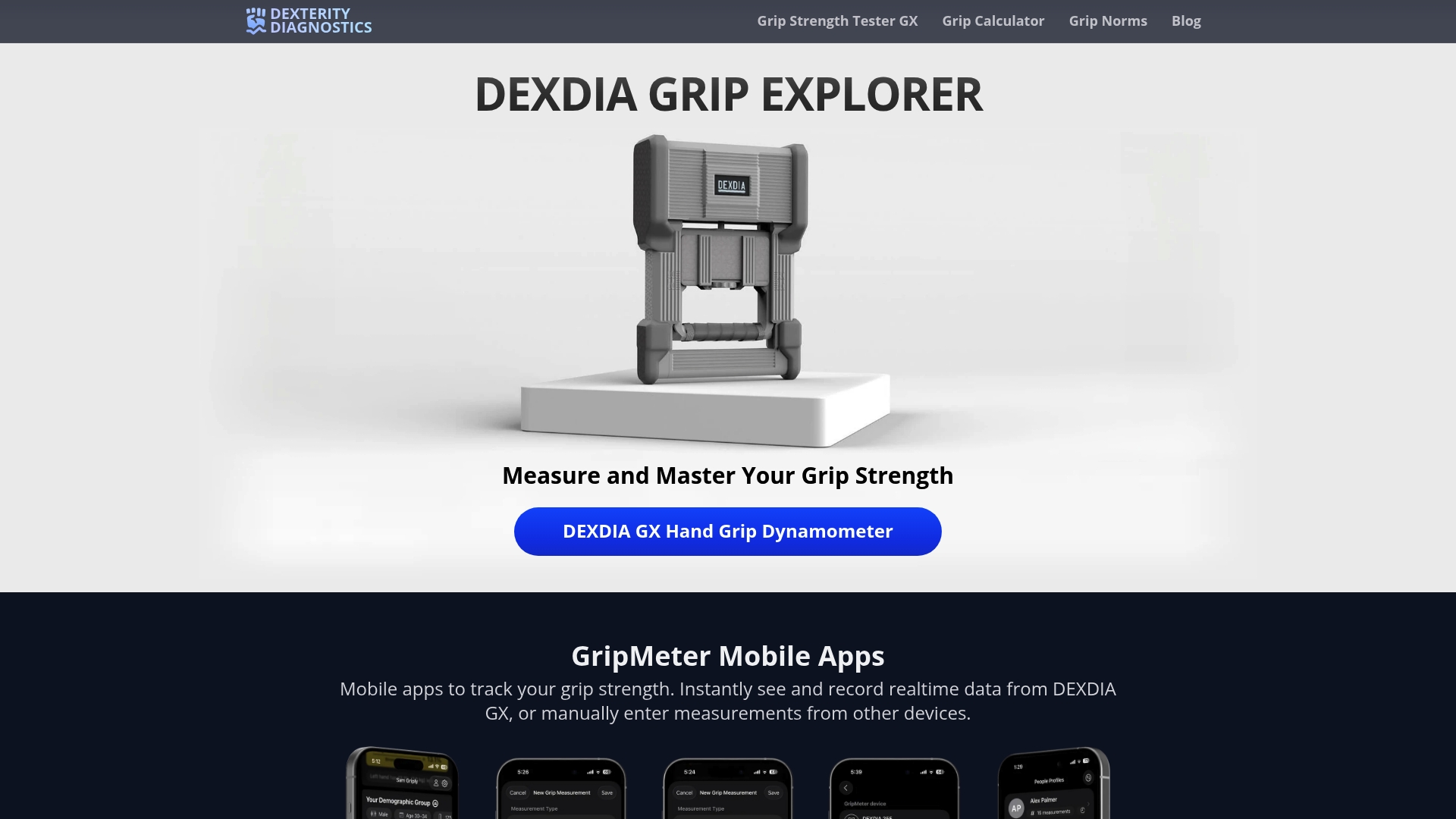
The device delivers accurate peak force readings for both hands, generates symmetry reports in the companion app, and stores timestamped session data so coaches can track changes across a full season. It fits the exact protocol described in this article: test both hands, compare to normative ranges, identify asymmetries, and adjust programming accordingly. For teams, the app supports multi-athlete tracking without requiring separate software subscriptions.
For players and coaches ready to move from guessing to measuring, the DEXDIA GX is available at Dexdia. Testing takes under five minutes and gives you data you can act on immediately.
Sources
The sources below are cited throughout this article. Each one addresses a specific follow-up question.
- Association of Grip Strength With Upper-Extremity Injury in Professional Baseball Pitchers
- Effect of grip strength and grip strengthening exercises on instantaneous bat velocity of collegiate baseball players
- GRIP STRENGTH DEVELOPMENT (NSCA coach resource)
- Get a Grip: Baseball Edition - Paradigm
- Ericcressey
- How to Build Grip Strength for Baseball – Impact Baseball