
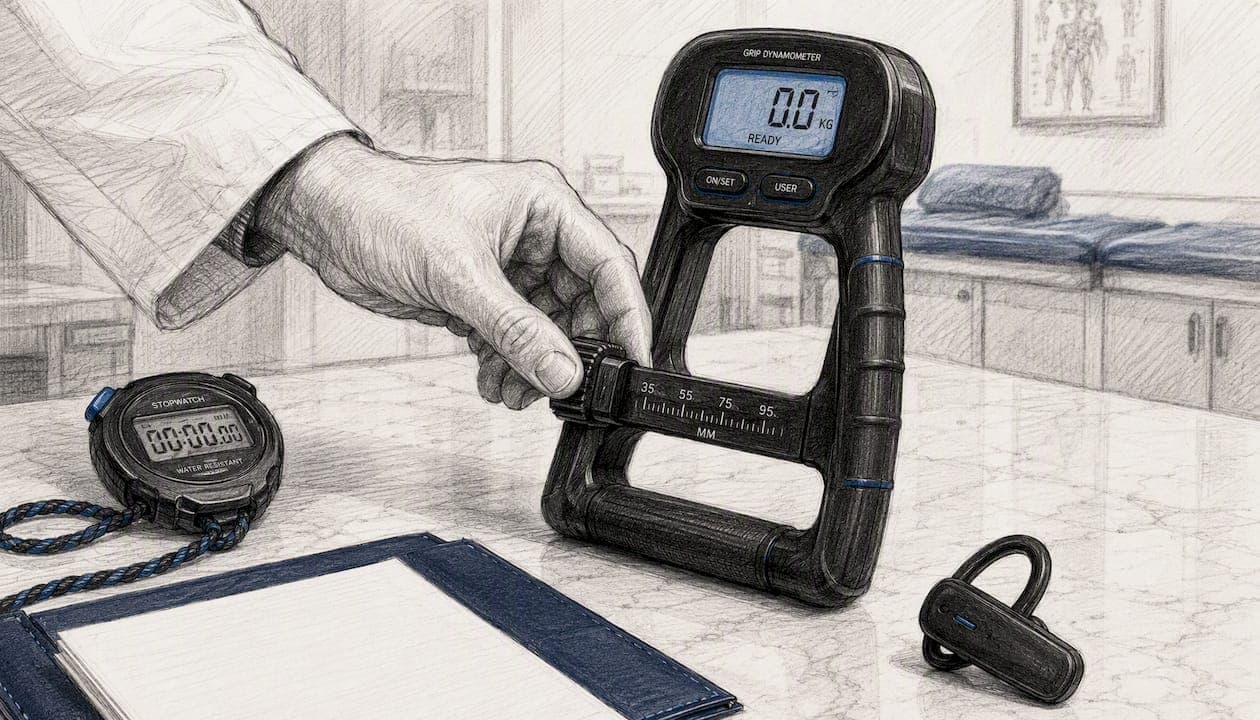
In this context, the "police grip strength test" refers to a standardized handgrip assessment performed with a Bluetooth-enabled dynamometer, specifically the DEXDIA GX, paired with the Dexdia app for per-hand recording, symmetry analysis, and longitudinal tracking. This is not a law enforcement selection test. It is a reproducible performance and rehabilitation measurement protocol built around a device-plus-app workflow.
The core recommendation: use a seated, standardized position, three maximal trials per hand, and Bluetooth capture to produce auditable, timestamped records. A grip strength asymmetry of roughly 10% between hands is a commonly cited clinical reference point, though research confirms this threshold varies by joint and task.
- Device: DEXDIA GX Bluetooth dynamometer
- Software: Dexdia app (iOS/Android) for per-hand profiles, symmetry reports, and CSV export
- Key metric: Percent asymmetry between dominant and non-dominant hand, benchmarked against age- and height-adjusted norms
Key Takeaways
A Bluetooth dynamometer paired with a structured app workflow is the most reliable field method for repeatable, auditable grip strength assessment and asymmetry tracking.
| Point | Details |
|---|---|
| Standardized protocol matters most | Seated position, 3 trials per hand, 60-second rest, and consistent verbal instruction reduce measurement noise. |
| 10% asymmetry is a reference, not a rule | A meta-analysis of over 18,000 participants supports ~10% as a general estimate; interpret against sport history and task context. |
| Bluetooth capture reduces error | A correlation of r = 0.951 between Bluetooth and original device versions supports wireless capture for field use. |
| Export data every session | CSV and PDF export from the Dexdia app creates auditable records for clinical documentation and trend analysis. |
| Dexdia GX covers the full workflow | The DEXDIA GX and Dexdia app handle pairing, per-hand labeling, LSI calculation, normative comparison, and export in one system. |
Table of Contents
- What equipment do you need for the police grip strength test?
- Step-by-step protocol for a reproducible grip strength test
- How do you interpret grip strength results and asymmetry?
- How do you make grip strength measures repeatable?
- How does the Dexdia app record, analyze, and export grip data?
- How do you maintain the DEXDIA GX and fix common issues?
- What does the research say about grip strength as a performance metric?
- The case for Bluetooth dynamometry in performance and rehab tracking
- The DEXDIA GX is built for exactly this protocol
- Sources
What equipment do you need for the police grip strength test?
A reliable grip strength assessment requires three categories of equipment: the measurement device, the recording platform, and the testing environment.
Hardware
- DEXDIA GX Bluetooth dynamometer (fully charged before each session)
- Smartphone or tablet (iOS 13+ or Android 8+) with Bluetooth 4.0 or higher
- Spare batteries or charging cable, depending on device model
Software
- Dexdia app installed and updated to the current version
- Optional: Dexdia Grip Strength Calculator for real-time normative comparison
- Optional: Printable grip strength norms (PDF) for paper-based backup
Accessories and environment
- Armless chair with back support (elbow at approximately 90°)
- Stopwatch or timer for rest intervals
- Clean towel to dry hands before testing
- Quiet room, consistent temperature, no distracting stimuli
The Dexdia app stores session data locally on the device by default. Optional cloud sync is available; clinics should confirm their data-handling practices align with applicable privacy standards before enabling cloud storage.
Pro Tip: Confirm the correct grip size setting before the first trial. An ill-fitting grip span is one of the most common sources of between-session variability and takes under 30 seconds to adjust.
A pilot study published in Gazzetta Medica Italiana reported a correlation of r = 0.951 between a Bluetooth-integrated dynamometer and the original device version, supporting the reliability of wireless capture for field testing.
Step-by-step protocol for a reproducible grip strength test
The standard protocol uses a seated position, three maximal trials per hand, 60-second rest intervals, and Bluetooth capture to the Dexdia app. Follow these steps in order.
- Pair the device. Open the Dexdia app, navigate to Devices, and select the DEXDIA GX from the Bluetooth scan list. Confirm the connection indicator is active before proceeding.
- Create or select a subject profile. Enter name, dominant hand, date of birth, sex, and body weight. These fields enable normative comparison and per-hand labeling in the report.
- Set units. Choose kilograms or pounds in the app settings and confirm the dynamometer display matches. Do not switch units mid-session.
- Position the subject. Seat the subject upright, feet flat on the floor, shoulder adducted, elbow flexed to approximately 90°, forearm in a neutral position. The wrist should be in slight extension (0–30°). No bracing against the thigh or chair arm.
- Warm up. Two to three submaximal squeezes at roughly 50% effort, 30 seconds apart, before the first recorded trial.
- Run three maximal trials per hand. Instruct the subject to squeeze as hard as possible for 3 seconds. Record the peak value for each trial. Rest 60 seconds between trials on the same hand.
- Alternate hands or complete one hand first. Either approach is acceptable; document which order was used and keep it consistent across sessions.
- Record dominant hand first unless a clinical reason dictates otherwise. Label each trial correctly in the app before saving.
- Save and export. After all six trials (three per hand), confirm the session is saved in the app. Export to CSV or PDF if a paper or EMR record is required.
- Schedule retests. For longitudinal tracking, retest at consistent intervals (typically every 4–8 weeks) at the same time of day to minimize diurnal variation.
Pro Tip: Standardizing the verbal instruction ("squeeze as hard as you can, now") reduces trial-to-trial variability more than most practitioners expect. Use identical wording every session.
Poor standardization of protocols and asymmetry indices is a documented source of reduced between-session reliability, as noted in a systematic review of inter-limb asymmetry reporting. Consistent positioning, instruction, and trial count are the primary controls available in field settings.
How do you interpret grip strength results and asymmetry?
Interpretation requires two parallel analyses: placing the absolute value in a normative context, and computing the percent asymmetry between hands.
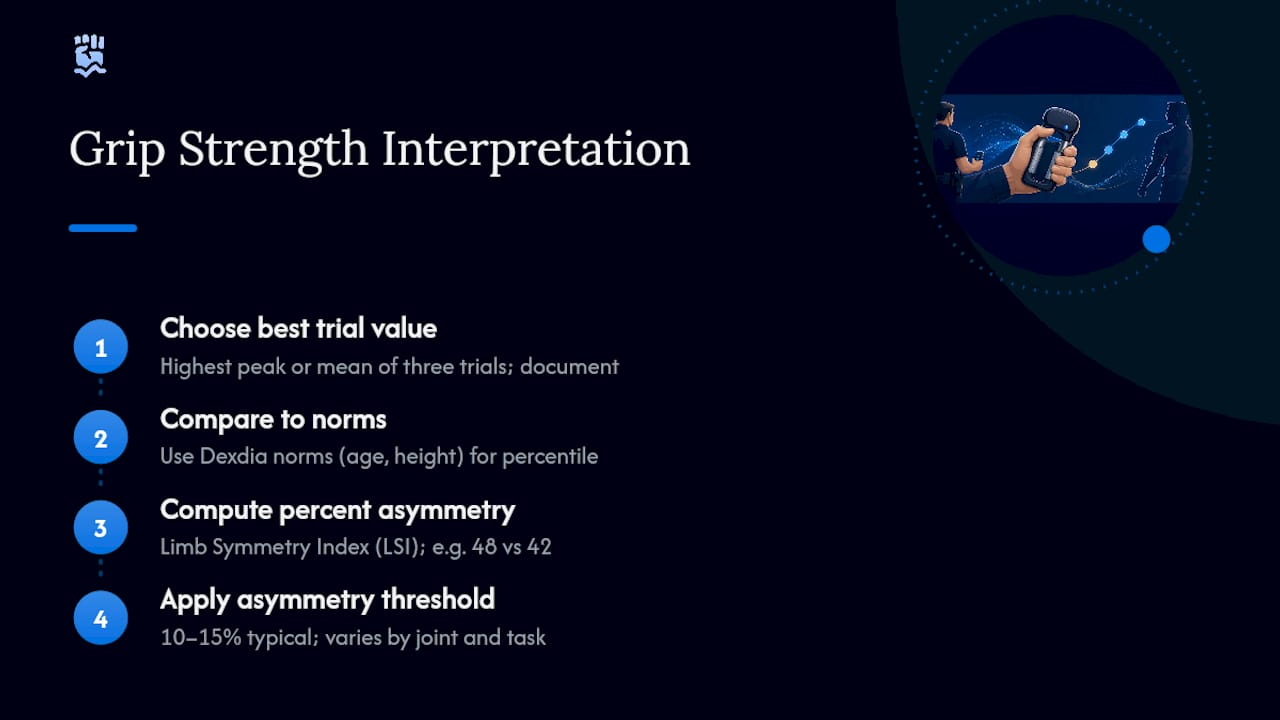
Step 1: Identify the best trial value per hand. Use the single highest peak from the three trials for each hand, or the average of all three if your protocol specifies averaging. Document which method you use and apply it consistently.
Step 2: Compare to normative data. Use the Dexdia grip strength norms by age and height or the interactive calculator to place the result in a percentile band. Norms differ by sex, age group, and body size.
Step 3: Calculate percent asymmetry. The formula most commonly used in the literature is the Limb Symmetry Index (LSI):
A worked example: dominant hand = 48 kg, non-dominant hand = 42 kg.
Step 4: Apply the threshold with context. A scoping review and meta-analysis of over 18,000 participants found that a ~10% asymmetry is a reasonable general estimate for clinical handgrip tests, but asymmetry magnitude varies substantially by joint and task. The 10–15% range appears frequently across the literature, though a systematic review identified 12 different asymmetry indices in use and noted poor standardization across studies.
How do you make grip strength measures repeatable?
Repeatability depends on four controls: standardized body position, consistent trial count, device calibration, and grip size. Remove any one of these and between-session comparisons become unreliable.
Common error sources and corrections
- Grip position drift: The hand shifts between trials. Mark the correct grip span on the device or use the app's grip-size field as a reminder.
- Inconsistent instruction: Variable verbal cues alter effort. Use a scripted prompt every time.
- Fatigue from insufficient rest: Less than 60 seconds between trials on the same hand depresses subsequent values. Use a timer.
- Bluetooth dropout mid-trial: A dropped connection loses the peak value. Confirm the connection indicator before each trial, not just at session start.
- Low battery: Device firmware may throttle output near depletion. Charge fully before each session.
Isokinetic dynamometry remains the laboratory reference standard for joint strength measures, but field devices are used because lab equipment is logistically impractical for most practitioners. A digital dynamometer buying guide covers the lab-versus-field trade-off in detail.
Pro Tip: Test at the same time of day across sessions. Grip strength shows measurable diurnal variation; morning values tend to be lower than afternoon values in most adults. Guidance on when to measure grip strength covers this in detail.
How does the Dexdia app record, analyze, and export grip data?
The Dexdia app automates the most error-prone parts of the workflow: capture timing, hand labeling, asymmetry calculation, and data storage. Bluetooth-enabled capture reduces transcription error versus manual logging, though practitioners must still control for biological variability through standardized protocol.
Pairing and setup
- Enable Bluetooth on the mobile device before opening the app.
- Select "Add Device" and choose the DEXDIA GX from the scan list.
- If the device does not appear, toggle Bluetooth off and on, then rescan.
- Confirm the battery indicator in the app shows adequate charge.
Per-session workflow
- Select or create the subject profile.
- Choose the hand (dominant/non-dominant) before each trial set.
- The app captures the peak value automatically at the end of the squeeze.
- Review the three trial values on screen; the app flags the highest.
- Add session notes (grip size used, any pain reported, time of day).
- Save the session. The app timestamps and stores it automatically.
Reporting and export
- Single-session summary: peak per hand, average, and LSI percent asymmetry.
- Rolling trend graph: tracks both hands across sessions with date markers.
- Export formats: CSV for spreadsheet analysis or EMR import; PDF for printed clinical records.
Privacy note: Session data is stored locally on the mobile device by default. Clinics using optional cloud sync should review their data-sharing settings and confirm compliance with applicable patient privacy standards before enabling that feature.
How do you maintain the DEXDIA GX and fix common issues?
Regular battery checks, firmware updates, and routine zero checks preserve measurement accuracy over time.
Daily and weekly maintenance
- Check battery level before every session; charge if below 30%.
- Wipe the grip surface with a dry cloth after each use; avoid liquid cleaners on sensor areas.
- Inspect the grip handle for cracks or loosening before the first trial of the day.
- Update firmware via the Dexdia app when prompted; updates often include calibration refinements.
- Store the device in its case at room temperature, away from direct sunlight and moisture.
Common troubleshooting
- Bluetooth won't pair: Restart both the app and the device. If the DEXDIA GX still does not appear in the scan list, forget the device in the phone's Bluetooth settings and re-pair from scratch.
- Intermittent value spikes: Usually caused by grip position shifting during the squeeze. Recheck grip size and hand placement, then rerun the trial.
- Device reads zero: Perform a zero/tare check in the app's device settings. If the issue persists after a full charge cycle, contact Dexdia support.
- App loses session mid-test: Force-close and reopen the app; the last saved session is typically retained. Export data immediately after each session to avoid loss.
Pro Tip: Run a quick zero check at the start of each testing day by placing the device on a flat surface with no load applied and confirming the app reads 0 kg. This takes under 10 seconds and catches calibration drift before it affects a session.
What does the research say about grip strength as a performance metric?
Handgrip strength is a practical indicator of upper-limb isometric force and, in physically active populations, correlates with broader strength measures. A study of physically active adults reported strong positive correlations (ρ > 0.70) between handgrip strength and whole-body isometric force variables, supporting its use as a field proxy for global isometric capacity.
Known limitations
- Grip strength is task-specific. It reflects isometric hand and forearm force, not dynamic or sport-specific power.
- Field devices have lower precision than isokinetic laboratory dynamometers. The trade-off is practicality and cost.
- Asymmetry indices are not standardized across the literature. The systematic review identified 12 different index types, which limits direct comparison between studies.
- Population norms vary by age, sex, and body size. Applying norms from one demographic to another introduces error.
When a result falls outside expected ranges and the cause is unclear, or when a subject reports pain during testing, referral to a licensed clinician is appropriate. The DEXDIA GX is a performance and rehabilitation tracking tool, not a medical diagnostic device.
For practitioners interested in how grip strength relates to broader health indicators, Dexdia's research resources cover the evidence in detail.
The case for Bluetooth dynamometry in performance and rehab tracking
The Dexdia Team's position is straightforward: the single largest source of error in longitudinal grip tracking is not the device, it is the workflow around it. Manual logging introduces transcription errors, inconsistent labeling, and missing timestamps that make trend data unreliable. A Bluetooth-connected device with a structured app removes those failure points.
Athletes benefit from per-hand trend graphs that make asymmetry changes visible across a training block. Clinicians benefit from exportable, timestamped records that support documentation and referral. Both groups benefit from normative context built into the reporting rather than requiring a separate lookup.
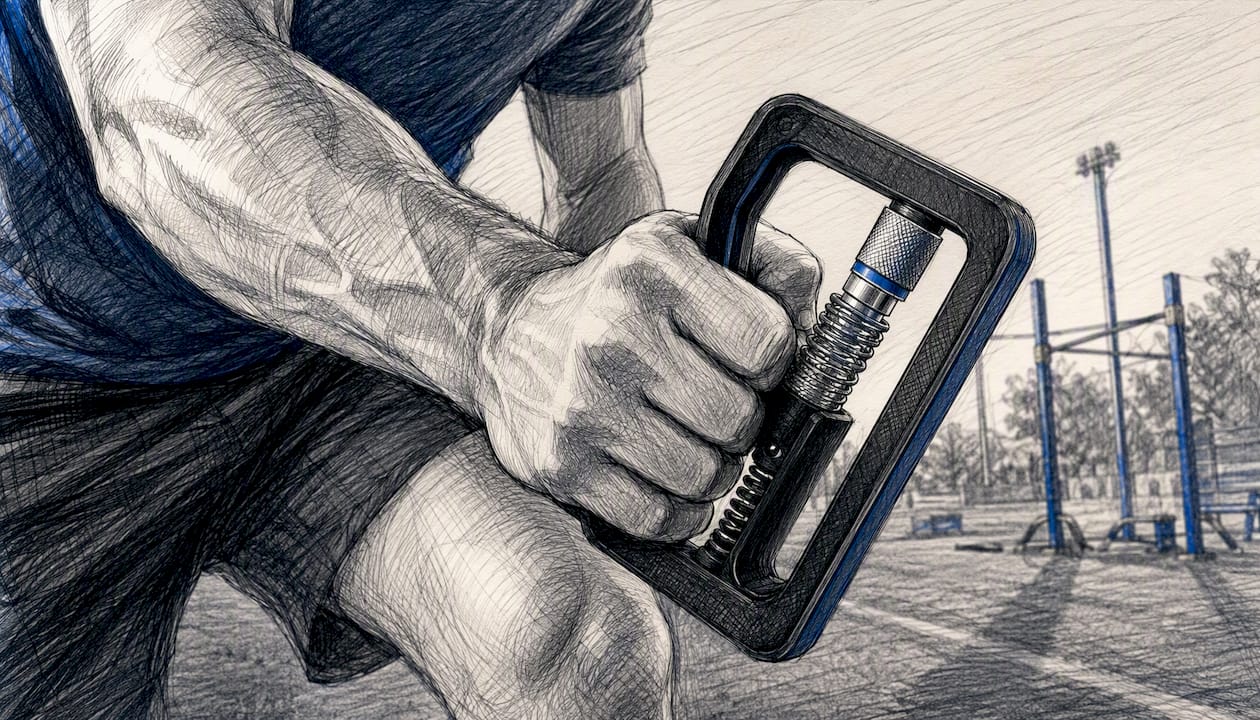
Dexdia provides research-backed norms, downloadable charts, and the Grip Strength Calculator as free resources. These tools support interpretation and reporting but do not constitute medical diagnosis. The DEXDIA GX is built for performance optimization and rehabilitation tracking, and that is the context in which all protocol recommendations here should be applied.
The DEXDIA GX is built for exactly this protocol
Practitioners who have read this far have a complete protocol. The DEXDIA GX is the device designed to execute it. Bluetooth capture feeds directly into the Dexdia app's per-hand profiles, asymmetry reports, and rolling trend graphs, covering every step from pairing to export without manual data entry.
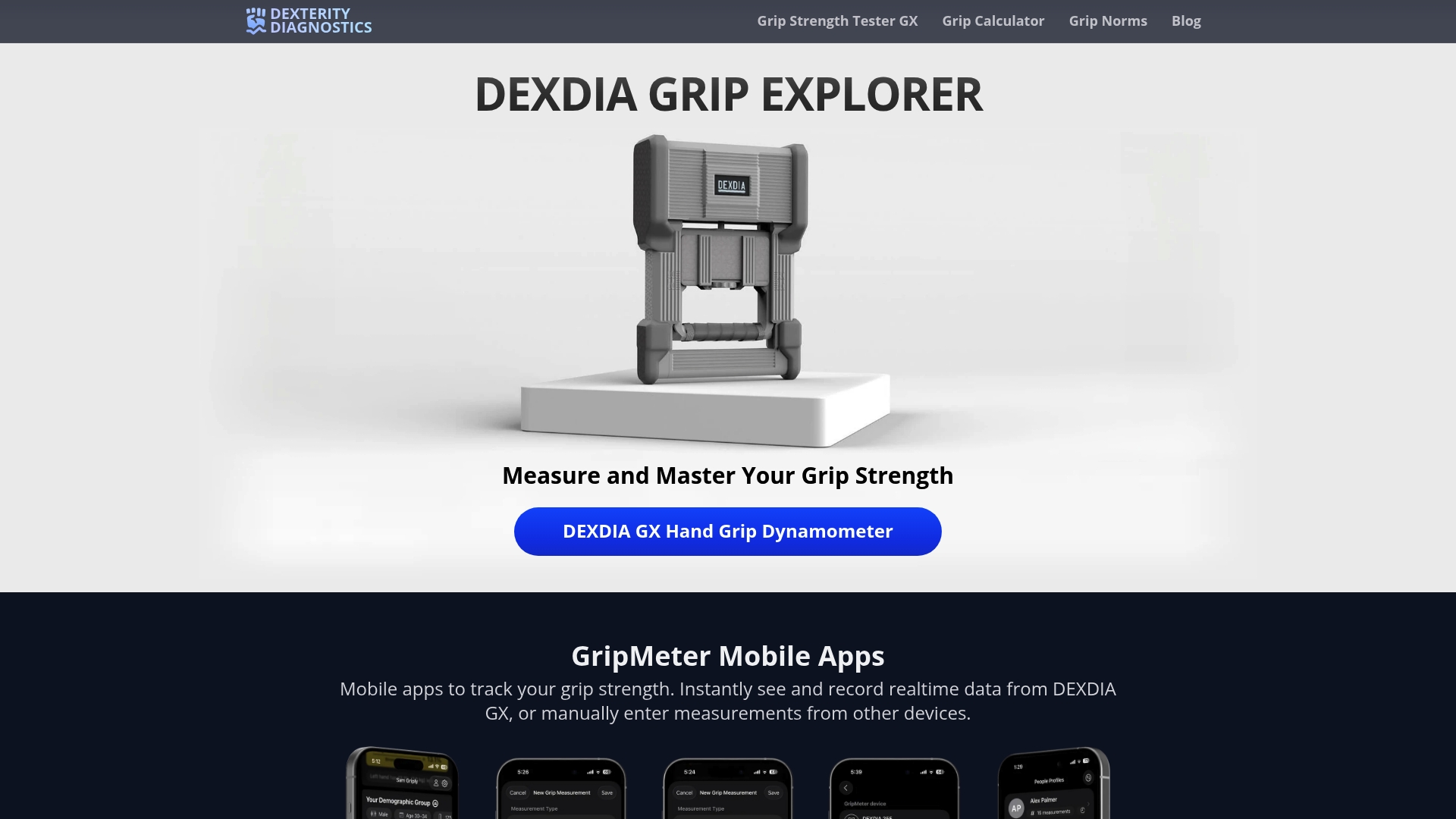
The feature-to-job match is direct: the device handles peak capture, the app handles labeling and LSI calculation, and the export function handles documentation. Normative comparison is built in via the Grip Strength Calculator and the norms by age and height. For practitioners tracking recovery timelines or athletes monitoring bilateral strength balance, the DEXDIA GX is available for direct purchase. This device is intended for performance and rehabilitation tracking, not for formal medical diagnosis.
Sources
The following peer-reviewed sources and Dexdia resources support the protocol, interpretation guidance, and evidence summary in this article.
Peer-reviewed sources
- A comprehensive scoping review and meta-analysis of upper limb strength asymmetry | Scientific Reports
- Enhancing physical fitness testing: integrating Bluetooth connectivity for improved hand grip dynamometry - Gazzetta Medica Italiana
- The Calculation, Thresholds and Reporting of Inter-Limb Strength Asymmetry: A Systematic Review
- Inter-limb isometric strength symmetry and its association with whole-body force production in physically active young adults | Scientific Journal of Sport and Performance
Dexdia resources