
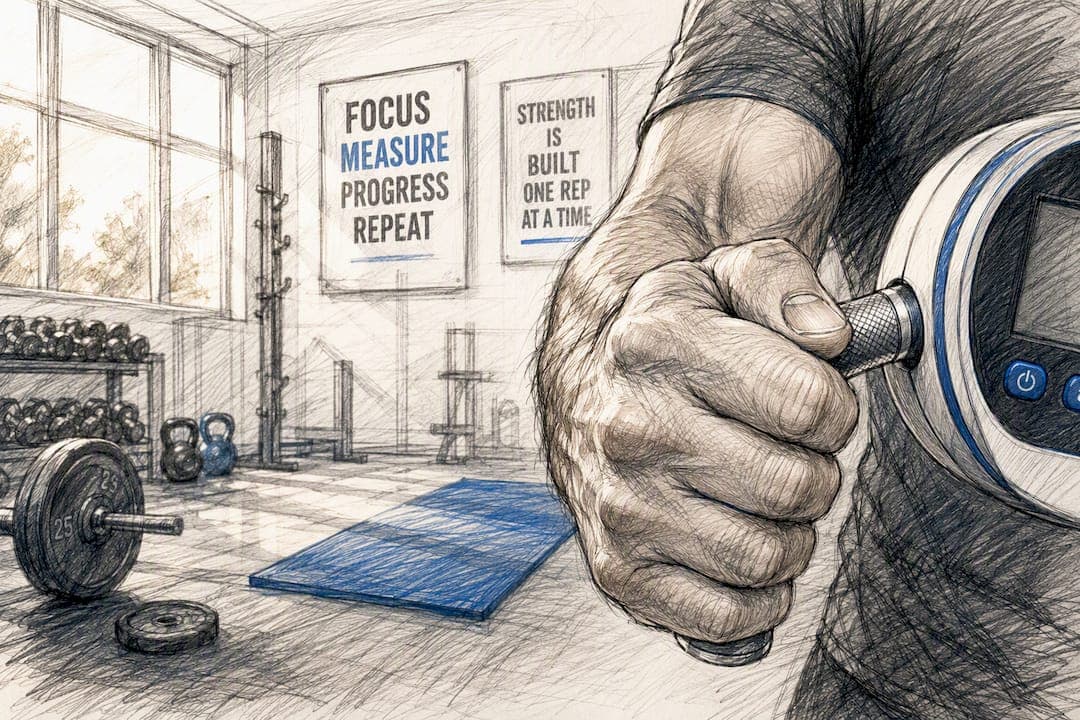
A sports-grade handheld dynamometer paired with a standardized testing protocol is the most reliable way to measure and monitor grip strength for performance work, and a connected device like the DEXDIA GX turns that single measurement into usable, trackable data. The protocol itself is simple: seated position, three trials per hand, 15 to 60 seconds of rest between attempts, record the peak value, and calculate the percent difference between hands.
This applies to performance monitoring and rehab tracking, not clinical diagnosis. Coaches, kinesiologists, and physical therapists use this workflow to spot fatigue, asymmetry, and training response over weeks and months, not to diagnose a neuromuscular condition.
- Verdict: use a Bluetooth or digital handheld dynamometer with app syncing, not an analog gauge you have to transcribe by hand.
- Protocol in one line: seated, elbow at 90 degrees, three alternating trials per hand, 15 to 60 seconds rest, record the peak.
- Scope: this is a performance and tracking tool, built for athletes and active adults, not a substitute for a clinical exam.
Key Takeaways
Consistent testing protocol and sport-specific norms turn a single grip strength number into a trustworthy performance signal worth acting on.
| Point | Details |
|---|---|
| Standardize the protocol | Use a seated 90-degree elbow position, three trials per hand, and 15 to 60 seconds of rest every session. |
| Interpret by sport, not by chart | Wrestlers and tennis players show markedly different norms, so match comparisons to the athlete's sport. |
| Treat 10% asymmetry as a guide | Average asymmetry runs near 8.1%, but sport and joint context matter more than a fixed cutoff. |
| Test the posture the sport uses | Overhead versus extended arm position changes measured asymmetry significantly. |
| Track trends, not single sessions | Log peak, average, and asymmetry over weeks using a synced app like the DEXDIA GX to separate real change from noise. |
Table of Contents
- How Do You Measure Grip Strength Correctly?
- What Does Your Grip Strength Number Actually Mean?
- Does Arm Position Change Your Grip Strength Reading?
- Building a Grip Strength Monitoring Routine That Works
- Training Programs to Build Grip Strength and Fix Asymmetry
- Why the DEXDIA GX Fits This Testing Protocol
- How Parkinson's Disease Affects Grip Strength Physiology
- Grip Strength as a Practical Signal for Symptom Management
- Setting Up a Consistent Grip Assessment Routine for Older or At-Risk Clients
- Correlating Grip Data With Broader Motor Function Assessments
- Occupational Therapy and Training Approaches for Improving Hand Function
- Can Grip Strength Trends Signal Treatment Response?
- The Testing Discipline Most Programs Get Wrong
- Put the Protocol to Work With DEXDIA GX
- Frequently Asked Questions
- Sources
How Do You Measure Grip Strength Correctly?
A grip test is only as useful as its consistency. If the posture, handle setting, or rest interval changes between sessions, the numbers stop being comparable, and you lose the ability to detect real change versus noise.
The seated position with the shoulder adducted, elbow flexed to 90 degrees, and forearm neutral is the standard reference posture used in most clinical and sports research protocols, following American Society of Hand Therapists conventions. Handle position matters too. Most dynamometers offer multiple grip settings, and the second position from the smallest setting tends to produce the strongest, most repeatable readings for adult hands. Match the handle setting to the athlete's hand size rather than defaulting to one setting for everyone.
Here's the field protocol:
- Zero the device and confirm it reads in kilograms for consistency with published norms.
- Seat the athlete with elbow at 90 degrees, wrist neutral, forearm unsupported.
- Run three trials on one hand, then switch, alternating hands with 15 to 60 seconds of rest between attempts.
- Record the peak value per hand, but note which trial produced it.
- Repeat the exact posture and instructions every session; write them down if more than one tester will be running the test.
Handheld dynamometry reduces the subjectivity that comes with manual muscle testing, which is precisely why it has become the default in performance and rehab settings. A fixed digital device also removes the tester's grip strength as a variable, something that quietly skews manual testing more than most people realize.
Pro Tip: Have the athlete perform two unrecorded warm-up squeezes at submaximal effort before the real trials. It reduces the "first-trial spike" some people show when they haven't gripped anything hard in a while.
What Does Your Grip Strength Number Actually Mean?
A raw number in kilograms means very little without context, and the context that matters most is sport, not age alone. A 2025 study of 146 Division I athletes found wrestlers averaging 52.1 kg on the right hand, while tennis players averaged 42.7 kg.
Sport-specific reality: A tennis player posting 43 kg isn't underperforming. A wrestler at that same number probably is. Norms only work when matched to the sport.
Comparing a rock climber's grip to a generic population chart, instead of a climbing-specific benchmark, tends to produce misleading conclusions in either direction.
Asymmetry follows the same logic. Calculate percent asymmetry as the difference between hands divided by the stronger hand's score. A large scoping review across many sports found grip strength asymmetry averaging close to 8.1% between dominant and non-dominant hands, but the range varies widely by sport and joint. The commonly repeated "10% rule" is a rough average, not a diagnostic cutoff.
- Under roughly 8-10% asymmetry: likely normal variation, especially in non-throwing or non-racket sports.
- Well above that range, paired with a functional complaint (grip fatigue, dropped equipment, one-sided fatigue): worth targeted corrective work.
- Always check trend over time before reacting to one session's number.
For deeper context on where your numbers fall, grip strength norms by age and height offer a useful comparison layer.
Does Arm Position Change Your Grip Strength Reading?
Yes, and by enough to change your conclusions about asymmetry. A study on female basketball players found that grip strength asymmetry measured significantly lower when the arm was tested overhead compared to fully extended, with a statistically significant difference between the two postures. Test only one position and you might report a symmetry problem that doesn't exist in the position the sport actually uses.
Match posture to the sport's actual demand:
- Overhead athletes (volleyball, tennis, basketball): test in an overhead or shoulder-flexed position, not just the standard seated posture.
- Grapplers and strongman-style athletes (wrestling, farmer carries, climbing): the standard extended or neutral seated position reflects the sport well.
- General fitness or return-to-play tracking: the neutral seated posture remains the most repeatable baseline for most people.
Record which posture you used for every session, and never compare a reading taken overhead against a baseline taken with the arm extended. Report norms alongside the posture they came from, since a norm collected in one posture won't transfer cleanly to another.
Building a Grip Strength Monitoring Routine That Works
A single test tells you almost nothing. A trend line tells you everything. Set a baseline during preseason or program start, then retest at a fixed cadence rather than randomly.
- Baseline: two sessions within the first week to establish natural test-retest variability before you trust any single number.
- In-period checks: weekly or biweekly during active training blocks.
- Post-injury gating: retest before clearing an athlete to return, using the pre-injury baseline as the target.
Log more than the peak number. Track peak, average of three trials, which trial produced the peak, percent asymmetry, and any context notes like sleep, soreness, or recent training load. A single low session without that context is easy to misread as regression when it's actually fatigue.
Digital systems that sync results automatically, similar in principle to platforms like VALD DynaMo, remove the transcription errors that creep into spreadsheet-based tracking and make trend spotting far faster.
Pro Tip: Test at the same time of day and before, not after, heavy upper-body or grip-intensive training. Post-fatigue testing adds noise that masks real trend changes.
For guidance on how often to retest specific populations, see when to measure grip strength.
Training Programs to Build Grip Strength and Fix Asymmetry
Building raw grip strength and correcting a lopsided imbalance are related goals but call for different emphasis. Progressive overload drives the first; targeted unilateral work drives the second.
- Gripper progression: 3 sets of 5 to 8 reps, 3 times weekly, advancing gripper tension only when all reps are clean and controlled.
- Heavy holds (farmer carries, dead hangs): 3 to 4 sets of 20 to 40 second holds, 2 to 3 times weekly, prioritizing time under tension over load.
- Farmer carries for grip and grip endurance: 3 to 4 rounds of 20 to 30 meters, moderate to heavy load, 2 times weekly.
- Unilateral corrective template for asymmetry: train the weaker hand at slightly higher volume (add one extra set), 3 to 4 sessions weekly, while continuing to test both hands to track convergence.
The corrective approach isn't theoretical. A six-week unilateral intervention in clay shooters reduced bilateral grip asymmetry and produced a measurable jump in shooting accuracy, with both changes reaching statistical significance. That's a real, if sport-specific, example of asymmetry correction translating into performance, not just a better number on a chart.
Keep an eye on volume creep. Grip work is deceptively easy to overdo, and tendon irritation in the forearm shows up as a drop in max strength before it shows up as pain. Pair grip-specific work with your athlete's overall strength program rather than bolting it on as an afterthought.
Why the DEXDIA GX Fits This Testing Protocol
The DEXDIA GX is built as a sports performance diagnostic device, not a medical instrument, and its mobile app integration exists specifically to support the protocol described above without extra spreadsheet work.
- Auto-records each of the three trials per hand and flags the peak, so you're not manually logging numbers mid-session.
- Calculates percent asymmetry and symmetry trends automatically, matching the interpretation approach outlined earlier.
- Applies age- and height-referenced norms so a reading can be contextualized immediately, not weeks later.
- Syncs data for coach, therapist, or athlete review, supporting the longitudinal cadence this protocol depends on.
The device is positioned for performance optimization and rehab tracking, not medical diagnosis. It fits squarely in the hands of kinesiologists, physical therapists, and coaches monitoring athletic performance, not clinicians running diagnostic workups.
How Parkinson's Disease Affects Grip Strength Physiology
For anyone tracking grip data across a broader population, it's worth understanding why some individuals show grip patterns that don't follow standard training logic. Parkinson's disease disrupts the basal ganglia's role in regulating motor output, and that disruption shows up in grip testing as more than simple weakness. Force production becomes less consistent from trial to trial, with greater variability in peak output even when the person exerts a maximal effort.
Rigidity and bradykinesia, two hallmark features of the condition, interfere with the smooth ramp-up of force that a standard grip test assumes. A healthy grip trial looks like a fast rise to peak force followed by a controlled hold. In a neuromuscular system affected by Parkinson's, that curve can be slower to rise, less stable at the peak, and harder to sustain across three trials.
Tremor adds another layer of noise. Resting or action tremor can cause the readout on a dynamometer to fluctuate rather than settle, which matters if you're working with a mixed population that includes older or neurologically affected participants inside a broader fitness or rehab program. For a kinesiologist or physical therapist running assessments across a varied caseload, recognizing this pattern helps separate genuine strength decline from tremor-related measurement noise. The takeaway for anyone using a sports dynamometer in this context: don't average away the variability. It's part of the signal, not just noise to be smoothed over.
Grip Strength as a Practical Signal for Symptom Management
Tracking grip strength over time inside a broader performance or rehab program gives you a low-effort way to catch functional decline before it becomes obvious in daily tasks. A drop across sequential sessions, especially one paired with growing asymmetry between hands, often shows up in grip data before someone reports trouble with jar lids, buttons, or handshakes.
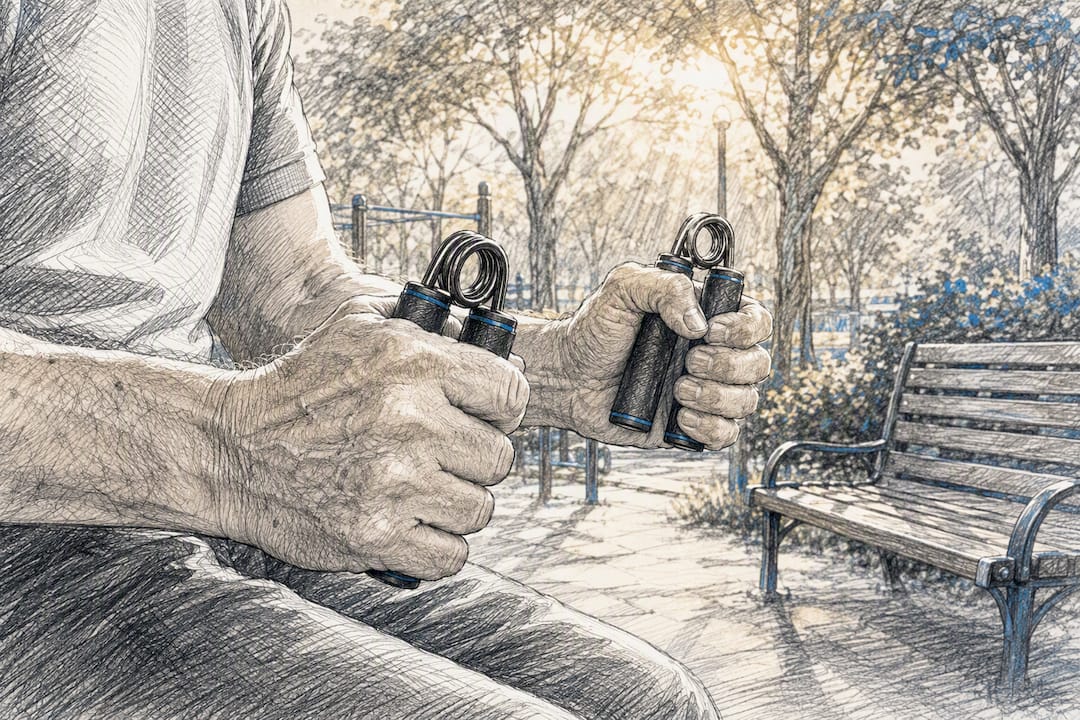
This matters most in the context of program design rather than diagnosis. If a physical therapist or trainer is working with an older adult client who has known neuromuscular changes, grip trend lines become a useful adjunct metric alongside functional task performance and standard strength testing. A stable or improving grip trend generally correlates with better hand function in daily activities, while a steady downward trend across multiple sessions is a signal to escalate rehab focus or refer for a closer clinical look, since sports and rehab professionals are not positioned to interpret that trend as diagnostic on their own.
The practical value here is early detection through consistency, not analysis. A single low session tells you almost nothing on its own. A month of sessions, tested the same way each time, tells you whether hand function is trending in a direction worth addressing in the training or rehab plan. That's the same logic driving athletic monitoring, just applied to a different population and a different set of red flags.
Setting Up a Consistent Grip Assessment Routine for Older or At-Risk Clients
The same protocol discipline that makes athletic testing meaningful applies here, arguably with even less room for error. Variability in posture, rest interval, or instructions will swamp a real signal fast when someone's baseline force output is already lower and less stable.
Stick to the seated position with elbow at 90 degrees and forearm neutral, the same posture recommended for general performance testing. Consistency in setup matters more than any single "ideal" posture when working with clients who may show more day-to-day variability, so once you pick a position, keep it fixed across every session for that individual.
Run three trials per hand with adequate rest between attempts. For clients whose force output fluctuates more due to tremor or fatigue, resist the temptation to average out a poor trial. Note it, and note the conditions (medication timing, time of day, fatigue level) instead of quietly discarding it. Those context notes often explain more than the number itself.
Test at a consistent time relative to any relevant medication schedule if the client's care team has flagged one, and keep that timing fixed across sessions rather than testing whenever convenient. Document handle setting and posture every time, exactly as recommended for athletic testing, since a hand with reduced dexterity may need a different handle position than a typical adult, and that setting needs to stay fixed once chosen. Rehab professionals working with this population benefit from the same app-based logging discussed earlier. A written or app-based record removes the guesswork from "was this session weaker, or did we just test it differently?"
Correlating Grip Data With Broader Motor Function Assessments
Grip strength alone won't tell a fitness or rehab professional everything about someone's overall motor function, but it correlates meaningfully with broader measures of neuromuscular capacity. Handgrip strength shows a strong association with whole-body isometric strength measures like the isometric mid-thigh pull, which makes grip testing a practical, low-barrier proxy for general strength status. That relationship holds across most populations, though it's a proxy, not a replacement, for task-specific testing when precision matters.
In a rehab or fitness setting working with clients who show broader motor symptoms, a declining grip trend often shows up alongside other functional changes, slower sit-to-stand times, reduced gait speed, or diminished balance scores. None of these correlations are diagnostic on their own. They're useful as a pattern check: if grip strength, gait, and balance are all trending the same direction, that's a stronger signal than any single measure moving alone.
Practitioners should treat grip strength as one input in a broader functional picture rather than a standalone severity marker. A physical therapist noticing a consistent downward grip trend alongside other functional declines has a legitimate reason to flag the pattern for closer clinical evaluation, but the grip number itself doesn't diagnose anything or quantify disease severity on a clinical scale. That distinction keeps the tool in its proper lane: a sensitive, easy-to-repeat measure that feeds into a bigger functional assessment, not a stand-in for one.
Occupational Therapy and Training Approaches for Improving Hand Function
Improving hand function in clients with reduced grip capacity draws on the same progressive-overload logic used in athletic grip training, adjusted for a lower starting point and a greater emphasis on functional carryover. Occupational therapy approaches typically combine graded resistance work, similar in principle to the gripper progressions and heavy-hold protocols described earlier, with task-specific practice on activities like buttoning, jar-opening, or utensil use.
Medication timing plays a role that doesn't come up in typical athletic programming. For clients on medication schedules that affect motor symptoms, therapists and trainers working alongside a care team often coordinate session timing with the client's known "on" periods, when motor control tends to be more consistent, to get the most reliable training response and the most useful test data. That's a scheduling detail worth asking about if you're working with this population, even though it's outside a fitness professional's scope to manage.
Resistance progression should stay conservative and closely monitored: smaller load jumps, more frequent low-intensity sessions rather than fewer high-intensity ones, and constant attention to whether force output is trending up, flat, or down across sessions. The unilateral corrective template described in the training section, prioritizing the weaker or more affected hand with slightly higher session frequency, applies here too, though progression should be paced to the individual's actual response rather than a fixed athletic timeline. Occupational therapists remain the appropriate professionals to design the clinical side of this work. Fitness and rehab professionals supporting the process are best positioned contributing consistent, well-documented tracking data rather than adjusting the therapeutic plan itself.
Can Grip Strength Trends Signal Treatment Response?
Grip strength trend lines can serve as a useful, low-cost signal for tracking whether a training or rehab intervention is producing a measurable functional response, provided the testing stays rigorously consistent session to session. This is where the discipline built into athletic testing protocols, fixed posture, fixed trial count, fixed rest interval, pays off most, because a trend that holds up under those controls is far more trustworthy than one built on inconsistent testing conditions.
A steady or improving trend after a change in training approach, rehab focus, or a client's broader care plan suggests the intervention is producing a real functional effect, at least in hand strength. A flat or worsening trend despite consistent testing conditions is a legitimate reason to revisit the approach, whether that means adjusting the training program or flagging the pattern for the client's broader care team to review.
None of this positions grip strength as a formal biomarker in the clinical sense. It's a practical, repeatable, low-burden metric that fitness and rehab professionals can layer into a broader monitoring plan alongside functional task assessments. The value comes from the same place it does in athletic testing: not the single number, but the trend, tracked the same way every time, long enough to separate a real pattern from ordinary session-to-session noise.
The Testing Discipline Most Programs Get Wrong
Most grip strength programs fail not because the exercises are wrong, but because the testing behind them is inconsistent. A different posture one week, a skipped rest interval the next, a different tester holding the device, and suddenly a real trend gets buried under measurement noise nobody accounted for.
The conventional advice treats a single grip number as meaningful on its own. It rarely is. A 45 kg reading means something different for a wrestler than a tennis player, something different tested overhead versus extended, and something different in week one of a program versus week twelve. Context, not the raw kilogram figure, is what separates useful data from a number on a chart.
What deserves more attention than it gets: the trial-to-trial variability itself. Most programs record the peak and discard the rest, but the spread between three trials often reveals fatigue, technique inconsistency, or measurement noise that the peak number alone hides completely.
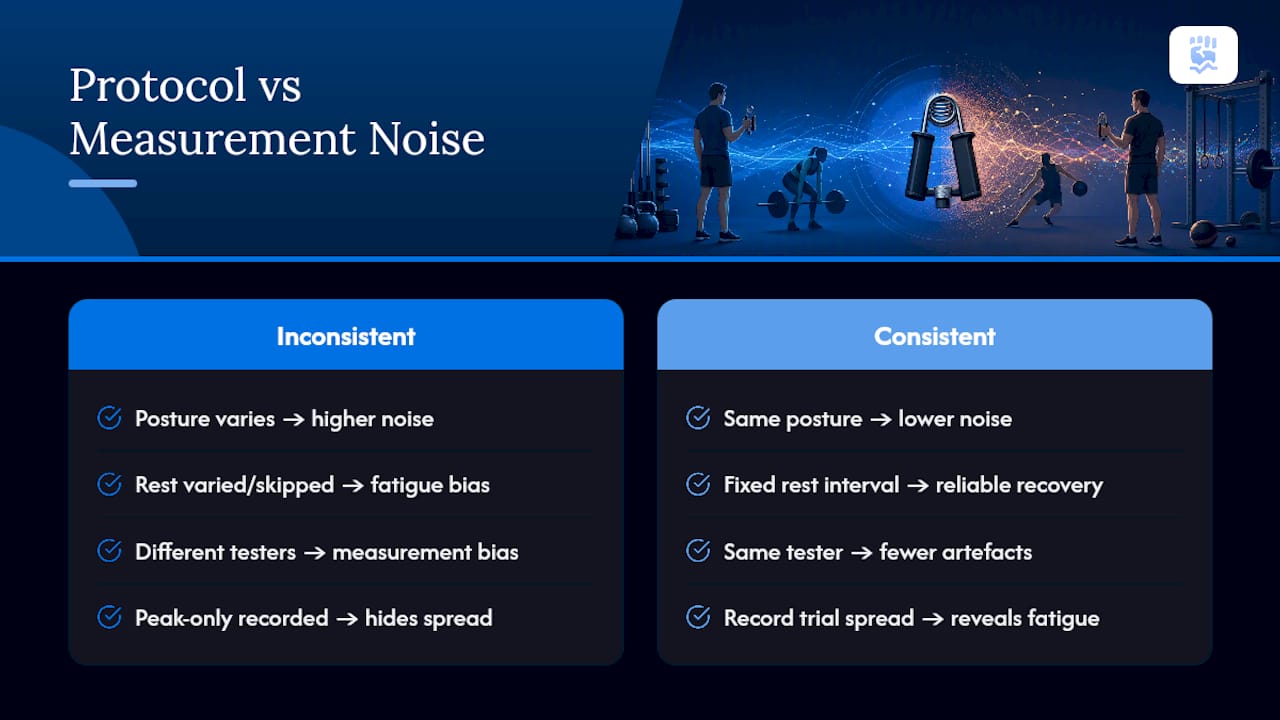
Prioritize protocol consistency before chasing bigger numbers. A stable, repeatable testing setup, done the same way every session, will surface more useful information over eight weeks than a dozen inconsistent max-effort tests ever could.
Put the Protocol to Work With DEXDIA GX
Everything in this protocol, the standardized posture, the three-trial scheme, the asymmetry math, only pays off when the testing setup makes it easy to repeat correctly every single time. That's the specific gap the DEXDIA GX was built to close.
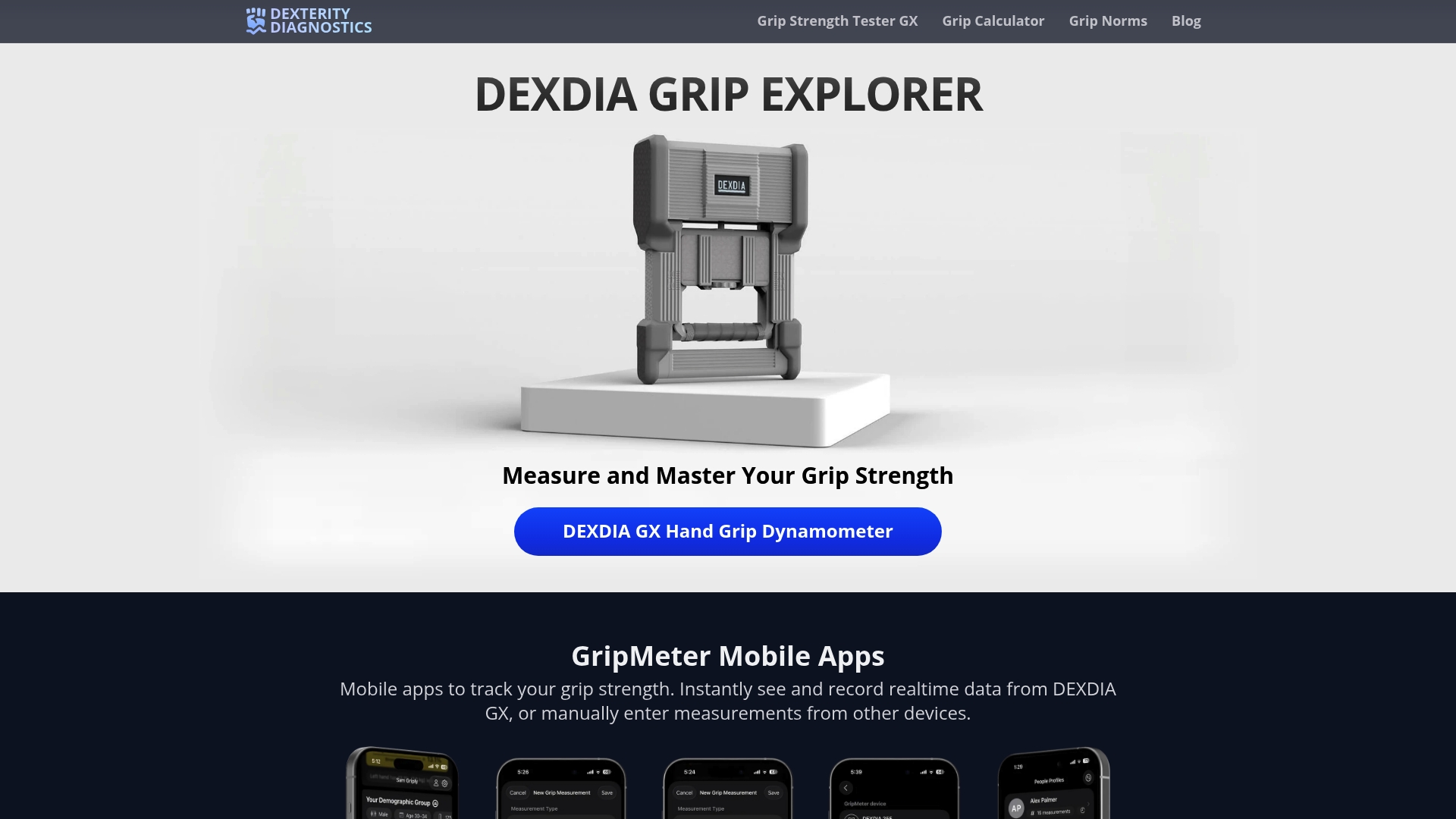
The device auto-records each trial per hand, calculates peak and average automatically, and runs the symmetry analysis in the companion app the moment testing wraps, removing the manual tracking errors that quietly undermine most spreadsheet-based programs. Instead of guessing whether a reading is high, low, or normal, the app cross-references sport-specific and age-based norms instantly. If you want to see where a current number lands before committing to a device, the grip strength calculator gives an immediate percentile and symmetry read using numbers you already have.
For coaches, kinesiologists, and physical therapists running this protocol across a full roster or caseload, the DEXDIA GX product page has full specs and ordering details. Start there, and the testing routine outlined in this article becomes a five-minute part of any session rather than a separate administrative task.
Frequently Asked Questions
What's a normal grip strength score for an athlete? There's no single normal score. Sport matters more than almost any other factor: Division I wrestlers average around 52 kg on the right hand, while tennis players average closer to 43 kg. Compare your numbers to sport-specific norms rather than a generic population chart.
How much grip asymmetry between hands is a problem? Treat 10% as a rough heuristic rather than a hard threshold, and weigh it against sport, dominant-hand demands, and whether the athlete reports any functional issue.
Does hand position affect my grip strength test results? Yes. Testing overhead versus with the arm extended produces measurably different asymmetry readings. Always test in the posture that matches the sport's actual demand, and keep that posture fixed across every session.
How often should I retest grip strength for tracking purposes? A baseline of two sessions in the first week, followed by weekly or biweekly checks during active training, gives enough data to separate a real trend from normal session-to-session variation.
Can grip strength testing help with training programs for older or at-risk populations? Grip trend data can be a useful adjunct signal in a broader fitness or rehab program for older adults, including those with neuromuscular changes, but it works as a monitoring tool alongside other functional assessments, not as a standalone diagnostic measure.
Sources
- Division I athletes handgrip study (2025)
- A comprehensive scoping review and meta-analysis of upper limb strength asymmetry
- Intervention study linking asymmetry correction to improved shooting performance