
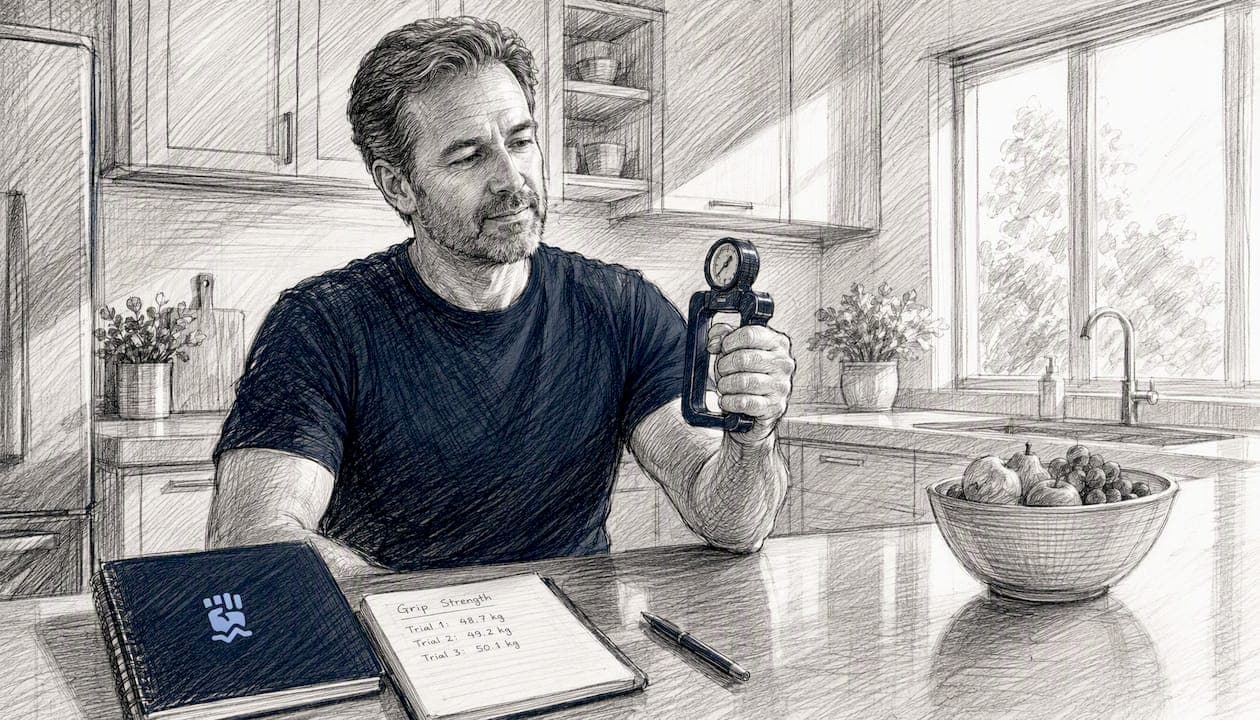
The most reliable way to measure grip strength is a seated hand dynamometer test: elbow bent at 90°, wrist neutral, three maximal squeezes per hand with 30–60 seconds of rest between trials, recording either the highest or average reading. That protocol, codified in the UK Biobank/Jamar standard, is what clinical researchers use, and it's reproducible enough to track meaningful change over months. If you don't have a dynamometer, validated at-home substitutes like a bathroom scale squeeze or timed towel hang give useful directional signals, though they can't match the precision of a calibrated device.
Quick-start summary:
- Have a dynamometer? Sit down, elbow at 90°, wrist neutral, squeeze maximally for 3–5 seconds, rest 30–60 seconds, repeat three times per hand, log the highest reading.
- No dynamometer? Use a bathroom scale squeeze or timed towel hang for rough tracking only — not for clinical comparison.
- Clinical thresholds to know: below ~26 kg (57 lbs) for men and ~16 kg (35 lbs) for women flags weak grip in most research protocols.
- Track trends, not single scores. One number tells you little; a series of readings under identical conditions tells you a great deal.
Pro Tip: Test at the same time of day, after the same brief warm-up, every session. Morning readings and post-workout readings can differ enough to obscure real progress.
Table of Contents
- Why measuring grip strength matters for your health
- How to measure grip strength with a hand dynamometer
- How to interpret your score: benchmarks and clinical thresholds
- At-home grip tests when you don't have a dynamometer
- Why trends matter and how Bluetooth dynamometers simplify tracking
- How to improve grip strength: exercises and a 6-week progression
- When a low or dropping grip score needs professional attention
- Key Takeaways
- Grip strength testing: a perspective from the Dexdia Team
- The DEXDIA GX makes consistent grip tracking straightforward
- Further reading and sources
Why measuring grip strength matters for your health
Grip strength is one of the most studied biomarkers in aging research. It reflects the overall integrity of the musculoskeletal system and correlates with bone density, cognitive performance, and cardiovascular risk in ways that few other simple physical tests can match. A single squeeze of a dynamometer captures information about neuromuscular function, nutritional status, and physical reserve that clinicians use to screen for sarcopenia and frailty.
What makes it particularly useful is how easy it is to measure repeatedly. Unlike a VO2 max test or a DEXA scan, a grip test takes under two minutes and requires no lab. That accessibility makes it practical for longitudinal monitoring, whether you're tracking recovery from an injury, following a training program, or simply keeping an eye on age-related changes.
Grip strength should not be read in isolation. Clinicians typically interpret it alongside leg strength, gait speed, and body weight changes for a fuller picture of functional capacity. A low grip score alone is a signal worth investigating, not a diagnosis. Dexdia's overview of grip strength as a health indicator covers the evidence base in more depth for readers who want the research context.
Statistic to know: Clinical research commonly flags grip strength below 26 kg (57 lbs) in men and below 16 kg (35 lbs) in women as weak grip, thresholds used in sarcopenia screening protocols across multiple large-scale studies.
How to measure grip strength with a hand dynamometer
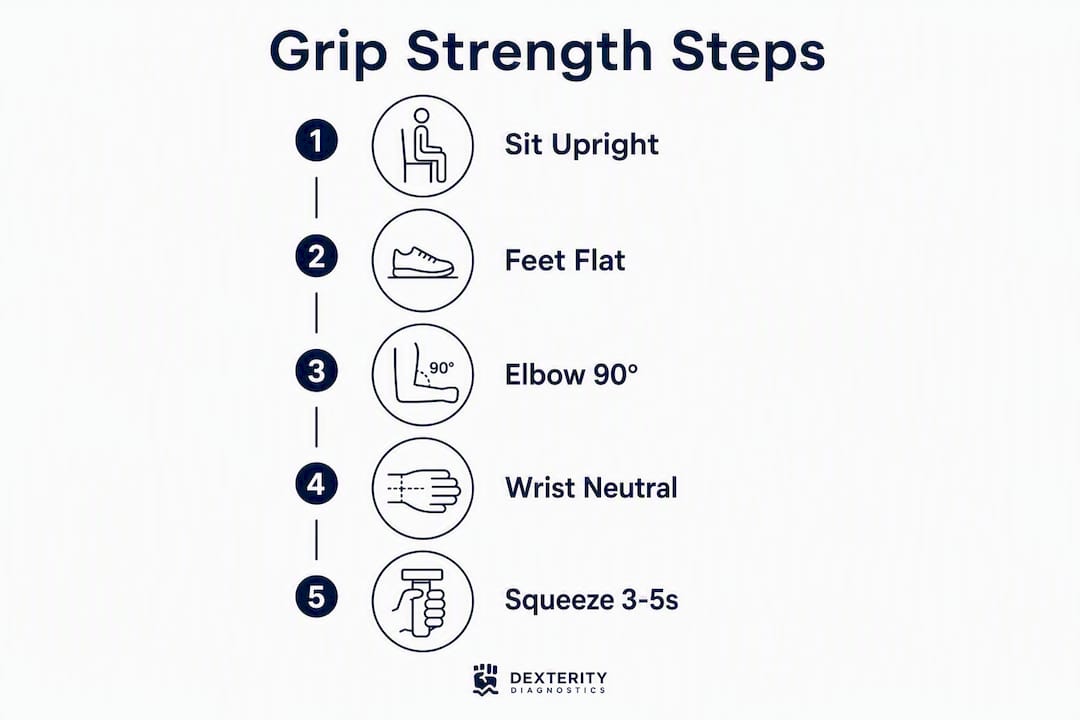
The complete protocol in one sentence: sit upright, feet flat, elbow at 90°, wrist neutral, squeeze the dynamometer maximally for 3–5 seconds, rest 30–60 seconds, and repeat three times per hand starting with the dominant hand. Here is each step in detail.
Posture and position
Sit in a chair with no armrests. Keep your feet flat on the floor, back straight, and the tested arm close to your body. The elbow should be bent at exactly 90°, forearm parallel to the floor, wrist in a neutral position (not flexed or extended). This is the UK Biobank/Jamar protocol position used in population-level research, and deviating from it changes your score enough to make comparisons unreliable.

Device setup
Adjust the handle width so the middle finger sits comfortably at roughly a 90° bend. The correct grip size affects force output directly — too wide or too narrow reduces the reading. Zero the device before each trial if it has a peak-hold function, and confirm the unit (kg or lbs) matches your recording sheet.
Trial structure
| Variable | Standard |
|---|---|
| Position | Seated, elbow 90°, wrist neutral |
| Squeeze duration | 3–5 seconds maximal effort |
| Rest between trials | 30–60 seconds |
| Trials per hand | 3 |
| Recording rule | Highest reading, or average of 3 |
| Hand order | Dominant first, then non-dominant |
Complete all three trials on the dominant hand before switching. Record both the highest single reading and the average across three trials — each tells you something slightly different about maximal capacity versus consistency.
Common mistakes that reduce accuracy
- Testing immediately after heavy exercise inflates fatigue and suppresses the reading.
- Resting the device against your leg during the squeeze offloads force and inflates the score.
- Holding your breath creates a Valsalva effect that can artificially boost a single trial.
- Changing handle width between sessions makes longitudinal comparison meaningless.
- Skipping the rest interval between trials underestimates true maximal strength.
Pro Tip: Log the handle setting, time of day, and warm-up activity alongside every score. Those three variables account for most of the unexplained variation people see when comparing sessions weeks apart.
How to interpret your score: benchmarks and clinical thresholds
A grip reading only becomes useful when placed against a reference. Clinical research uses sex-based cutoffs as the primary screening tool, with the most widely cited thresholds being approximately 26 kg (57 lbs) for men and 16 kg (35 lbs) for women to flag weak grip. These are not absolute pass/fail lines — they are population-derived signals that indicate elevated risk when crossed.
Age, body size, and testing protocol all shift where a "normal" score falls. A 35-year-old male athlete and a 70-year-old woman will have very different expected ranges, which is why age- and sex-stratified norms are more informative than a single universal cutoff. Dexdia's grip strength norms by age and height provide stratified reference values for more precise comparison.
| Category | Men | Women | Context |
|---|---|---|---|
| Weak grip / sarcopenia flag | Below ~26 kg (57 lbs) | Below ~16 kg (35 lbs) | Commonly used clinical cutoff |
| Average adult range | Typical adult range | Typical adult range | Broad population reference |
| Above average | Above typical adult range | Above typical adult range | Active/athletic adults |
Statistic to know: Certain clinical thresholds are used in research cohorts as points at which grip weakness correlates with increased fall risk, mobility limitations, and sarcopenia-related outcomes.
Beyond the absolute number, two patterns deserve attention. First, a significant difference between left and right hands (generally more than 10% in non-dominant-to-dominant comparison) can indicate asymmetric neuromuscular issues worth investigating. Second, a declining trend over months — even if scores stay above clinical cutoffs — is a more actionable signal than any single reading. Use Dexdia's grip strength calculator to compare your score against age- and sex-matched norms directly.
At-home grip tests when you don't have a dynamometer
At-home alternatives measure grip endurance or rough force rather than calibrated maximal strength. They are useful for screening and trend detection, but they cannot substitute for a dynamometer when clinical precision matters.
Each method tests a different grip attribute, so choosing the right one depends on what you want to track:
- Bathroom scale squeeze: Place a bathroom scale at waist height, grip the edges, and squeeze for approximately 3 seconds. Read the peak weight as a rough force proxy. Repeatability is low, but it gives a directional baseline when nothing else is available.
- Timed dead hang: Hang from a pull-up bar with an overhand grip and record how long you can hold. This tests grip endurance, not maximal force. Rough benchmarks: under 15 seconds needs work, 15–30 seconds is average, 30–60 seconds is good, over 60 seconds is strong.
- Towel hang: Drape a thick towel over a bar and grip the folded ends. The unstable surface increases demand on the fingers and forearm. Use the same time benchmarks as the dead hang.
- Plate pinch: Pinch two weight plates together (smooth sides out) and hold them at your side for time. This isolates pinch grip rather than crush grip, which is a distinct functional capacity.
- Farmer's carry: Walk a set distance carrying heavy dumbbells or kettlebells at your sides. This tests functional grip endurance under load and integrates core and shoulder stability.
The core limitation of all these methods is standardization. Without a fixed handle width, calibrated resistance, and a controlled posture, scores from one session to the next can vary for reasons unrelated to actual strength change. Use them for rough tracking and motivation, not for clinical comparison against published norms.
Why trends matter and how Bluetooth dynamometers simplify tracking
A single grip score is a data point. A series of scores collected under identical conditions is a trend, and trends are where the real diagnostic and performance value lives. One reading tells you where you are today; six readings over three months tell you whether you're improving, plateauing, or declining — and at what rate.
Testing every two weeks to monthly is the recommended cadence for training and rehabilitation monitoring. For long-term health surveillance without an active program, testing every 3–6 months is sufficient. Testing more frequently than every two weeks rarely adds useful information because grip strength changes slowly, and the noise from day-to-day variation can obscure real signal.
Manual logging works, but it introduces friction: forgotten entries, inconsistent timestamps, and transcription errors accumulate over months. Bluetooth-enabled dynamometers address this by automating data capture, timestamping each trial, and storing historical readings in a connected app. The DEXDIA GX does this and adds left/right symmetry reporting, which makes it straightforward to spot asymmetries developing over time without manually comparing columns in a spreadsheet.
| Feature | Manual logging | Bluetooth dynamometer (e.g., DEXDIA GX) |
|---|---|---|
| Timestamp accuracy | User-dependent | Automatic |
| Left/right symmetry tracking | Manual calculation | Automated |
| Trend visualization | Spreadsheet required | In-app graph |
| Export for clinician review | Manual formatting | Direct export |
| Entry error risk | Moderate to high | Low |
Pro Tip: If you're tracking for rehab or performance, use the same device, the same handle setting, and the same time of day for every session. Review both the highest single-trial reading and the variability across your three trials — increasing consistency across trials is itself a sign of neuromuscular improvement.
How to improve grip strength: exercises and a 6-week progression
Consistent, progressive loading across crush, pinch, and support grip patterns is the most reliable way to build grip strength. Compound upper-body lifts (deadlifts, rows, pull-ups) provide a foundation; targeted grip work accelerates specific adaptations.
Effective exercises by grip type:
- Crush grip: Hand gripper progressions, barbell deadlifts with a double-overhand grip, dumbbell rows
- Pinch grip: Plate pinch holds, pinch-grip dumbbell carries
- Support/endurance grip: Dead hangs, farmer's carries, rope climbs
6-week sample progression
- Weeks 1–2: 3 sets of farmer's carries (30–40 meters), 3 sets of dead hangs (max hold, 2–3 reps), hand gripper at a comfortable resistance for 3 × 10 reps. Test grip strength at the end of week 2.
- Weeks 3–4: Add one set to each exercise, increase gripper resistance by one level, extend farmer's carry distance to 40–50 meters. Add plate pinch holds (3 × 20–30 seconds).
- Weeks 5–6: Increase gripper resistance again, add barbell deadlifts or heavy dumbbell rows twice per week, maintain dead hang volume. Retest grip strength at the end of week 6 and compare to baseline.
For adults with hand pain, arthritis, or recent wrist or elbow injury, isometric holds at lower loads (light gripper, light plate pinch) and higher repetitions are a safer starting point. Avoid maximal-effort squeezes if there is active joint inflammation, and consult a physical therapist before progressing load.
Pro Tip: Grip strength often improves as a secondary effect of increasing overall upper-body and pulling strength. Prioritize compound lifts and adequate recovery before adding high-volume isolated grip work.
When a low or dropping grip score needs professional attention
A single score below clinical thresholds is worth noting; a score that drops noticeably over weeks or months without a clear training explanation warrants a clinician visit. The distinction matters because grip decline can be the first measurable sign of conditions that benefit from early intervention.
Seek evaluation from a physician or physical therapist if you observe any of the following:
- Grip scores consistently below common clinical thresholds for men or women without a history of inactivity or recent injury
- A decline of more than 10–15% over a 3–6 month period with no change in training
- A significant and persistent left-right asymmetry (greater than 10%) that was not previously present
- New hand, wrist, or forearm pain during or after testing
- Neurologic symptoms: numbness, tingling, or weakness that extends beyond the hand
- Grip decline occurring alongside unintended weight loss, increased falls, or notable fatigue
A physical therapist or kinesiologist will typically follow up with a full upper-extremity strength assessment, a neurologic screen, and a functional mobility evaluation. If sarcopenia or frailty is suspected, a physician may order additional tests. Physical therapy for seniors can address both the grip weakness and the underlying functional deficits that often accompany it.
Note: The thresholds cited here are drawn from clinical research and are intended as general reference points. They are not a substitute for professional evaluation. Confirm any health concern with a qualified clinician.
Key Takeaways
A seated hand dynamometer test using the 90° elbow protocol, repeated three times per hand and recorded as the highest or average score, is the gold standard for measuring grip strength reliably.
| Point | Details |
|---|---|
| Gold-standard protocol | Seated, elbow at 90°, wrist neutral, 3 trials per hand, 30–60 seconds rest between trials. |
| Clinical thresholds | Clinical cutoffs in research protocols: below ~26 kg (57 lbs) for men or ~16 kg (35 lbs) for women flags weak grip. |
| At-home alternatives | Bathroom scale squeeze and timed dead hang give directional signals but lack the precision for clinical comparison. |
| Track trends, not single scores | Test every few weeks for training monitoring; less frequently for long-term health surveillance. |
| Dexdia DEXDIA GX | Automates timestamping, left/right symmetry analysis, and trend visualization for consistent longitudinal tracking. |
Grip strength testing: a perspective from the Dexdia Team
The most common mistake adults make with grip testing is treating a single number as a verdict. A score of 28 kg means almost nothing without knowing the protocol used, the handle setting, the time of day, and what the same person scored three months earlier. The clinical thresholds cited in research — 26 kg for men, 16 kg for women — are population-level screening tools derived from large cohorts. They are useful starting points, not individual diagnoses.
What actually changes behavior and outcomes is trend data collected under consistent conditions. This is why Dexdia built the DEXDIA GX around Bluetooth connectivity and app-based logging rather than a simple analog dial. The device is a performance diagnostic tool, not a medical device, and that distinction matters. Kinesiologists and physical therapists who use it in practice do so because it removes the administrative friction from longitudinal assessment, not because it replaces clinical judgment.
The research-backed norms available on Dexdia's site are drawn from published population studies and are stratified by age, sex, and height. They give context that a raw number cannot. If you're using any dynamometer, the single most valuable habit you can build is testing under identical conditions every time and logging the result immediately. The trend that emerges over 6–12 months is the signal worth acting on.
The DEXDIA GX makes consistent grip tracking straightforward
Tracking grip strength over time requires removing the variables that introduce noise: inconsistent logging, forgotten timestamps, and manual left/right comparisons. The DEXDIA GX grip strength tester addresses all three by connecting directly to a mobile app that timestamps every trial automatically, stores historical readings, and generates a symmetry report comparing left and right hand performance across sessions.
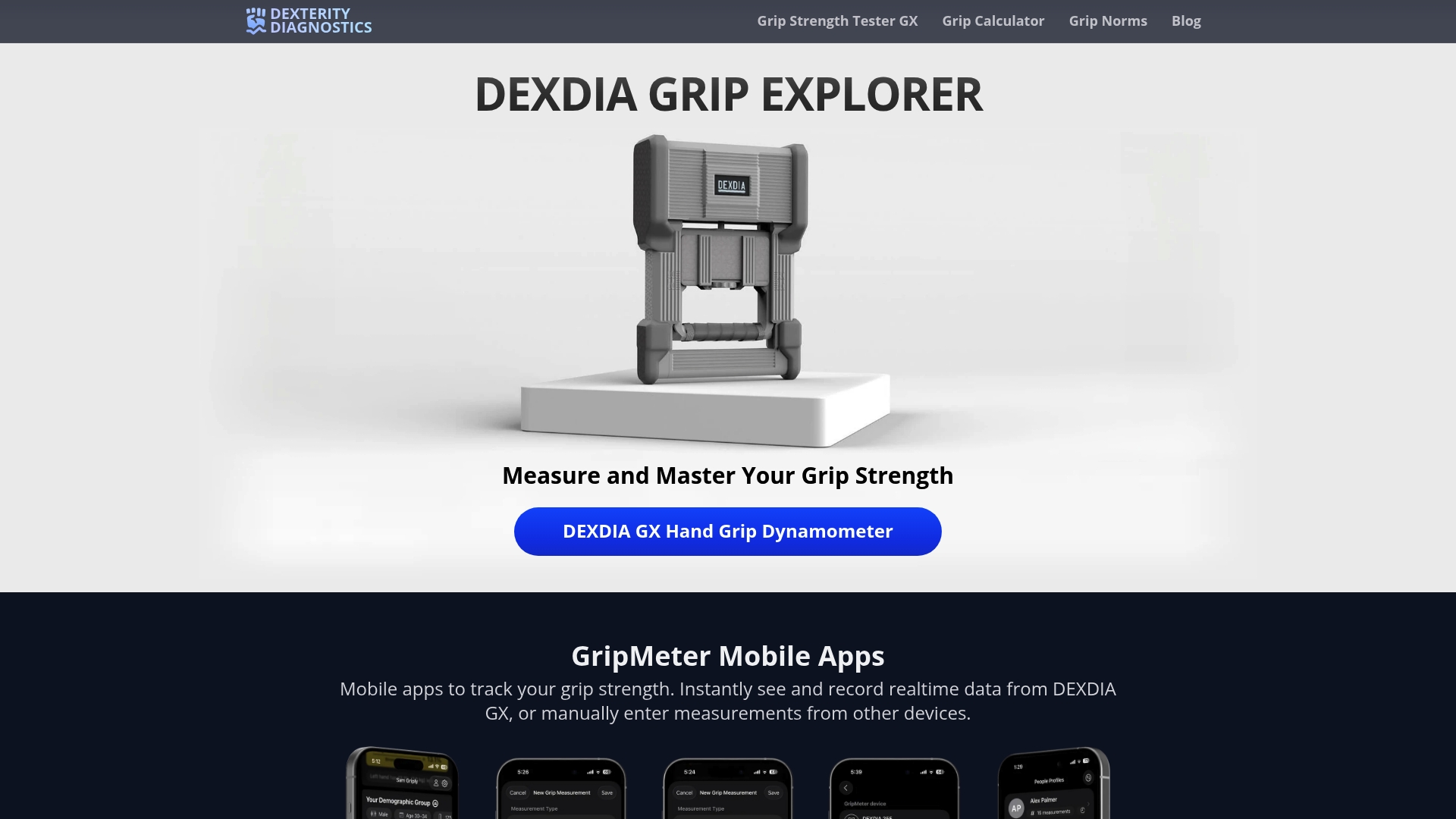
The companion app includes research-backed normative data, so each reading is immediately placed in context against age- and sex-matched reference values. Reports are exportable, which makes it straightforward to share results with a physical therapist or kinesiologist. The DEXDIA GX is a performance diagnostics tool built to the standards used by sports professionals and rehabilitation specialists — not a regulated medical device, and positioned accordingly.
For adults who want to move beyond a single-session number and build a reliable picture of their grip health over time, the DEXDIA GX is a practical starting point. Check the grip strength norms by age and height to see where your current score falls, then use the device to track whether your training or recovery program is producing measurable change.
Further reading and sources
- UK Biobank Grip Strength Measurement Manual — the standard protocol reference for handle settings, calibration, and peak-hold procedures
- Cleveland Clinic: Grip Strength — What to Know — clinical summary of thresholds, health links, and interpretation guidance
- PMC: Grip Strength as a Biomarker of Aging — peer-reviewed overview of grip strength's role in health surveillance
- PMC: Sarcopenia and Grip Strength Cutoffs — research on sex-based thresholds and sarcopenia screening
- Dexdia: Grip Strength Norms by Age and Height — stratified normative reference values for score interpretation
- Dexdia: Printable Grip Strength Norms (PDF) — downloadable charts for at-home or clinical reference
- Dexdia: Grip Strength Calculator — interactive tool to compare your score against population norms
- Dexdia: How to Determine Grip Strength — overview of device types and measurement approaches