
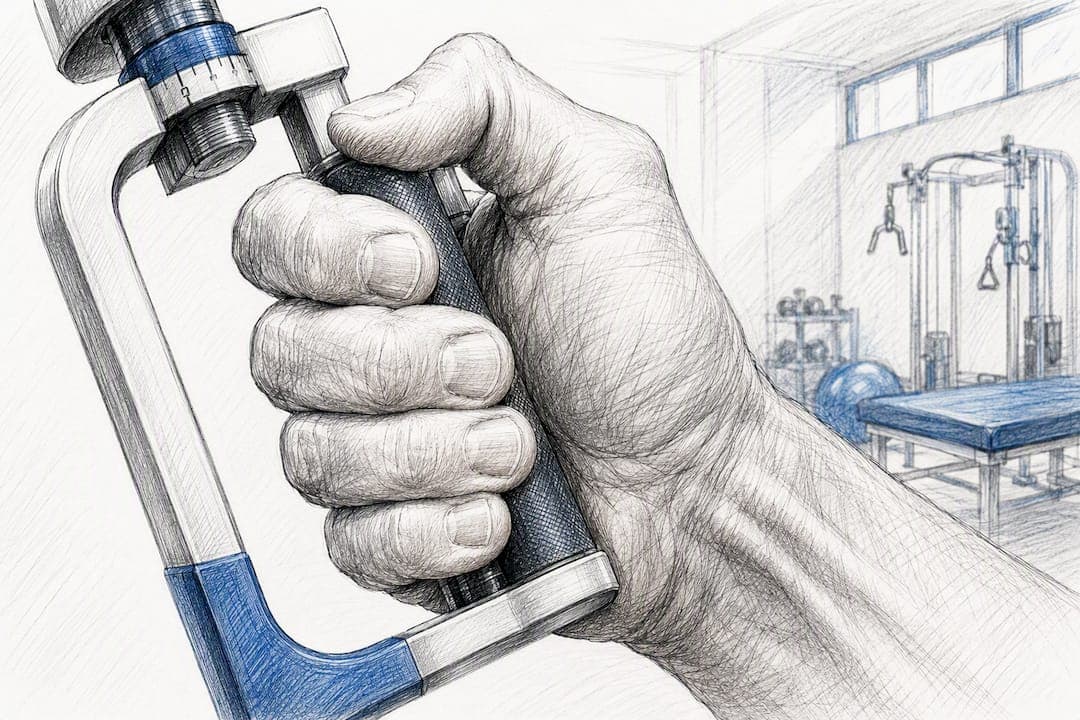
Grip strength to weight ratio (GSWR) is your combined handgrip strength in kilograms divided by your body weight in kilograms. Normalizing grip strength this way predicts health risk more reliably than raw grip strength alone in most cohort research, because it accounts for the fact that a 200-pound man and a 120-pound woman need very different amounts of force to be considered strong for their frame. Cohort data tracking this ratio over time has found that people in the lowest GSWR range face significantly higher all-cause and cardiovascular mortality than those in the highest range.
TL;DR:
- Grip strength to weight ratio declines with age, especially after 50, and is generally lower in women and untrained individuals.
- A low GSWR signals increased health risks, but thresholds vary by age, sex, and population, warranting further clinical assessment.
- Improving GSWR involves targeted grip training and managing body weight, with consistent testing crucial for tracking progress.
- Higher GSWR is strongly associated with lower mortality and cardiovascular risk, particularly when normalized for body mass.
- Proper standardization in testing conditions and using validated norms enhances the reliability and interpretability of GSWR measurements.
Table of Contents
- What Is the Formula for Grip Strength to Weight Ratio?
- What Are Normal Grip Strength to Weight Ratios by Age and Sex?
- Does Grip Strength to Weight Ratio Predict Mortality and Disease Risk?
- What Is a Good Grip Strength Ratio Between Hands?
- How Do You Measure Grip Strength Correctly for Accurate Results?
- How Clinics and Coaches Track Grip Strength to Weight Ratio Over Time
- What Factors Affect Grip Strength to Weight Ratio?
- How Can You Improve Your Grip Strength to Weight Ratio?
- How Is Grip Strength to Weight Ratio Used in Sports and Rehab?
- What Are the Limitations of Using Grip Strength to Weight Ratio?
- When Should You Rely on Grip Strength to Weight Ratio?
- Get Repeatable Grip Strength to Weight Ratio Data With Dexdia
- Where Does the Research on Grip Strength to Weight Ratio Come From?
- Sources
What Is the Formula for Grip Strength to Weight Ratio?
Researchers calculate GSWR as combined grip strength divided by body weight, both expressed in the same unit. The standard formula used in large cohort studies looks like this:
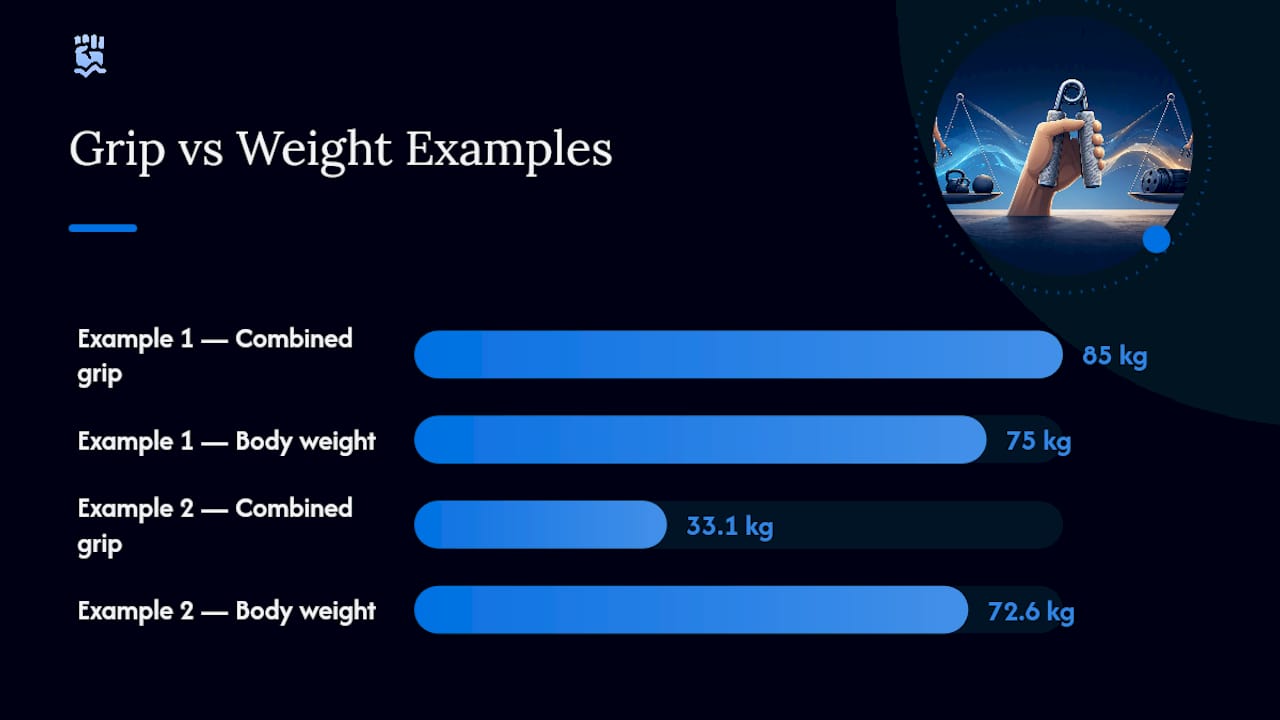
GSWR = (Left-hand max grip + Right-hand max grip) ÷ Body weight
Most population studies, including the NHANES and CHARLS analyses, sum the maximum reading from each hand rather than using a single-hand score. Participants who only complete a one-hand test typically get excluded from combined-metric analyses, because a single hand doesn't capture total grip capacity. For self-testing, following that same convention keeps your numbers comparable to published norms.
Here's how to calculate it step by step:
- Take three grip trials per hand on a calibrated dynamometer and record the single best reading from each hand.
- Add the two best readings together to get combined grip strength.
- Convert body weight to kilograms if your scale reads in pounds (divide pounds by 2.2046).
- Divide combined grip strength by body weight in kilograms.
- Multiply by 100 if you want the result expressed as a percentage of body weight.
Worked example one: A person grips 40 kg with the left hand and 45 kg with the right hand, weighing 75 kg. Combined grip is 85 kg.
Worked example two: A 160-pound person grips 35 lb and 38 lb. Convert weight first: 160 ÷ 2.2046 = 72.6 kg. Convert grip totals: (35 + 38) ÷ 2.2046 = 33.1 kg.
Report GSWR to one decimal place. Rougher approximations, like dividing pounds by 10 instead of converting properly, introduce roughly 2% error into the calculation, which is enough to shift someone across a normative boundary in a borderline case.
What Are Normal Grip Strength to Weight Ratios by Age and Sex?
Normative GSWR values shift substantially with age, sex, and training background, which is why a single universal cutoff doesn't work well across a whole population. Cohort researchers typically split results into quartiles or quintiles rather than a single pass/fail line, comparing where an individual sits relative to others of the same age and sex.
Broad patterns that show up consistently across normative datasets:
- Adult men in general population studies tend to have combined GSWR values that vary within a moderate to high range, with trained lifters and grapplers often showing higher ratios.
- Adult women commonly have combined GSWR values within a moderate range, reflecting typical sex differences in absolute grip strength and body composition.
- GSWR tends to decline steadily after middle age for both sexes, driven by muscle loss that outpaces changes in body weight.
- Athletes in grip-dependent sports, such as climbing or wrestling, routinely sit in the top quintile for their age and sex group.
A commonly used clinical flag places a low GSWR as a signal that warrants further evaluation, particularly in older adults being screened for frailty or sarcopenia. That threshold isn't a diagnosis. It's a trigger for a closer look at muscle mass, functional capacity, and fall risk.
The biggest limitation with normative tables is population mismatch. A table built from general community-dwelling older adults doesn't tell you much about a competitive powerlifter, and a table built from athletes overstates what's realistic for someone recovering from a hospitalization. Dexdia's printable grip strength norms break results down by age and height bands specifically to reduce that mismatch, giving readers a reference point closer to their own demographic rather than a single blended average.
Clinicians generally use these thresholds as a screening step, not a final answer. A low GSWR prompts additional assessment, functional tests, body composition scans, gait speed, rather than an automatic label.
Does Grip Strength to Weight Ratio Predict Mortality and Disease Risk?
Yes, and the effect size is large enough that grip strength to weight ratio has become one of the more discussed biomarkers in aging research over the past several years. Multiple cohort analyses drawing on NHANES and CHARLS data have linked higher GSWR to substantially lower mortality risk, independent of age.
The numbers behind the claim: Individuals in the highest GSWR quartile showed up to a 73% reduction in all-cause mortality (hazard ratio 0.27, 95% CI 0.16 to 0.43) compared with those in the lowest quartile, with a similarly steep reduction in cardiovascular mortality.
That relationship isn't a straight line. The data follows an L-shaped pattern: most of the mortality benefit shows up as GSWR climbs from the lowest range into the moderate range, then the curve flattens. Going from a low ratio to an average one appears to matter more than going from average to exceptional, which has practical implications for anyone using GSWR to set training goals rather than chasing marginal gains at the top end.
Grip strength normalized by body weight also outperforms both raw grip strength and BMI-adjusted grip strength when it comes to predicting metabolic syndrome. A population analysis found that normalized grip strength showed a dose-response relationship with metabolic syndrome, while absolute grip strength alone did not correlate at all. That's a meaningful distinction: two people can have identical raw grip strength and completely different metabolic risk profiles once body weight enters the equation.
Key findings worth knowing before you draw conclusions from any single test:
- The mortality and CVD associations come from large observational cohorts, not randomized trials, so they show correlation rather than proven cause and effect.
- Residual confounding is a real concern. Factors like undiagnosed illness, medication use, or overall frailty can lower both grip strength and body weight simultaneously.
- Generalizability is limited by the study populations. NHANES and CHARLS reflect the American and Chinese populations they were drawn from, and results may shift somewhat in other regions or age brackets.
- The relationship between GSWR and metabolic syndrome has been replicated across separate population samples, which strengthens confidence in the pattern despite each individual study's limits.
None of this means a low GSWR reading guarantees a health problem, or a high one guarantees you're in the clear. It means GSWR carries real signal at the population level, and a downward trend over repeated testing is worth discussing with a clinician rather than dismissing.
What Is a Good Grip Strength Ratio Between Hands?
Grip Strength Ratio (GSR) measures the balance between your two hands rather than your strength relative to body weight, and it's calculated differently. The formula divides the weaker or injured hand by the stronger or non-dominant reference hand:
GSR = Injured hand grip ÷ Non-injured hand grip
Healthy volunteers with no hand or wrist condition average a GSR around 0.97, meaning both hands perform almost identically. That baseline shifts dramatically with injury. Patients recovering from a distal radius fracture averaged a GSR of just 0.52, while patients with other hand and wrist disorders averaged around 0.74. GSR correlates strongly with the DASH score, a standard outcome measure for arm, shoulder, and hand disability, which makes it a genuinely useful proxy for functional recovery without needing a separate questionnaire.
- A GSR near 0.97 suggests balanced hand function with no meaningful asymmetry.
- A GSR between 0.74 and 0.90 often reflects a mild, ongoing hand or wrist condition still affecting strength.
- A GSR at or below 0.52 typically indicates a significant deficit, consistent with recent fracture or major injury.
The commonly cited "10% rule," flagging any difference greater than 10% between hands as clinically significant, is a useful starting screen but not an absolute diagnostic line. Researchers note that optimal diagnostic thresholds for asymmetry vary by condition and population, so a deviation just over 10% in an otherwise healthy adult means something different than the same deviation in a post-surgical patient.
Pro Tip: Track GSR alongside absolute grip values during rehab. A rising GSR that's still climbing toward the non-injured hand's baseline is often a better sign of real functional recovery than an isolated grip strength number, since it cancels out age and sex differences that complicate raw comparisons.
Clinicians lean on GSR heavily for unilateral injuries because it strips out variables like age, sex, and body size that complicate absolute grip comparisons. It's a within-person comparison, and that makes it one of the more sensitive tools for deciding when someone is ready to return to full function.
How Do You Measure Grip Strength Correctly for Accurate Results?
Consistency in test setup matters more than most people expect, because wrist angle, handle position, and posture can shift a reading by several percent between sessions even when actual strength hasn't changed.
Follow this protocol for results you can trust over time:
- Sit upright with the shoulder adducted, elbow flexed at 90 degrees, and forearm in a neutral position, neither pronated nor supinated.
- Keep the wrist in a neutral or slightly extended position. Flexion or excessive extension changes the mechanical advantage of the forearm muscles and skews the reading.
- Set the dynamometer handle to a grip span that fits your hand size. A handle set too wide or too narrow reduces peak output regardless of true strength.
- Perform three maximal trials per hand with at least 15 to 30 seconds of rest between attempts to avoid fatigue affecting later trials.
- Record the single highest reading from each hand rather than averaging all three, matching the method used in most published cohort studies.
- Test at a similar time of day and note any recent upper-body training that might temporarily affect output.
Consistent wrist position and testing posture significantly influence measured grip strength, which is the single most common source of noise in home or clinic testing. Two sessions using different wrist angles can produce readings several percent apart even from the same person on the same day, enough to create a false impression of progress or decline.
Device calibration matters just as much as technique. A dynamometer that drifts out of calibration over months of use will quietly distort every reading, which is why repeatability and consistent units matter more than raw sensitivity specs when choosing hardware. Dexdia covers device selection and setup in more depth in its guide to determining grip strength.
Pro Tip: Log wrist posture and handle setting alongside every test session, not just the number. If a reading looks off months later, that log tells you whether it's a real change or a setup difference.
How Clinics and Coaches Track Grip Strength to Weight Ratio Over Time
A useful GSWR monitoring workflow follows a simple arc: baseline assessment, goal setting, periodic reassessment, and a progress report that shows the trend, not just a single number.
The baseline session establishes combined grip strength, body weight, and hand-by-hand symmetry on day one. From there, a coach or clinician sets a target based on where the person sits relative to age and sex norms, whether that's climbing out of a flagged low range or simply maintaining strength through a rehab window. Reassessment at regular intervals, typically every four to eight weeks, shows whether the trend line is moving in the right direction.
Automated symmetry analysis changes how quickly a practitioner can act on that data. Instead of manually calculating GSR after every session, a connected dynamometer flags an emerging asymmetry the moment it appears, which matters most in the early weeks after an injury when small deviations are easiest to correct with targeted exercise.
| Workflow stage | What it captures | Why it matters |
|---|---|---|
| Baseline assessment | Combined grip, body weight, hand symmetry | Establishes the starting point and flags immediate concerns |
| Goal setting | Target GSWR or GSR based on age/sex norms | Gives training or rehab a measurable endpoint |
| Periodic reassessment | Repeat testing every 4 weeks | Confirms whether the trend is improving, flat, or declining |
| Progress report | Trend visualization over multiple sessions | Turns raw numbers into a decision clinicians can act on |
GSWR works best as one input in a broader assessment battery rather than a standalone verdict. Pairing it with functional capacity testing, body composition data, and a clinical history gives a fuller picture than any single biomarker can provide on its own.
- Trend visualization across sessions catches slow declines that a single reading would miss entirely.
- Symmetry data flagged automatically reduces the lag between an injury-related deficit appearing and someone acting on it.
- A shared digital record lets a patient move between a physical therapist and a strength coach without losing testing history.
What Factors Affect Grip Strength to Weight Ratio?
Age is the single strongest driver of GSWR decline, largely because sarcopenia, the age-related loss of muscle mass, erodes grip output faster than body weight typically drops. That gap widens after age 50 and accelerates again past 65, which is exactly why age-stratified normative tables matter more here than in almost any other strength metric.
Sex differences show up early and persist throughout life, reflecting both average muscle mass and hormonal differences in muscle development. Men typically post higher combined grip totals in absolute terms, but the ratio narrows somewhat once body weight enters the equation, since men also tend to carry more total body mass.
Training status reshapes GSWR independent of age or sex. Someone doing regular resistance training, especially anything involving pulling, carrying, or direct grip work, tends to sit well above the norm for their demographic. Sport-specific demands matter too: weight-dependent sports and physical confrontations put a premium on relative rather than absolute strength, which is part of why wrestlers and climbers often post some of the highest GSWR figures across any population studied.
Body composition changes independent of muscle, fat gain without a corresponding strength increase, mechanically lower GSWR even when grip strength itself hasn't declined. That's a distinct pathway from sarcopenia and worth separating out when interpreting a downward trend.
How Can You Improve Your Grip Strength to Weight Ratio?
Improving GSWR means either raising grip strength, managing body weight, or both, and most effective programs target the first variable directly since it responds faster to training than sustainable weight change does.
Direct grip work forms the foundation. Farmer's carries, dead hangs from a pull-up bar, and towel or thick-handle variations of standard lifts all overload the forearm flexors specifically. Grip-specific tools like hand grippers (Captains of Crush is the most commonly referenced brand in strength circles) and pinch blocks add targeted volume beyond what compound lifts provide alone.
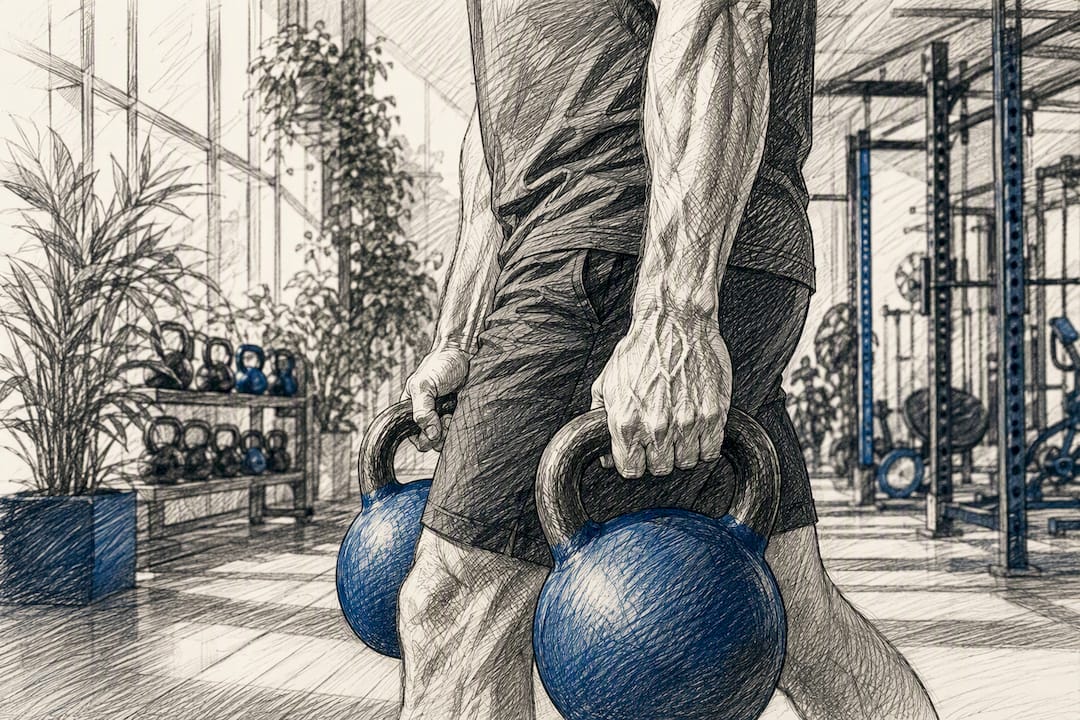
Compound pulling movements build grip strength as a byproduct of training something bigger. Deadlifts, rows, and pull-ups all demand sustained grip under load, and progressive overload on these lifts tends to carry over to isolated grip testing.
Training frequency matters more than intensity for grip work specifically, since forearm muscles recover faster than larger muscle groups. Three sessions per week of targeted grip training, even five to ten minutes each, tends to outperform a single exhaustive session.
Body weight management factors in differently depending on starting composition. Someone carrying excess fat mass improves GSWR by losing weight without changing grip strength at all, while someone already lean needs to focus almost entirely on the numerator, actual grip output, since further weight loss would only reduce the denominator at the cost of muscle.
How Is Grip Strength to Weight Ratio Used in Sports and Rehab?
In sport, GSWR functions as a practical proxy for relative strength in any discipline where competitors are grouped or matched by weight class. Wrestlers, judoka, and mixed martial artists rely on grip to control an opponent's posture and positioning, and a fighter with a high GSWR can often out-grapple a heavier opponent with weaker relative grip. Climbers use it even more directly, since climbing performance correlates tightly with the ability to support total body weight through the fingers and forearms alone.
In rehabilitation, GSWR and its companion metric GSR serve different but complementary purposes. GSWR tracks whether overall strength relative to body size is returning to a healthy range after illness, surgery, or extended bed rest, particularly relevant in older patients where hospitalization itself can trigger rapid muscle loss. GSR tracks whether a specific injured limb is catching up to its uninjured counterpart, which matters most for unilateral injuries like wrist fractures or nerve involvement.
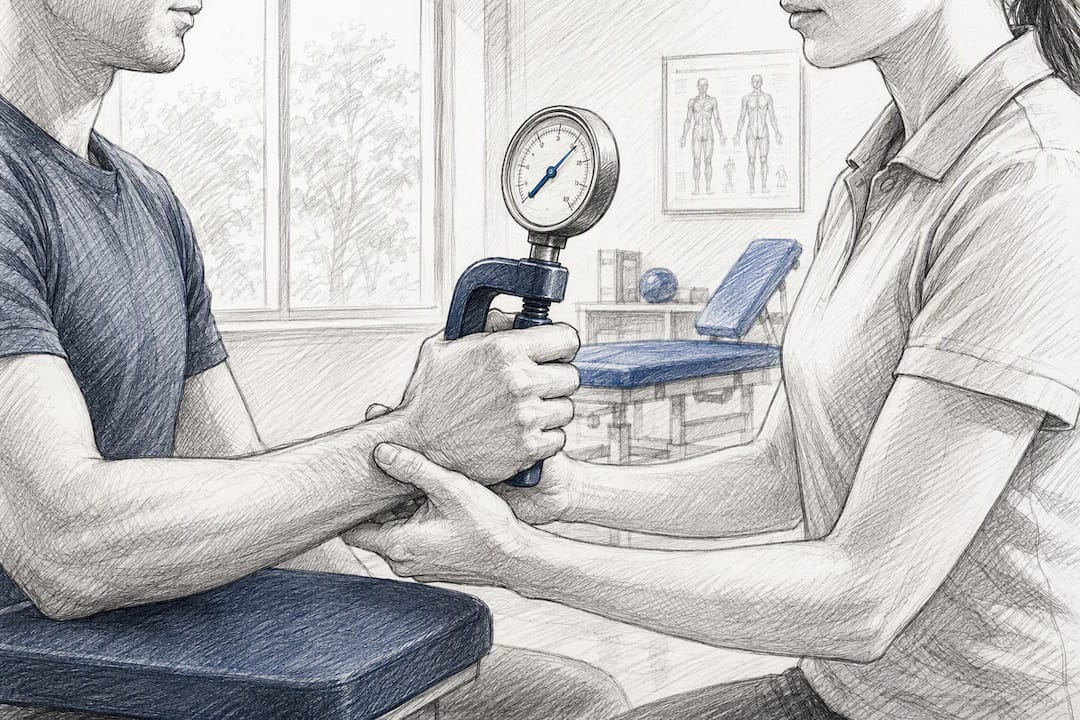
Return-to-function decisions increasingly combine both absolute improvement and symmetry restoration rather than relying on either metric alone. A patient whose GSR has returned to baseline but whose overall GSWR remains well below their pre-injury norm may still need continued strengthening even though the injured hand looks "recovered" relative to the other one.
What Are the Limitations of Using Grip Strength to Weight Ratio?
GSWR is a useful screening tool, not a diagnostic instrument, and treating it as a standalone verdict on health or performance overstates what a single number can tell you.
The biggest limitation is that body weight itself is a moving target. Two people with identical grip strength but very different body compositions, one carrying more fat mass, one carrying more muscle, will post different GSWR scores despite having comparable functional strength in daily tasks. The ratio doesn't distinguish between a low denominator from healthy leanness and a low denominator from underlying illness or malnutrition.
Population mismatch is a persistent problem. Normative bands built from general community cohorts don't translate cleanly to elite athletes, and thresholds validated in older adults screened for frailty don't necessarily apply to a healthy 30-year-old. The mortality and metabolic syndrome associations described earlier come from observational cohort designs, which means they show strong correlation but can't fully rule out confounding factors like undiagnosed illness affecting both grip and weight simultaneously.
Test conditions introduce their own variability. Differences in dynamometer calibration, wrist posture, or grip span between testing sessions can shift a reading enough to create a false trend. Used alongside functional testing and clinical judgment rather than in isolation, GSWR still earns its place as one of the simpler, more reproducible biomarkers available for tracking relative strength over time.
When Should You Rely on Grip Strength to Weight Ratio?
GSWR earns its place fastest in three settings: general health screening, rehab progress tracking, and any weight-class or weight-dependent sport where relative strength decides outcomes. In those contexts, a single ratio compresses a lot of useful information into a number a coach or clinician can act on immediately.
It's least useful as a standalone verdict. Pairing GSWR with functional capacity testing, such as gait speed or a sit-to-stand test, and with basic body composition data gives a much clearer picture than the ratio alone. A low GSWR paired with normal functional capacity and healthy body composition tells a very different story than a low GSWR paired with declining function.
Readers chasing a better number should focus on direct grip training and compound pulling work over months, not days. Readers who see a GSWR flagged well below normative range, especially alongside other signs like unintended weight loss or declining mobility, should treat that as a prompt for a clinical evaluation rather than a training problem to solve alone. The distinction between "train harder" and "get assessed" depends entirely on the broader context GSWR sits inside, never on the ratio by itself.
— Dexdia Team
Get Repeatable Grip Strength to Weight Ratio Data With Dexdia
Getting a GSWR number once is easy. Getting the same reliable number every time, across sessions, testers, and months of tracking, is where most home and clinic testing breaks down. The DEXDIA GX solves that specific problem: it connects to a mobile app that logs every trial, calculates combined grip and GSWR automatically, and flags left-right asymmetry without any manual math.

Clinicians and physical therapists use it to track rehab progress against research-backed norms instead of guessing whether a patient's recovery is on schedule. Coaches use it to monitor athletes across a season and catch strength declines before they show up as injuries. Fitness enthusiasts use it to see whether months of grip training are actually moving the needle. The device is built for performance tracking and clinical support, not for medical diagnosis, and Dexdia's regulatory information page spells out exactly where that line sits.
Start by running your own numbers through the grip strength calculator to see where your current GSWR falls against age and sex norms, then check the DEXDIA GX product page if you're ready to start tracking trials that actually compare across sessions.
Where Does the Research on Grip Strength to Weight Ratio Come From?
- NHANES and CHARLS cohort analysis linking GSWR quartiles to all-cause and cardiovascular mortality.
- Comparison of grip strength and weight-normalized grip strength in relation to metabolic syndrome and quality of life.
- Grip Strength Ratio and DASH score correlation study across hand and wrist conditions.
- Handgrip strength asymmetry clinical relevance review on diagnostic thresholds.
- Dexdia's printable norms and grip strength predictive validity resource for further reading.
This article is general information, not a substitute for advice from a qualified doctor. Consult a qualified healthcare professional about your own circumstances before acting on anything here.
Sources
- Comparison between grip strength and grip strength divided by body weight in their relationship with metabolic syndrome and quality of life in the elderly
- Grip strength-to-weight ratio, all-cause and cardiovascular mortality, and cardiovascular disease prevalence: Evidence from NHANES and CHARLS
- Grip strength ratio: a grip strength measurement that correlates well with DASH score in different hand/wrist conditions
- Handgrip strength asymmetry and its clinical relevance (PMC article)