
In this guide, "grip strength longevity" means building a long-term, repeatable record of handgrip strength (HGS) using a calibrated Bluetooth dynamometer and a companion app — not a single snapshot, but a structured monitoring program that reveals trends over weeks, months, and seasons. The most immediate action is a three-step baseline protocol.
- Step 1: Conduct a standardized 3-trial test for each hand using a calibrated device, seated with the elbow at 90°.
- Step 2: Record each hand separately with a timestamp, handle-width setting, and body mass logged alongside the values.
- Step 3: Export a CSV backup immediately after testing so the baseline is preserved before any app update or device swap.
Pro Tip: The DEXDIA GX is the recommended device for this protocol. Its Bluetooth auto-sync, per-hand recording, and CSV export make all three steps above executable in under five minutes.
Key Takeaways
Longitudinal grip-strength monitoring is most reliable when a standardized protocol, a calibrated Bluetooth dynamometer, and consistent data export practices are maintained across every testing session.
| Point | Details |
|---|---|
| Establish a baseline first | Run three standardized trials per hand across at least three sessions before drawing any trend conclusions. |
| Standardize every protocol variable | Fix handle width, time of day, verbal cues, and rest intervals; procedural variance is the primary source of longitudinal noise. |
| Export and back up after every session | Timestamped CSVs with device ID and firmware version protect multi-year records from app updates and hardware changes. |
| Match testing cadence to the goal | Daily to 3× per week for acute rehab; weekly or biweekly for in-season monitoring; monthly for long-term baseline tracking. |
| Use DEXDIA GX for full protocol support | Bluetooth auto-sync, adjustable handle, CSV export, and demographic norms make the DEXDIA GX the recommended device for this workflow. |
Table of Contents
- Why does longitudinal grip-strength monitoring matter for performance and rehab?
- Which device and app features actually matter for long-term, repeatable data?
- What is the standardized testing protocol for reliable longitudinal records?
- How do you interpret baselines, trends, and asymmetry without over-reacting to noise?
- What testing cadence fits rehab, routine monitoring, and season planning?
- How should you manage, export, and integrate grip-strength data into clinic or team systems?
- What device maintenance and calibration steps preserve longitudinal validity?
- What are the most common measurement mistakes and how do you fix them?
- What does the research say about HGS reliability and protocol validity?
- How should athletes and patients prepare before a grip-strength test?
- How do environmental factors affect grip measurements, and how do you control them?
- How do you train clinicians, coaches, and athletes to use devices consistently?
- How do you integrate grip strength data with other performance metrics?
- What should you do when upgrading devices or apps to maintain data continuity?
- The case for longitudinal grip monitoring over single-value snapshots
- Dexdia GX: built for the protocol described in this guide
- Sources
Why does longitudinal grip-strength monitoring matter for performance and rehab?
Longitudinal grip tracking detects meaningful change earlier than ad-hoc testing because it separates true physiological shifts from day-to-day noise. A single HGS value tells you where an athlete stands today; a time-series tells you whether they are recovering, plateauing, or declining.
Concrete applications include:
- Rehab milestone tracking: A post-surgical patient's weekly grip values show whether tissue healing is translating into functional strength gains, giving the clinician an objective trigger for progressing load.
- Pre/post-session fatigue monitoring: Comparing morning and post-session values flags acute neuromuscular fatigue before it accumulates into overtraining.
- Seasonal readiness checks: Pre-season baselines, compared against mid-season and post-season values, reveal whether training loads are preserving or eroding grip capacity.
A review on HGS in athletic contexts emphasizes that grip strength's greatest value lies in baseline profiling and within-athlete trend detection, not in single-value comparisons against population norms. Research in elite youth football also confirms that HGS testing is feasible for routine team monitoring because a single trained practitioner can complete the assessment in under two minutes per athlete, making it scalable across squads.
Pro Tip: Export your team's CSV data monthly and cross-reference grip percentiles from the grip strength norms database to flag athletes whose values are drifting below their demographic cohort.
Which device and app features actually matter for long-term, repeatable data?
Choose a Bluetooth-enabled, factory-calibrated dynamometer with an adjustable handle, per-hand recording, CSV export, and built-in normative comparison tools. Those five features determine whether a dataset remains usable three years from now.
The feature checklist below covers what to verify before purchasing:
| Feature | Why it matters for longitudinal data |
|---|---|
| Bluetooth auto-sync | Eliminates manual-entry errors; timestamps each trial automatically |
| CSV export | Allows integration with EMR, Excel, or athlete management systems |
| Adjustable grip width | Standardizes handle position across testers and body sizes |
| Factory calibration | Ensures absolute values are comparable across sessions |
| Per-hand recording | Captures left/right asymmetry at every time point |
| Demographic norm support | Contextualizes raw values against age- and sex-matched percentiles |
| Battery life and firmware updates | Prevents data gaps from device downtime |
Different dynamometer technologies — hydraulic, spring, strain-gauge, and pneumatic — produce different absolute values and must not be used interchangeably within a longitudinal record. Switching device types mid-program invalidates the trend line.
The DEXDIA GX meets every item on this checklist. Its companion app, described in the GripMeter App Store listing, provides automatic recording, demographic percentile comparisons, and CSV export. For handle-width guidance specific to your population, the best grip size reference covers the practical settings.
Pro Tip: Log the device serial number and firmware version in every exported CSV. If a firmware update changes sensor behavior, you will have a clear audit trail to assess whether recalibration is needed.
What is the standardized testing protocol for reliable longitudinal records?
A short, repeatable protocol that balances reliability and time constraints will maximize longitudinal validity. The following procedure is adapted from multi-study consensus recommendations.
- Seat the athlete in a chair with feet flat on the floor, shoulder adducted, elbow flexed to 90°, forearm in neutral rotation, wrist between 0° and 30° extension.
- Set the handle width to the position that produces the highest force for that individual; record the setting and use it at every subsequent session.
- Conduct three trials per hand, alternating hands between trials (dominant, nondominant, dominant, nondominant, dominant, nondominant) with at least 60 seconds of rest between each trial.
- Use standardized verbal cues — the same scripted phrase at each session ("Squeeze as hard as you can, now") — to control motivational variance.
- Record peak force and average of three trials for each hand; report both values in the data log.
- Log required fields immediately after testing.
Standardized posture and at least three trials with ≥1-minute rest are the two protocol elements most consistently associated with reliable HGS measurement across review-level evidence.
How do you interpret baselines, trends, and asymmetry without over-reacting to noise?
Set individualized baselines and use statistical thresholds — rolling averages and minimal detectable change (MDC) — rather than one-size-fits-all asymmetry rules. A review-level analysis explicitly advises against applying a blanket 10% rule for acceptable left-right asymmetry, recommending individualized interpretation in sport context instead.
Practical interpretation steps:
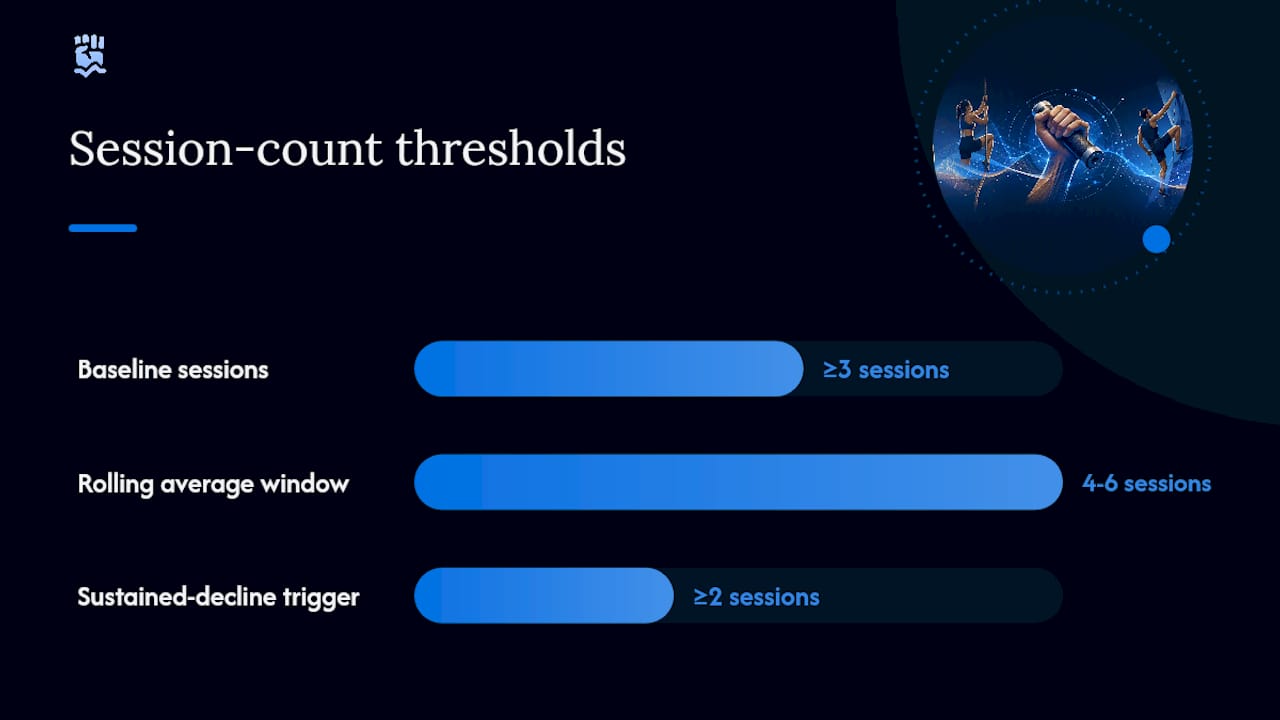
- Establish a baseline from the average of at least three separate testing sessions conducted within two weeks under identical conditions.
- Calculate rolling averages over four to six sessions to smooth out single-session noise before drawing conclusions about trend direction.
- Apply MDC thresholds specific to your device and population; a change that falls within the standard error of measurement (SEM) is not a meaningful shift.
- Evaluate asymmetry in context: dominant-hand superiority is common and expected. In a study of 214 youth tennis players, dominant-hand values were consistently higher than nondominant values after controlling for body mass and maturation — a finding that cautions against automatically flagging all asymmetry as pathological.
Decision framework:
- Change within MDC: Continue current program; retest at scheduled interval.
- Decline >MDC, single session: Retest within 48 hours before altering load.
- Sustained decline across two or more sessions: Reduce session intensity; investigate fatigue, nutrition, or sleep.
- Asymmetry increasing over successive tests: Monitor weekly; consider targeted grip work if functional complaints emerge.
- Sudden step-change (>15% in one session): Treat as a measurement error first; check handle setting, device firmware, and retest same day.
Pro Tip: Body mass independently predicted grip strength in youth populations, explaining a large portion of variance after adjusting for age and maturity. Always log body mass alongside grip values so future re-analysis can account for weight changes during growth or weight-class sport cycles.
What testing cadence fits rehab, routine monitoring, and season planning?
Testing frequency depends on the monitoring goal. Daily or every-session checks suit acute rehab; weekly or biweekly testing fits routine performance monitoring; monthly assessments serve long-term baseline tracking.
| Use case | Recommended frequency | Minimum timeline for meaningful trend |
|---|---|---|
| Acute rehab (post-injury/surgery) | Daily to 3× per week | 2–3 weeks of consistent data |
| In-season performance monitoring | Weekly or biweekly | 4–6 weeks |
| Off-season baseline and return-to-sport | Monthly | 8 weeks |
| Youth athlete development | Monthly with maturation notes | One full season |
Key cadence principles:
- Fewer than three data points cannot establish a trend; plan testing schedules accordingly.
- For when to schedule grip assessments within a training week, morning pre-session testing consistently produces the least within-day variability.
- Youth athletes require maturation context alongside raw values; HGS correlates with sprint and jump performance in elite youth football, but predictive value increases with age and biological maturity.
How should you manage, export, and integrate grip-strength data into clinic or team systems?
Exportable, timestamped CSVs and unique device IDs are the foundation of long-term data integrity and cross-system integration. Without them, multi-year records become uninterpretable when staff changes or software updates occur.
| CSV field | Purpose |
|---|---|
| Athlete/patient ID | Links records across sessions without exposing personal data |
| Session date and time | Enables time-series analysis and fatigue pattern detection |
| Device ID and firmware | Flags any hardware-related data discontinuities |
| Handle width setting | Confirms protocol consistency across testers |
| Hand (L/R), trial values, peak, mean | Core measurement data |
| Tester ID | Enables inter-rater reliability checks |
| Body mass, fatigue notes, RPE | Contextual covariates for trend interpretation |
Integration tips: link grip records to session RPE and training load data so trend analysis can distinguish grip decline caused by fatigue from genuine strength loss. For clinics, obtain written consent before storing identifiable grip data and confirm storage practices comply with applicable privacy regulations.
Pro Tip: Schedule a batch export and versioned backup every time a firmware update is released. App updates occasionally change data schemas; a pre-update backup preserves the original format for longitudinal continuity. The DEXDIA GX companion app supports CSV export, making this a one-step process.
What device maintenance and calibration steps preserve longitudinal validity?
A simple QC and calibration routine — daily check, monthly calibration log, annual verification — preserves the comparability of longitudinal records across years.
Maintenance checklist:
- Daily: Inspect for physical damage; confirm battery level is sufficient for a full testing session; verify Bluetooth pairing before the first athlete.
- Monthly: Log a calibration check using a known reference weight or manufacturer-specified verification procedure; record the result and tester name in the device log.
- Annually: Submit for or conduct a full calibration verification; retain the calibration certificate with the device log.
- Firmware updates: Apply updates during off-peak periods; run a verification test immediately after updating to confirm sensor output is unchanged.
- Storage: Keep the device at room temperature, away from moisture and direct sunlight; avoid dropping or compressing the sensor housing.
| QC event | Frequency | Log fields |
|---|---|---|
| Physical inspection | Daily | Date, tester, pass/fail |
| Calibration check | Monthly | Date, reference value, measured value, tester |
| Full calibration verification | Annually | Certificate number, date, technician |
| Firmware update | As released | Version before/after, verification test result |
Never introduce a second device type into an existing longitudinal dataset without a parallel-testing period to establish a conversion factor. Even within the same brand, a hardware revision can shift absolute values.
What are the most common measurement mistakes and how do you fix them?
Most longitudinal noise is procedural and fixable with consistent protocol enforcement. The following checklist covers the errors that appear most frequently in clinical and team settings.
Common problems and quick fixes:
- Wrong handle width: Recheck the athlete's logged setting before every session; a one-position error can shift values by several kilograms.
- Inconsistent time of day: Morning values are typically higher than afternoon values in fatigued athletes; standardize to the same time window across all sessions.
- Tester variance: Different verbal cues or encouragement levels alter output; use a scripted cue and rotate testers only when unavoidable.
- Insufficient rest between trials: Less than 60 seconds of rest produces fatigue-suppressed values in later trials; use a stopwatch.
- Device drift after firmware update: Run a same-day verification test; if values shift unexpectedly, flag the session and recalibrate before continuing the longitudinal record.
Escalation steps when data appear invalid:
- Check handle width setting and device firmware version against the log.
- Retest the athlete within the same session using the correct settings.
- If values remain inconsistent, schedule a retest within 48 hours under controlled conditions.
- If a sudden step-change persists across two retests, quarantine that data point and note it in the record rather than including it in trend calculations.
- Refer for further clinical assessment if the athlete also reports pain, weakness, or functional limitation.
What does the research say about HGS reliability and protocol validity?
Recommendations in this guide rest on repeated findings that HGS is reliable when protocols are standardized, correlates with body mass and development in youth populations, and is most valuable as a longitudinal monitoring marker rather than a standalone diagnostic.
Key empirical takeaways:
- Device type determines absolute value; hydraulic, spring, strain-gauge, and pneumatic dynamometers are not interchangeable within a longitudinal record.
- Test-retest reliability depends on standardized posture, consistent trial count, and adequate rest intervals.
- In youth athletes, body mass and maturation stage are primary covariates; raw values without these adjustments can be misleading.
- Asymmetry thresholds must be individualized; blanket rules lack empirical support across sports and populations.
- HGS correlates with sprint and jump performance in youth football, with predictive value moderated by age and maturity.
How should athletes and patients prepare before a grip-strength test?
Standardizing pre-test conditions is as important as the protocol itself. Uncontrolled warm-up, fatigue, or nutrition status introduces variability that obscures real trends.
Preparation guidelines:
- Warm-up: Perform 2–3 minutes of light hand and wrist movement (finger extensions, wrist circles) before testing. Avoid heavy grip-intensive exercise in the 24 hours prior.
- Fatigue control: Do not test after a high-intensity training session. Schedule grip assessments before the main training load, not after.
- Nutrition and hydration: Test in a normally fed and hydrated state. Acute dehydration measurably reduces muscle force output.
- Medication and health status: Note any medications or acute illness in the fatigue field of the data log; these are legitimate covariates, not disqualifiers.
How do environmental factors affect grip measurements, and how do you control them?
Temperature and time of day are the two environmental variables most likely to introduce systematic bias into longitudinal records.
Cold ambient temperatures reduce hand muscle temperature, which lowers peak force output. Test in a climate-controlled environment when possible, targeting a room temperature between 68°F and 77°F (20°C–25°C). If field testing in variable conditions, log the ambient temperature as a covariate in the CSV.
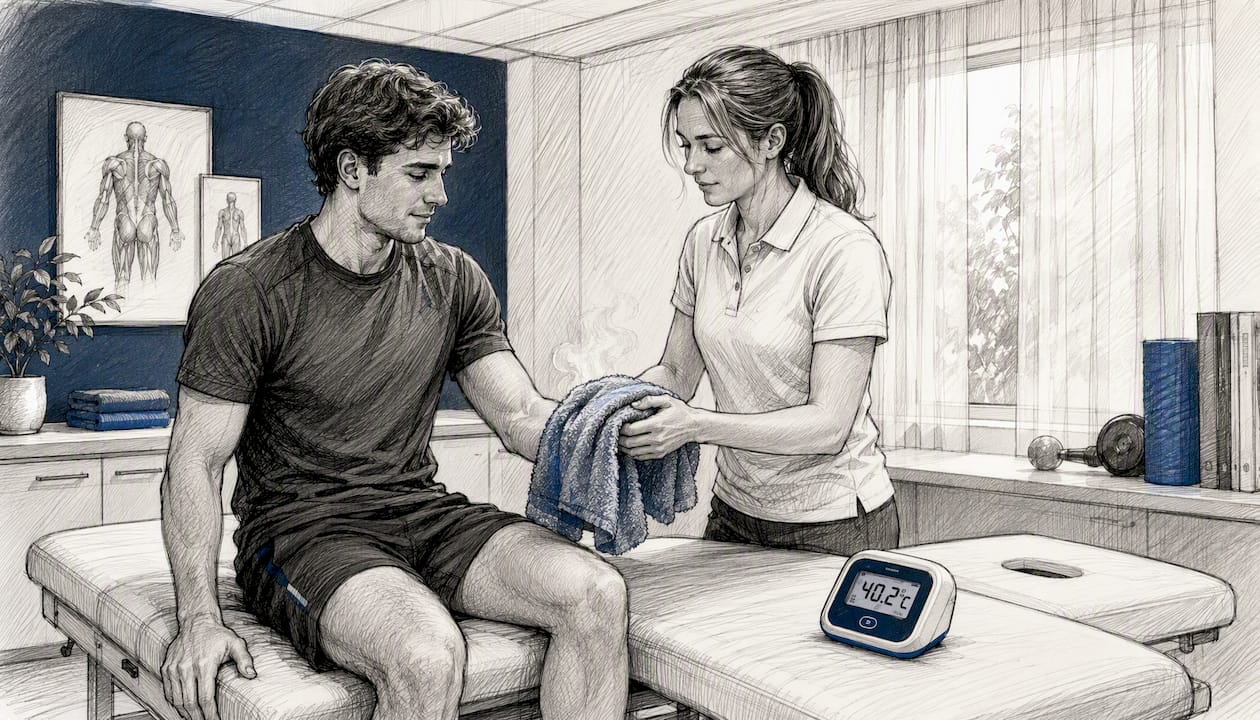
Time of day produces a diurnal pattern in muscle strength. Most individuals produce slightly higher grip values in the late morning to early afternoon compared to early morning. Standardize all testing to the same two-hour window across sessions — for example, always between 8:00 AM and 10:00 AM — and document the actual test time in the timestamp field.
How do you train clinicians, coaches, and athletes to use devices consistently?
Consistent device use across a team or clinic requires structured onboarding, not just a manual. Tester variance is one of the most common sources of longitudinal noise, and it is preventable.
Recommended training steps:
- Conduct a live demonstration session covering device setup, handle adjustment, Bluetooth pairing, and the scripted verbal cue before any athlete is tested.
- Require each new tester to complete five practice sessions with a reference athlete or colleague before collecting data that enters the longitudinal record.
- Maintain a tester certification log that records who completed training, when, and on which device firmware version.
- When staff turnover occurs, run a parallel-testing period where the outgoing and incoming tester assess the same athletes on the same day to quantify any inter-rater difference.
Athlete preparation training is equally important. Athletes who understand why the protocol is standardized — and what the data is used for — are more likely to comply with pre-test preparation requirements.
How do you integrate grip strength data with other performance metrics?
Grip strength data gains interpretive power when linked to other physiological and performance measures. Standalone grip values answer "how strong is the hand today?" Integrated data answers "what does this grip trend mean for overall readiness?"
Practical integration approaches:
- Link to RPE and training load: A declining grip trend alongside rising RPE suggests accumulated fatigue rather than detraining. Separating these two causes requires the load data.
- Pair with sprint and jump metrics: In youth athletes, HGS correlates with sprint and jump performance; tracking both together strengthens readiness assessments.
- Connect to sport-specific indicators: For racket sports, climbing, and throwing disciplines, grip trends can be cross-referenced with sport-specific performance indicators. Resources like athletic longevity programming guides illustrate how grip fits within broader performance monitoring frameworks.
- Use the grip calculator for percentile context: The grip strength calculator converts raw values into demographic percentiles, making it straightforward to communicate where an athlete stands relative to their cohort at any point in the monitoring cycle.
What should you do when upgrading devices or apps to maintain data continuity?
Device and app upgrades are inevitable over a multi-year monitoring program. Without a deliberate transition plan, an upgrade can break the longitudinal record.
Before upgrading:
- Export a full CSV backup of all historical data in the current format before installing any app update or replacing hardware.
- Document the current device serial number, firmware version, and app version in the device log.
- Run a parallel-testing period of at least two weeks where both the old and new device (or app version) are used simultaneously on the same athletes to quantify any systematic offset.
After upgrading:
- If the parallel test reveals a consistent offset between old and new values, apply a correction factor to the historical data and document the adjustment in the record.
- Update the CSV schema documentation to reflect any new fields or changed field names in the updated app export.
- Notify all testers of the version change and retrain on any protocol changes the new firmware or app introduces.
Planning upgrades during off-season or low-stakes monitoring periods minimizes disruption to active rehab or competition-phase records.
The case for longitudinal grip monitoring over single-value snapshots
The conventional approach in many clinics and training facilities is to measure grip strength at intake and again at discharge or season end. That two-point model misses everything in between: the recovery plateau at week four, the overtraining signal at week eight, the asymmetry that emerged after a wrist sprain and never fully resolved.
The evidence base for HGS as a longitudinal tool has grown substantially since 2019, with applications expanding across racket sports, climbing, football, and rehabilitation. What the research consistently shows is that the value is in the trend, not the number. A single grip value, even a high one, tells a practitioner very little without the trajectory behind it.
Athletes with structurally dominant hands, sport-specific adaptations, or prior injuries may show varying asymmetries without any functional deficit. Applying a blanket correction protocol to those athletes based on a single reading is a misuse of the data. The protocol in this guide is designed to give practitioners enough longitudinal context to make that distinction confidently.
Dexdia GX: built for the protocol described in this guide
The DEXDIA GX delivers every feature the device-selection checklist requires: Bluetooth auto-sync, per-hand recording, adjustable handle width, factory calibration, and CSV export through its companion app. Clinics and performance teams that have been relying on manual-entry dynamometers can transition to the DEXDIA GX without losing prior records — historical data imports into the CSV schema, and the normative comparison tools provide immediate demographic context for existing baselines.
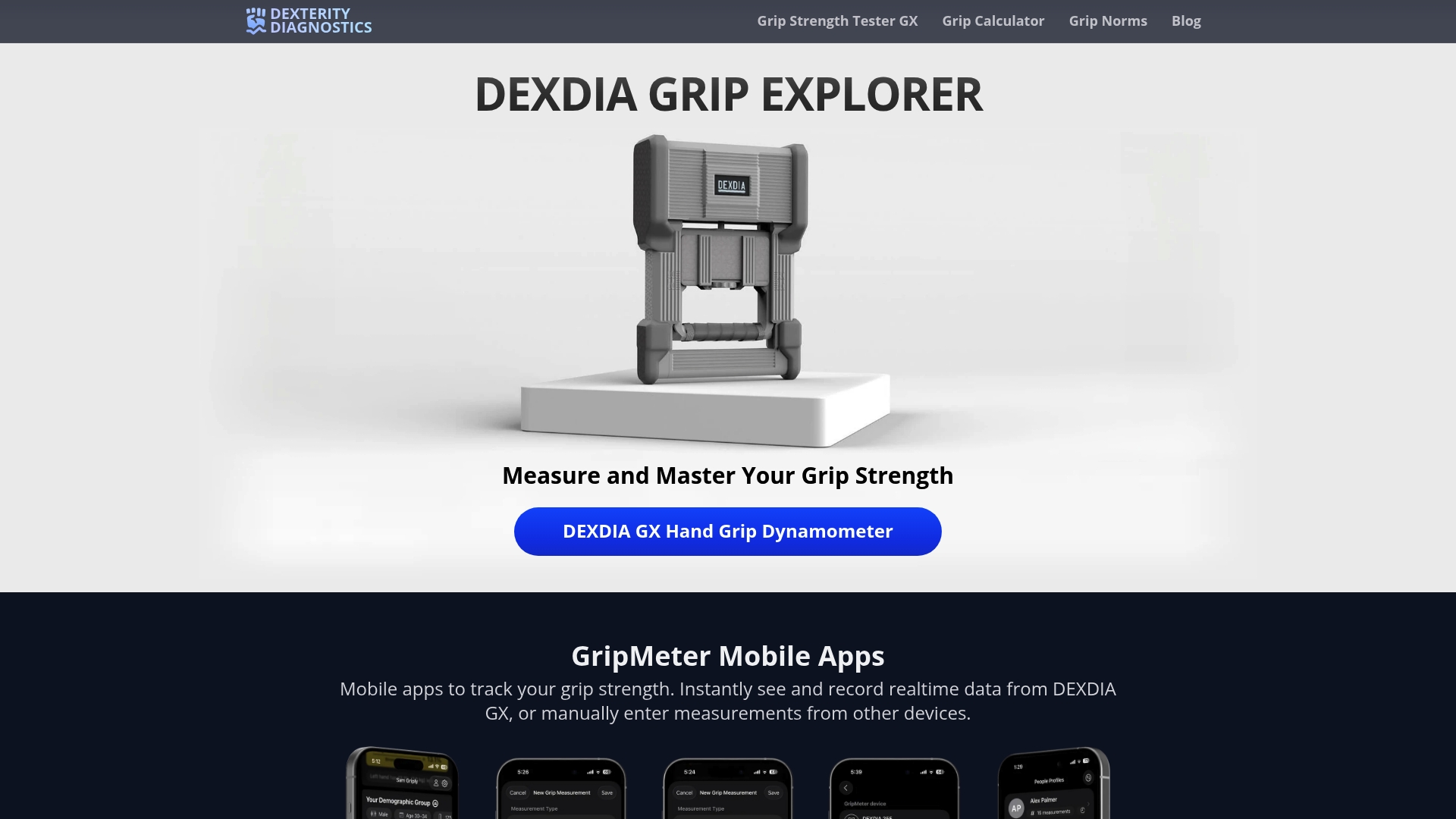
The grip strength norms database and the interactive grip strength calculator are available alongside the device, giving practitioners the reference tools to contextualize every data point from day one. Visit the DEXDIA GX product page to review specifications and place an order.
Sources
The following peer-reviewed studies and resources informed the recommendations in this guide. Practitioners seeking deeper methodological context should consult the primary sources directly.
- GripMeter Grip Strength Tester App - App Store
- Nature: review article (s41598-025-87413-w)
- Waikato research review on validity and reliability of handgrip dynamometers
Methodological note: recommendations in this guide prioritize peer-reviewed sources with defined protocols and sample sizes. Where review-level evidence conflicts with single-study findings, the review-level guidance takes precedence.